

Crypto Regulation News
Regulatory developments are shaping the future of digital assets across global markets. This live section from CoinEdition delivers crypto regulation news, covering new laws, enforcement actions, and policy changes from key jurisdictions. It tracks updates from regulators, including the SEC and other global agencies, alongside stablecoin rules and compliance trends. Alongside the latest developments, it explains what these changes mean for users, investors, and the broader market. From legislative moves to industry responses, CoinEdition keeps you informed on the latest regulatory shifts impacting the crypto ecosystem.
EU States Target Regulatory Gold-Plating
A group of at least 17 EU governments is backing plans to reduce national bureaucracy that can make operating across the single market more difficult. Led by Austria and Italy, the initiative calls for faster and simpler implementation of EU legislation, reviews of existing rules and less duplication in business reporting. The push comes as Brussels also seeks broader regulatory simplification to improve EU competitiveness.
Vietnam Seeks EU Crypto Oversight Lessons
Vietnam is turning to Austria and wider EU experience as it develops supervision for its emerging crypto market. Officials said the country expects its first licensed crypto-asset service providers to begin operating in 2026 and is building oversight around FATF recommendations, risk management, investor asset protection and anti-money laundering. Austria proposed deeper technical exchanges through IOSCO.
CFTC Advances Crypto Market Framework
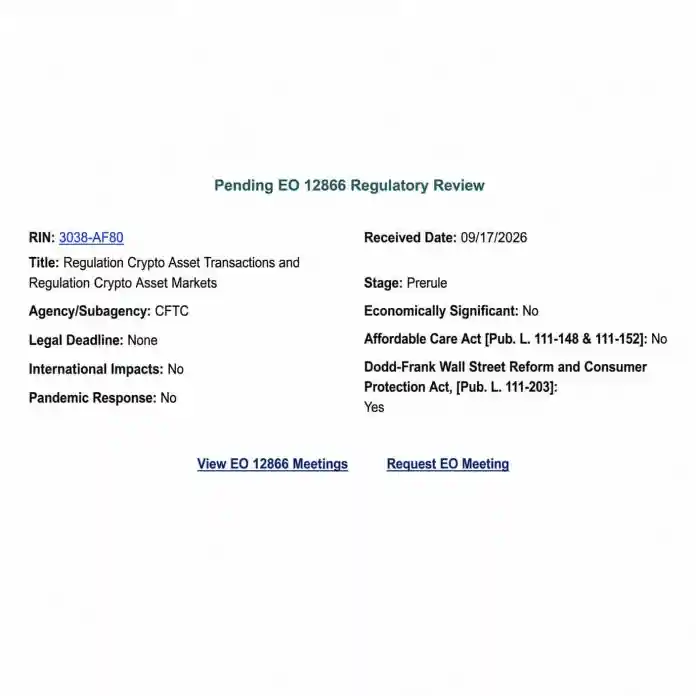
A CFTC proposal covering crypto asset transactions and markets entered White House regulatory review on September 17. The filing comes as the agency works on rules for crypto market structure using its existing Commodity Exchange Act authority. OIRA review is an early procedural step, and the CFTC has not yet published the proposal’s full text or confirmed specific requirements for trading venues, custody or retail transactions.
U.S. SEC Allows Trading of Tokenized Stocks
The U.S. SEC has approved a temporary conditional exemption, described as an innovation exemption, allowing limited trading of tokenized U.S. stocks in on-chain environments, Unfolded reported. The measure lets regulated traditional financial institutions and crypto platforms test and operate on-chain stock trading in a temporary sandbox format until formal rules are established.
Two Major US Crypto Bills Advance
Two major digital asset bills have cleared House committees. The American Reserve Modernization Act advanced 28–21 and would establish a statutory framework for a U.S. Strategic Bitcoin Reserve and federal digital asset holdings. Separately, the Digital Asset Tax Certainty Act passed 38–5, proposing clearer rules for mining, staking, small crypto transactions, reporting and existing tax anti-abuse provisions.
UK Targets Crypto-Linked Illicit Finance
The UK government is recruiting 500 additional officers and investing more than £500 million over three years to target money laundering networks and seize criminal assets. The new strategy will focus on organised crime, international laundering networks, hostile actors, and illicit finance linked to technologies such as crypto, fintech, and AI. Officials say recovered assets will also be redirected toward law enforcement and public services.
UK Tweaks Crypto Rules Before 2027
The UK is adjusting its crypto regulatory framework to prevent stablecoin payment firms from being caught unnecessarily by dealing and arranging requirements. HM Treasury said the changes are intended to support tokenised payments while maintaining the broader FCA-supervised crypto regime. Firms should still assess whether their activities will require FSMA authorisation when the new framework begins on 25 October 2027.
Argentina Joins OECD Crypto Tax Framework
Argentina has committed to implement the OECD’s Crypto-Asset Reporting Framework and begin automatically exchanging information on crypto transactions by September 2029. The move will give Argentine tax authorities more visibility into crypto activity conducted abroad and is aimed at reducing tax evasion and avoidance linked to offshore digital assets. Argentina becomes part of a growing global CARF network spanning 77 jurisdictions.
EU Sets 24-Hour Cyber Alert Rule
The EU’s Cyber Resilience Act reporting requirements take effect from September 11, requiring manufacturers of products with digital elements to report actively exploited vulnerabilities and severe security incidents. Companies must submit an early warning within 24 hours and a full notification within 72 hours. Reports will be filed through ENISA’s new Single Reporting Platform and shared with relevant national cyber authorities.
UK Digital ID Security Gets Upgrade
The UK is expanding passkey access for GOV.UK One Login as part of its push to make digital public services simpler and safer. Passkeys use device-based security such as Face ID, fingerprint, or PIN, while biometric data stays on the user’s device and is not stored by GOV.UK One Login. The feature remains optional, so users can continue signing in with passwords if preferred.