Crypto Regulation News
Regulatory developments are shaping the future of digital assets across global markets. This live section from CoinEdition delivers crypto regulation news, covering new laws, enforcement actions, and policy changes from key jurisdictions. It tracks updates from regulators, including the SEC and other global agencies, alongside stablecoin rules and compliance trends. Alongside the latest developments, it explains what these changes mean for users, investors, and the broader market. From legislative moves to industry responses, CoinEdition keeps you informed on the latest regulatory shifts impacting the crypto ecosystem.
UK Opens FCA Crypto Applications
The FCA has opened applications for crypto firms seeking authorisation under the UK’s new regulatory regime. Firms intending to keep operating should apply by February 28, 2027, ahead of the framework taking effect on October 25, 2027. Applicants will need to meet standards covering consumer protection, customer-asset safeguarding, market integrity and financial resilience.
Spain Clarifies Crypto Self-Custody Rules
Spanish taxpayers do not need to include crypto in Modelo 721 when they personally control the wallet’s private keys, according to Tax Agency guidance. The rule covers both hot and cold non-custodial wallets. Reporting instead focuses on qualifying crypto held with foreign custodians, with the standard €50,000 aggregate threshold applying to reportable overseas holdings.
ESMA Sets 2027 Crypto Priorities
ESMA will make MiCA supervision a key 2027 priority as the EU shifts from rulemaking toward implementation. The regulator plans to strengthen supervisory convergence for crypto-asset service providers, focus on operational resilience and potentially advance the next phase of MIDAS, its centralized crypto market-surveillance system. Tokenisation and the use of AI in financial supervision will also remain major areas of work.
South Korea Reviews Crypto Liquidity Ban
South Korean regulators are reassessing longstanding restrictions on formal crypto market-making. The FSC is examining whether designated liquidity providers could operate under tighter supervision to deepen order books and narrow bid-ask spreads, particularly for less liquid assets. The framework remains under consideration, with no final rules or implementation date announced.
California Targets Meme Coins by Officials
Governor Gavin Newsom has signed AB 2409, introducing new restrictions on meme coins linked to California public officials. The law bars officials from issuing such tokens and limits listings that use their likeness. California also approved separate measures strengthening restitution for crypto-fraud victims and establishing clearer procedures for seizing digital assets connected to criminal networks.
Russia Sets Foreign Crypto Reporting Rules
Russia is bringing offshore crypto activity under tighter tax oversight as its regulated digital asset market develops. From May 2027, covered Russian residents will have to report qualifying transactions involving crypto addresses outside domestic regulated depositories. The move comes as officials estimate around 20 million Russians hold roughly 3.7 trillion rubles, or $44 billion, in crypto and related products.
Russia Caps Bank Crypto Risk at 1%
The Bank of Russia is preparing new prudential rules that would cap banks’ exposure to cryptocurrencies and foreign digital instruments at 1%. The proposed ratios will cover both direct holdings and crypto-linked derivatives, while allowing some netting of long and short positions where liquidity and asset-freezing risks are considered low. Banks are expected to begin reporting the new ratios from January 2027.
EU States Target Regulatory Gold-Plating
A group of at least 17 EU governments is backing plans to reduce national bureaucracy that can make operating across the single market more difficult. Led by Austria and Italy, the initiative calls for faster and simpler implementation of EU legislation, reviews of existing rules and less duplication in business reporting. The push comes as Brussels also seeks broader regulatory simplification to improve EU competitiveness.
Vietnam Seeks EU Crypto Oversight Lessons
Vietnam is turning to Austria and wider EU experience as it develops supervision for its emerging crypto market. Officials said the country expects its first licensed crypto-asset service providers to begin operating in 2026 and is building oversight around FATF recommendations, risk management, investor asset protection and anti-money laundering. Austria proposed deeper technical exchanges through IOSCO.
CFTC Advances Crypto Market Framework
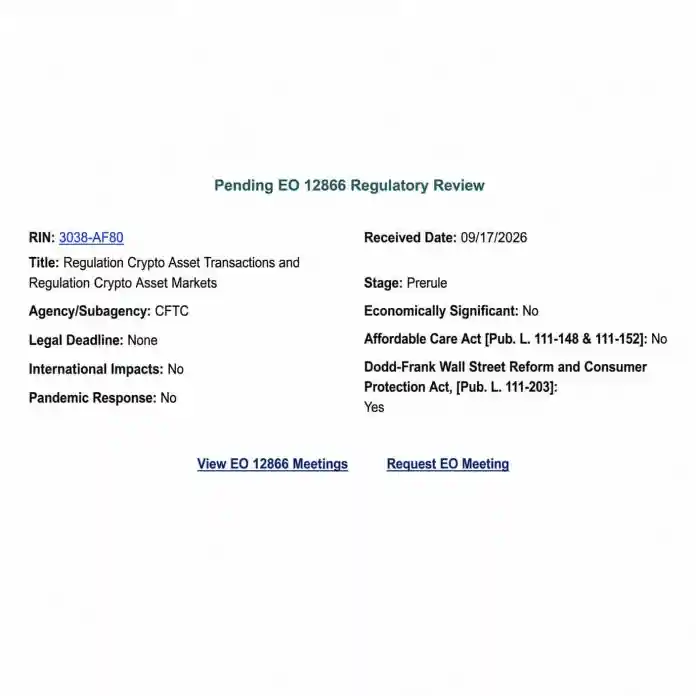
A CFTC proposal covering crypto asset transactions and markets entered White House regulatory review on September 17. The filing comes as the agency works on rules for crypto market structure using its existing Commodity Exchange Act authority. OIRA review is an early procedural step, and the CFTC has not yet published the proposal’s full text or confirmed specific requirements for trading venues, custody or retail transactions.