
- Digital asset inflows hit $1.1B, the largest since early January, with Bitcoin leading with $871M inflows.
- This rebound in risk appetite is driven by improved, lower-than-expected US CPI data and easing geopolitics.
- Strong inflows signal renewed institutional demand and could boost near-term crypto market sentiment.
According to Volume 281: Digital Asset Fund Flows Weekly Report, digital asset investment products recorded $1.1 billion in inflows for the week ending April 10, 2026, the largest weekly total since early January.
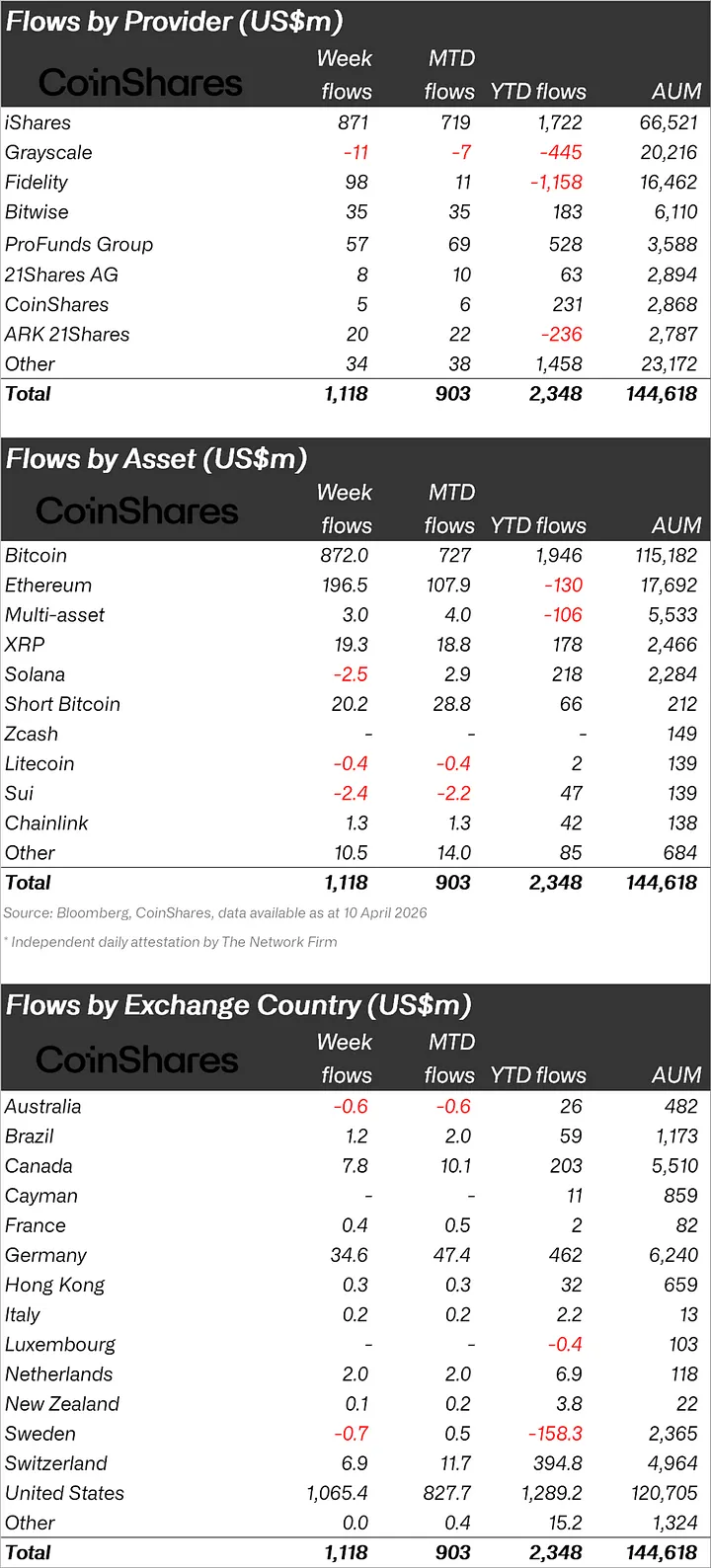
Bitcoin (BTC) led with $871 million in inflows, followed by Ethereum (ETH) with $197 million, as investor risk appetite rebounded after tentative ceasefire developments in Iran, alongside softer-than-expected US CPI and spending data.
Digital Asset Investment Products Inflows Hit $1.1B
Digital asset investment products recorded $1.1B in inflows for the week ending April 10, 2026, marking the strongest weekly total since early January. BTC led with $871M in inflows, followed by ETH with $196.5M and XRP with $19.3M. Solana recorded modest outflows of $2.5M, while other assets saw little to no meaningful flows.
Source: CoinShares
Regionally, the United States dominated with inflows of $1.06B, accounting for 95% of total weekly inflows. Germany followed with $34.6M, while Canada and Switzerland recorded comparatively modest inflows of $7.8M and $6.9M, respectively.
Softer US CPI Data and Easing Geopolitics Drive Rebound
Softer US CPI data has driven the rebound in digital asset investment products. On April 10, the US Bureau of Labor Statistics released March 2026 data showing headline inflation rising to 3.3% year-over-year from 2.4%, driven by higher energy costs. However, core CPI moderated to 0.2% month-over-month, below expectations of 0.3%, easing underlying price pressures.
Meanwhile, short-Bitcoin products also saw significant activity with $20.2M in inflows, indicating that some investors continued to hedge even as overall flows turned strongly positive. Trading volumes surged by 13% week-on-week to $21B, though they remain below the year-to-date average of US$31 billion.
Furthermore, diplomatic progress supported a clear easing of geopolitical tensions. Early April reports of a conditional two-week US–Iran ceasefire, with discussions of a possible extension to 45 days, helped calm markets. Oil prices fell sharply as fears of supply disruption faded, reducing the geopolitical risk premium and supporting broader risk appetite.
What’s Next for Crypto Markets?
Strong weekly inflows concentrated in the United States, alongside BTC’s leadership and ETH’s recovery, signal improvement. However, investor sentiment remains cautious, with the Fear and Greed Index at 45, indicating neutral market conditions. As of April 13, 2026, BTC trades at $71,836.16, up 1.5% over the past 24 hours, while ETH trades at $2,209.86, up 1.3% over the same period.
According to CoinCodex, BTC is projected to reach $83,110 over the next three months and $86,492 by the end of 2026, representing a 15.85% gain from current levels. ETH is projected to reach $2,716.64 by the end of 2026, representing a 23.12% gain from current prices.
Therefore, markets will closely monitor the Federal Reserve’s upcoming signals on rate cuts. Continued monitoring of CPI data, Federal Reserve signals, and geopolitical developments could determine whether this rebound sustains or reverses in the coming weeks.
Related: Crypto Funds Bleed $173M as XRP and Solana Attract Inflows
Disclaimer: The information presented in this article is for informational and educational purposes only. The article does not constitute financial advice or advice of any kind. Coin Edition is not responsible for any losses incurred as a result of the utilization of content, products, or services mentioned. Readers are advised to exercise caution before taking any action related to the company.