
- Bitcoin whale activity has reached its highest level since 2019.
- Bitcoin deposits to exchanges have dropped, reducing selling pressure and tightening available supply.
- Rising ETF inflows and a $1B USDT mint are boosting liquidity.
On-chain data is signaling a possible turning point for Bitcoin, as whale activity on exchanges has reached levels not seen in six years. At the same time, institutional inflows and fresh stablecoin liquidity continue to build across the market.
Bitcoin Whale Ratio Climbs to Highest Level
According to CryptoQuant verified author CW8900, the Exchange BTC Whale Ratio has climbed to its highest level since 2019. Notably, this metric measures the proportion of large transactions flowing into exchanges. Historically, this pattern has appeared near market bottoms.
The analyst explained that whales typically accumulate when prices are low and distribute holdings at higher levels. Meanwhile, retail investors often do the opposite.
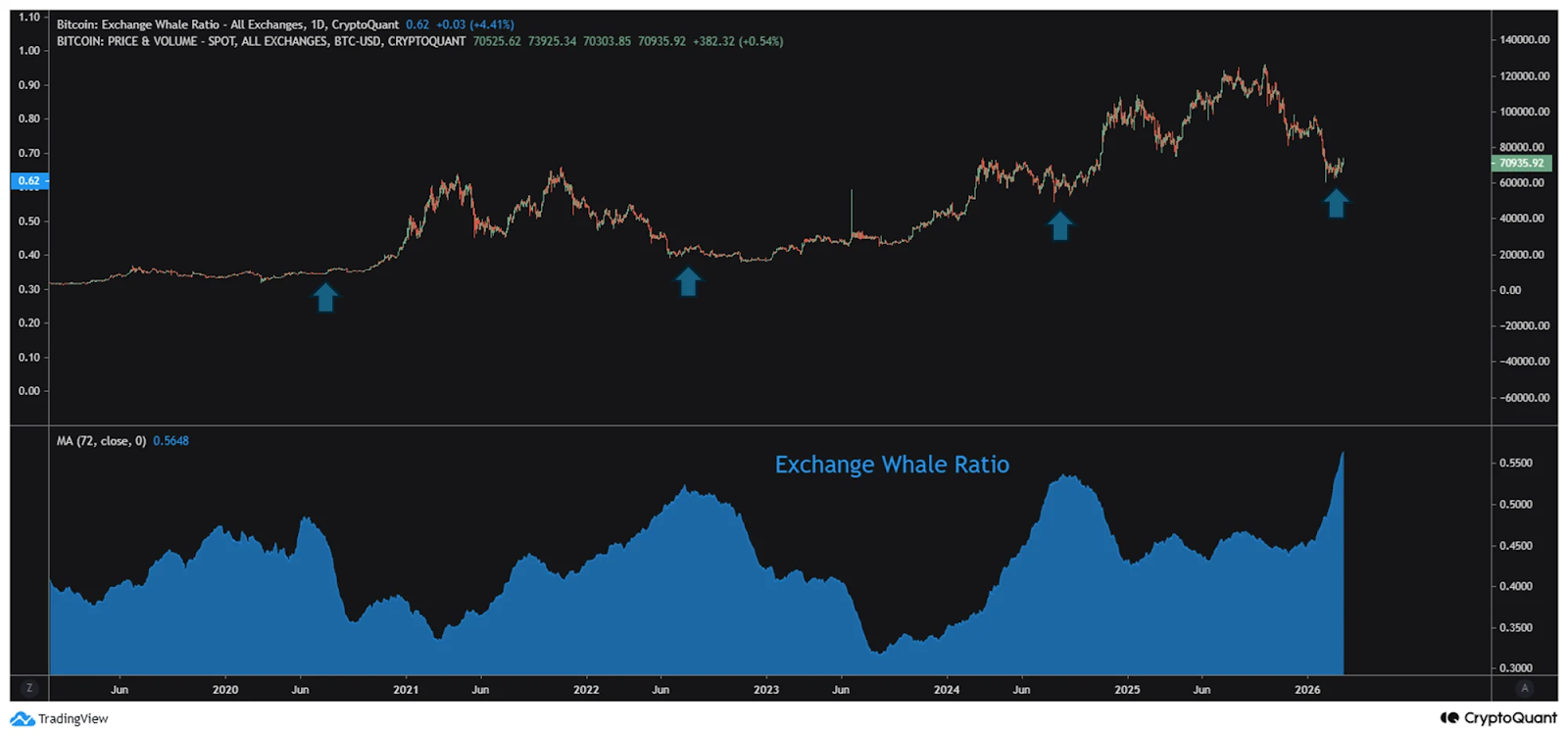
When the whale ratio increases significantly, it can indicate that large holders are positioning themselves for the next upward move.
At the same time, the ratio representing retail participation has fallen to its lowest level in six years. This suggests smaller investors are less active while whales continue accumulating aggressively.
CW8900 noted that this combination of metrics, along with other on-chain indicators, suggests the market may be approaching a short-term bottom. In other words, the conditions for a new uptrend may be forming.
Exchange Inflows Collapse as Selling Pressure Eases
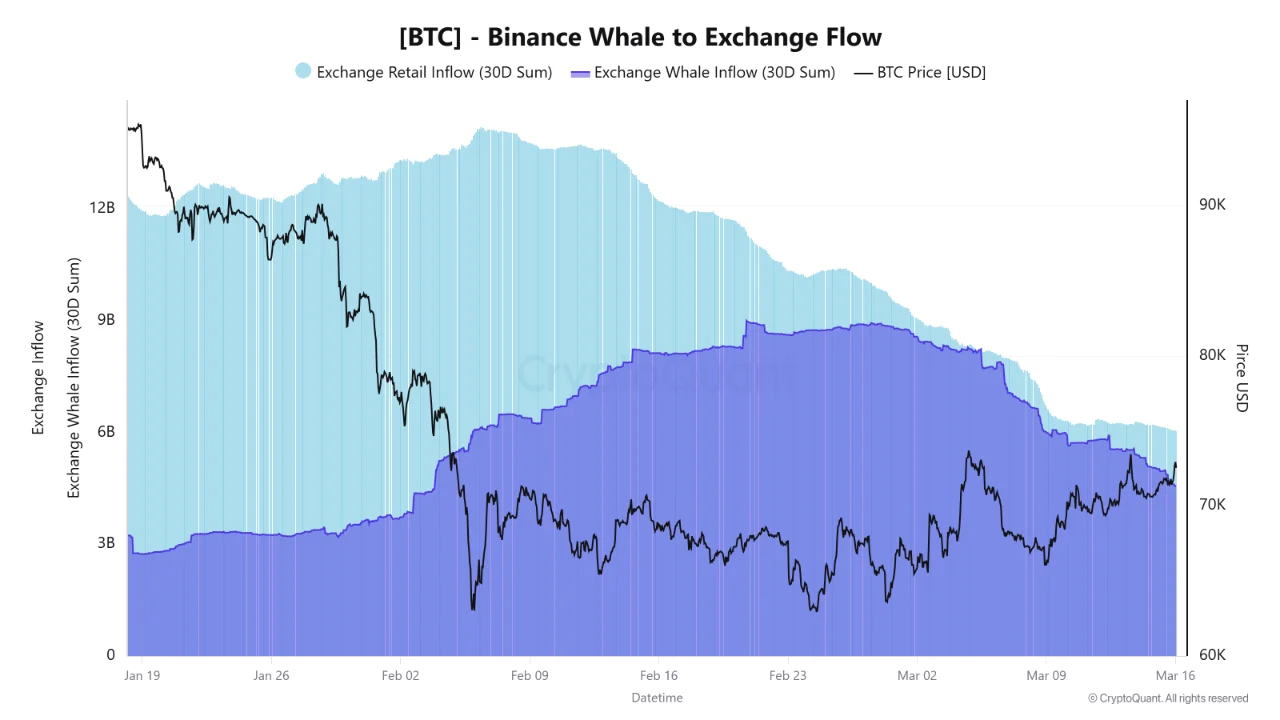
Additional market data shared by CryptoQuant analyst Amr Taha highlights a sharp drop in Bitcoin deposits to the major exchange Binance. This development historically reduces immediate selling pressure.
Over a 30-day period, retail inflows to Binance fell dramatically from roughly $14.2 billion on February 6 to around $6 billion by March 16. Whale deposits also declined sharply, dropping from $8.8 billion on March 1 to about $4.5 billion by mid-March.
Such declines mean fewer coins moved to exchanges for sale, tightening the available supply on spot markets.
Stablecoin Liquidity Expands as USDT Mint Appears
Meanwhile, liquidity across the crypto ecosystem expanded following a major Tether (USDT) issuance. On March 11, roughly $1 billion worth of USDT was minted on the TRON network. The minting marked the first major stablecoin expansion in over a month.
Historically, large stablecoin minting events often coincide with increased market liquidity, providing additional capital for traders and institutions to deploy into crypto assets.
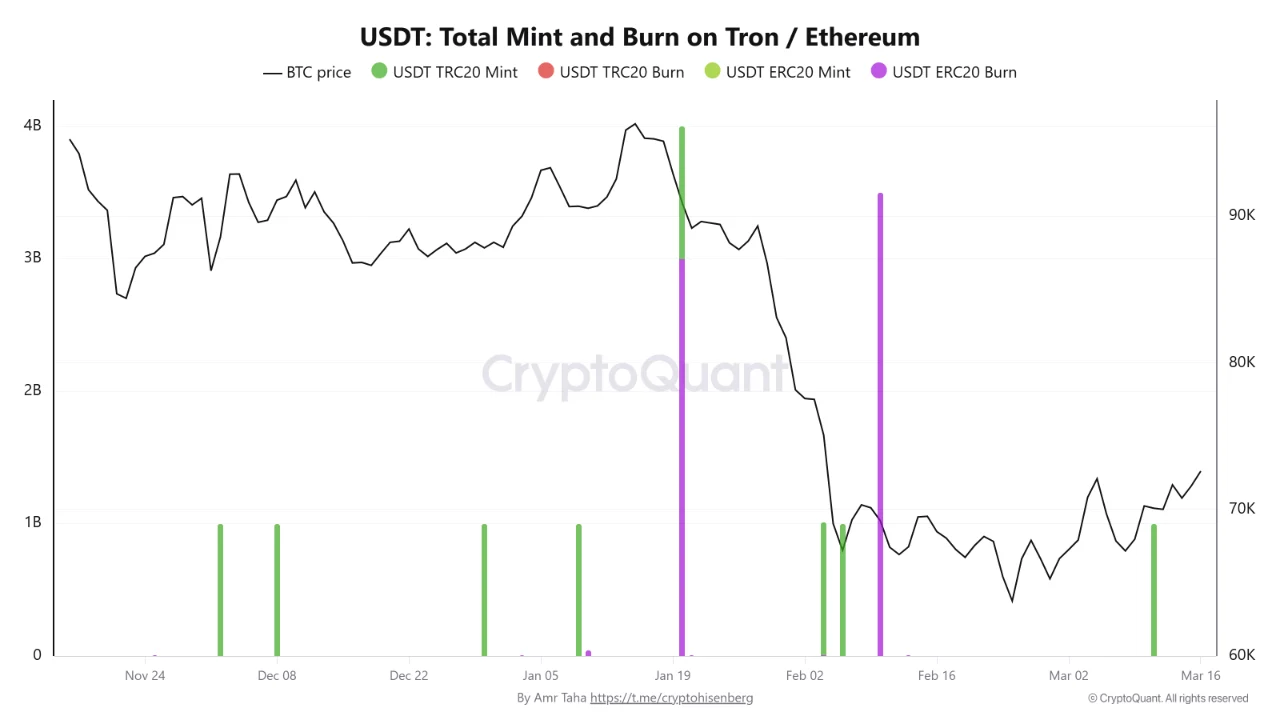
Notably, the mint occurred shortly before Bitcoin broke above $72,000, suggesting that the additional liquidity may have contributed to the recent price momentum.
ETF Inflows Signal Institutional Buying
Institutional demand has also strengthened through spot Bitcoin ETFs. The BlackRock spot ETF iShares Bitcoin Trust (IBIT) recorded two consecutive days of strong inflows. On March 12, it saw a $1.93 billion net inflow. Likewise, on March 13, IBIT recorded $803 million in net inflows.
Positive ETF flows typically translate into direct Bitcoin purchases, reinforcing buy-side pressure from large investors. Overall, spot Bitcoin ETFs have attracted about $2.1 billion in inflows over the past three weeks. The massive acquisition brings ETF ownership to roughly 6.1% of the total Bitcoin supply.
Bitcoin Holds Strong Amid Global Market Turbulence
The market momentum comes as Bitcoin demonstrates resilience amid global financial stress driven by rising geopolitical tensions.
Today, Bitcoin climbed above $74,000 and is trading around $73,800 at the time of reporting, marking a roughly 7% weekly gain. Analysts say the move highlights the asset’s increasing independence from traditional markets.
Related: Bitcoin Price Prediction: BTC Price Structure Signals Possible Rally if $75K Resistance Breaks
Research firm Bernstein noted that institutional products such as ETFs and corporate treasury strategies are reshaping Bitcoin’s ownership structure.
The firm pointed to continued accumulation by Strategy, led by executive chairman Michael Saylor. Specifically, the firm recently purchased 22,337 BTC worth about $1.57 billion. The company now holds 761,068 BTC in total.
Bernstein analysts argue that the combination of ETF inflows and corporate accumulation has strengthened Bitcoin’s long-term investor base, while retail traders have been net sellers in recent months.
Digital Gold Narrative Reemerges
Bitcoin’s recent performance has also reignited debate about its role as a geopolitical hedge. During the latest bout of global market uncertainty, the cryptocurrency outperformed several traditional assets, including equities and, in some sessions, even gold.
Some analysts now argue that Bitcoin is increasingly behaving like “digital gold,” particularly as institutional investors expand allocations to the asset during periods of global economic stress.
Combined with whale accumulation, falling exchange inflows, expanding stablecoin liquidity, and strong ETF demand, current on-chain signals suggest that large market participants may already be positioning for the next phase of Bitcoin’s market cycle.
Related: Bitcoin Is Beating Gold During War, Peter Schiff Pushes Back
Disclaimer: The information presented in this article is for informational and educational purposes only. The article does not constitute financial advice or advice of any kind. Coin Edition is not responsible for any losses incurred as a result of the utilization of content, products, or services mentioned. Readers are advised to exercise caution before taking any action related to the company.