
- Buterin urges guiding AI direction instead of racing blindly toward generalized intelligence.
- Privacy tools like local models and zero-knowledge payments enable safer AI interactions.
- Ethereum could power payments, reputation systems, and coordination between autonomous AI agents.
Ethereum co-founder Vitalik Buterin has outlined an updated vision for how blockchain technology and artificial intelligence should develop together, arguing that the future of AI should focus on privacy, decentralization, and economic coordination between autonomous agents rather than a race toward generalized artificial intelligence alone.
Buterin said discussions about “working on AGI” often overlook the importance of choosing how AI systems are deployed and governed. In his view, the next stage of development should ensure that AI systems expand human freedom while avoiding the concentration of power in either large institutions or centralized technology platforms.
Rethinking the AGI Narrative
Buterin questioned the common framing that technologists should simply “work on AGI,” saying the phrase often implies a race dynamic rather than thoughtful direction-setting.
“I get this feeling that the frame of ‘work on AGI’ itself contains an error: it is fundamentally undifferentiated,” he wrote, adding that the concept can suggest doing “the thing that, if you don’t do it, someone else will do anyway two months later.”
Instead, he said technological development should prioritize direction and societal outcomes. “Ethereum, and my own view of how our civilization should do AGI, are precisely about choosing a positive direction rather than embracing undifferentiated acceleration.”
He added that the long-term objective should be “an AI future where we foster human freedom and empowerment” while ensuring “the world does not blow up.”
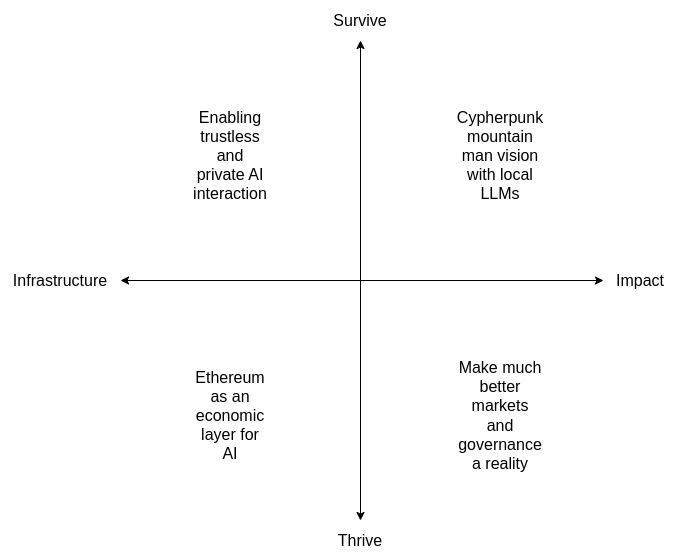
Privacy and Trustless AI Infrastructure
Buterin said a near-term priority is building infrastructure that enables private and trustless interaction with AI systems. This includes local AI tooling, zero-knowledge payments for API usage, and cryptographic verification of remote computations, allowing users to interact with models “without linking your identity from call to call.”
Ethereum as an Economic Layer for AI Agents
Another component of the proposal positions Ethereum as a coordination and settlement layer for AI-driven economic activity. Potential applications include automated payments for API calls, “bots hiring bots,” security deposits for autonomous agents, and reputation systems designed for AI participants.
“The goal here is to enable AIs to interact economically,” he wrote, saying such mechanisms could support decentralized AI architectures instead of systems run entirely by single organizations.
AI-Assisted Verification and Governance
Buterin also described how AI could help users verify blockchain activity and navigate decentralized applications. Local AI assistants could propose transactions, audit smart contracts, and verify the trust models of protocols, advancing the long-standing cypherpunk idea of “don’t trust; verify everything.”
Beyond infrastructure, he said, AI systems could help improve governance and decision-making mechanisms such as prediction markets, decentralized voting systems, and other coordination tools that have historically been constrained by limited human attention and processing capacity.
“LLMs remove that limitation, and massively scale human judgement,” Buterin wrote, adding that these tools could allow earlier theoretical governance ideas to be implemented more effectively.
Building a Decentralized AI Economy
Buterin said the initiatives form part of a broader effort to integrate AI and blockchain technologies in ways that support decentralized cooperation and stronger defensive systems against misuse.
While long-term scenarios such as human-AI integration remain speculative, he wrote that “there’s a lot to build” in the near term as developers construct the infrastructure for decentralized AI ecosystems.
Related: Here’s Ethereum Price Analysis for the Week According to ChatGPT, Claude, Perplexity, and Grok
Disclaimer: The information presented in this article is for informational and educational purposes only. The article does not constitute financial advice or advice of any kind. Coin Edition is not responsible for any losses incurred as a result of the utilization of content, products, or services mentioned. Readers are advised to exercise caution before taking any action related to the company.