
- Charles Hoskinson explains why Cardano was missing from Mastercard’s list of 87 crypto partners.
- Hoskinson says Cardano lacks a permanent organization dedicated to securing corporate partnerships.
- Cardano’s absence sparks debate over whether strong tech alone is enough to compete in crypto payments.
Cardano founder Charles Hoskinson has explained why the blockchain was absent from a recently shared list of 87 crypto companies and networks that Mastercard has partnered with.
The discussion started after crypto researcher Thomas Bush mapped out Mastercard’s ecosystem of crypto partners across several categories. The list included major blockchain networks such as Aptos, Avalanche, Polygon, Solana, and Ripple, alongside infrastructure providers, exchanges, custody firms, and banking partners.
However, Cardano was notably missing from the lineup.
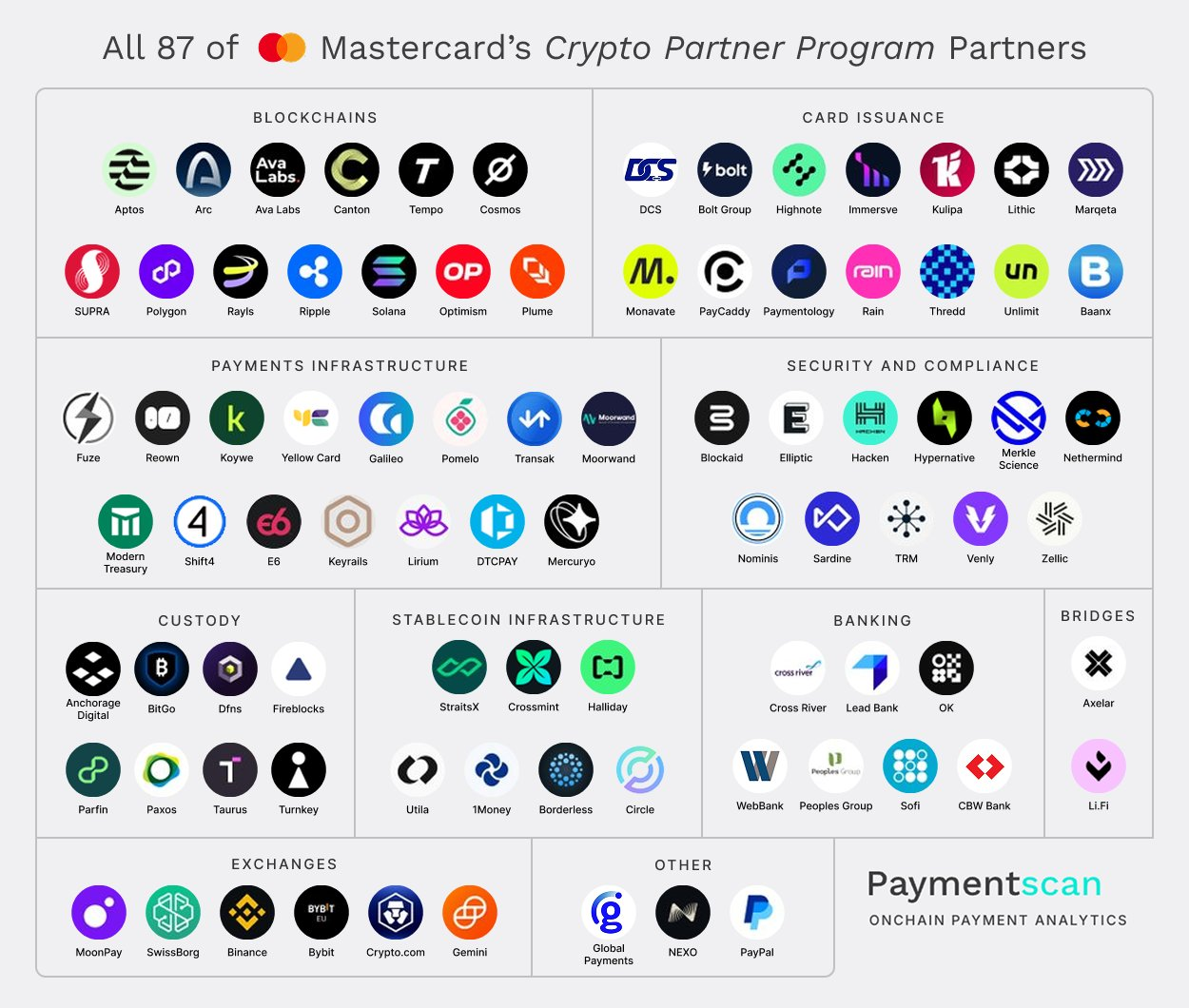
Community Questions Cardano Absence
The omission triggered discussion within the Cardano community. One ADA holder, @navir333, argued that many projects constantly focus on building new technology and struggle to achieve real-world integration.
The commenter cited Mastercard’s growing crypto network as an example. He noted that despite Cardano’s long development history, it was not on the integration list. Navir directly asked Hoskinson what the project might be doing wrong.
Hoskinson Points to Lack of Dedicated Integration Push
Hoskinson explained that the core issue lies in Cardano’s structure. Specifically, he cited the absence of a permanent organization focused on partnerships and integrations.
According to him, the situation differs from newer initiatives like Midnight blockchain, where a dedicated foundation actively pursues ecosystem integrations every day.
Hoskinson explained that Cardano lacks a similar permanent effort. While a group called Pentad previously pushed for integrations, he said the initiative was a one-time effort and needs to become a continuous activity if the network hopes to secure more large-scale partnerships.
Governance Structure Under Scrutiny
The discussion also highlighted concerns about Cardano’s governance model. Some community members noted that key organizations tied to the project have not done enough to drive real-world adoption.
One commenter argued that groups like the Cardano Foundation and Emurgo received large amounts of early ADA but have shown fewer visible results than Input Output Global, the development firm led by Charles Hoskinson.
Others believe Cardano’s decentralized structure may have slowed the creation of a clear business strategy, making it harder to compete with networks that actively pursue corporate partnerships.
Meanwhile, Mastercard is steadily expanding its blockchain and crypto partnerships, enabling payment networks to support crypto transactions, cards, and settlement solutions.
With Cardano not yet in that league, some now question whether strong technology alone is enough, or if deeper business partnerships are needed to compete in the growing crypto payments industry.
Related: Charles Hoskinson Says Cardano Now Hosts the World’s Largest DAO
Disclaimer: The information presented in this article is for informational and educational purposes only. The article does not constitute financial advice or advice of any kind. Coin Edition is not responsible for any losses incurred as a result of the utilization of content, products, or services mentioned. Readers are advised to exercise caution before taking any action related to the company.