
- A grayscale analysis report shows quantum risk to Bitcoin, with XRP and Solana already testing upgrades.
- The Google Quantum AI paper suggests that quantum leaps could crack Bitcoin’s ECDSA encryption sooner.
- Post-quantum migration could grow as the XRP Ledger gains a long-term edge amid a focus on quantum security.
Grayscale Research warned investors on April 6, 2026, that Google Quantum AI’s March 2026 paper shows quantum leaps could soon crack Bitcoin’s ECDSA encryption using Shor’s algorithm.
Meanwhile, the XRP Ledger gains a quantum edge by actively experimenting with post-quantum cryptography upgrades. The broader industry now calls for accelerated migration, aiming to achieve full post-quantum readiness by 2029 to safeguard decentralized blockchains.
Grayscale Quantum AI Report Shows Quantum Risk to Bitcoin
On April 6, 2026, Grayscale Research released a new Google Quantum AI paper stating that quantum computers could eventually use Shor’s algorithm to break the elliptic curve cryptography used to secure Bitcoin. The analysis warns that progress may occur in sudden leaps rather than gradual steps, making early preparation critical.
Bitcoin faces lower engineering risk than many other blockchains. Its UTXO model, proof-of-work consensus, lack of native smart contracts, and certain address designs limit exposure.
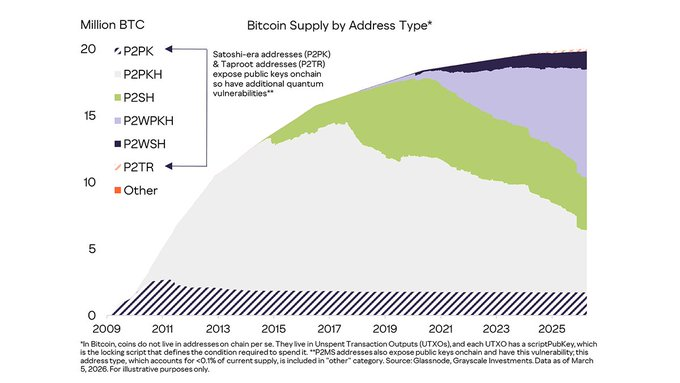
Source: X
For instance, Satoshi-era P2PK addresses and newer Taproot (P2TR) addresses expose public keys directly on-chain. These represent significant portions of the total supply and carry additional quantum vulnerabilities.
Quantum Leaps Could Crack Bitcoin’s ECDSA Encryption
Google Quantum AI paper suggests that quantum progress toward breaking elliptic curve cryptography may come in sudden leaps rather than gradual steps. This non-linear advancement means that the ability to crack Bitcoin’s Elliptic Curve Digital Signature Algorithm
(ECDSA) could emerge abruptly. Grayscale Research warns that waiting for further innovation could be risky as timelines remain uncertain.
Shor’s algorithm, developed in the mid-1990s, allows a quantum computer to quickly solve the elliptic curve discrete logarithm problems that secure ECDSA. According to the Google Quantum AI paper, breaking this cryptography would require only 1,200 to 1,450 logical qubits, a level of computational power closer than many realize.
Furthermore, Bitcoin faces lower engineering risk than many other blockchains because its UTXO model, proof-of-work consensus, lack of native smart contracts, and certain address designs limit exposure.
Broader Impact: XRP Ledger Gains Quantum Edge as Industry Prepares
Grayscale emphasizes that while no such machine with this quantum capability is available today, and quantum capability is still likely several years away, the potential for sudden leaps makes early action critical. The Google whitepaper shows that both $SOL and $XRP are already experimenting with post-quantum cryptography.
This early action positions XRP Ledger ahead of most blockchains as the industry prepares for the potential quantum threats to elliptic curve cryptography. This means that decentralized networks must move proactively through community consensus.
According to CoinMarketCap data, on April 7, 2026, XRP trades at $1.31, with a market capitalization of $80.43 billion, remaining stable near recent levels amid broader market caution and increased attention to quantum security readiness.
Therefore, XRP Ledger’s PQC experiments could provide a clear technical path forward, reduce future engineering risk, and give it a quantum edge. The industry calls for continued accelerated migration, with 2029 cited as a key target for full post-quantum readiness.
Related: Willy Woo Says Quantum Risk Weighs on Bitcoin
Disclaimer: The information presented in this article is for informational and educational purposes only. The article does not constitute financial advice or advice of any kind. Coin Edition is not responsible for any losses incurred as a result of the utilization of content, products, or services mentioned. Readers are advised to exercise caution before taking any action related to the company.