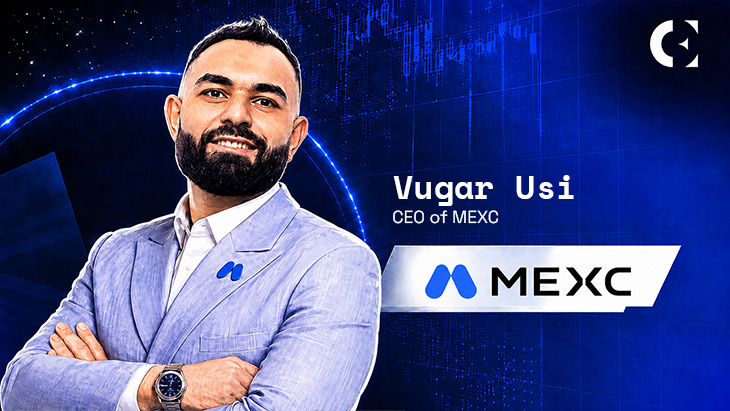

CoinEdition spoke with Vugar Usi, CEO of MEXC, ahead of CoinFest Asia 2026 to discuss the rise of 24/7 financial markets and the growing convergence of crypto and traditional finance in Asia. In this interview, Usi shares insights into why Asian traders are embracing round-the-clock access, what is driving the shift from traditional brokers to crypto exchanges, and how tokenized real-world assets could shape the next phase of financial markets.
1. The London Stock Exchange is moving toward round-the-clock trading, while your research suggests Asian traders are already getting comfortable with markets that never close. Why do you think 24/7 access is resonating so strongly with traders in Asia?
For Asian traders, 24/7 access means they can adjust their positions when a market-moving event happens outside traditional trading hours.
Our survey found that 75.1% had encountered a major event when traditional markets were closed, and 61.5% described broker trading hours as limited. When prices move sharply outside those hours, traders want to manage their exposure before traditional markets reopen.
Many Asian users already trade and hold capital on CEXs. APAC has high crypto adoption, and many users keep part of their trading capital in stablecoins. If the capital is already on the platform, traders can act as soon as prices move outside traditional market hours.
2. Your research found that 77.9% of Asian users with a TradFi background have moved from traditional brokers to crypto exchanges. What do you think is making Asian traders more willing to make that switch?
Asian traders are willing to switch when a CEX makes it easier to access the markets they already want to trade. A user who already holds USDT on a CEX can access crypto, gold, equities, or an index without opening another account, transferring funds back to a bank, or learning a second platform. In our survey, 42.6% cited complex account opening at traditional brokers, and 53.8% cited higher fees.
For 83.9% of surveyed Asian users, CEXs are already their primary venue for crypto trading. They have funded accounts and are familiar with the trading interface, which makes accessing traditional assets from the same account much more straightforward.
3. More than two-thirds of Asian respondents said 24/7 market access is one of the reasons they choose CEXs. Do you think people are starting to expect all financial markets to work this way, rather than seeing it as something unique to crypto?
Yes, I think traders who are used to 24/7 crypto markets are starting to expect the same level of access elsewhere. Our survey also found that 79% of Asian users would consider using a crypto platform to take a position in gold or oil when traditional markets are closed.
I expect round-the-clock access to become more common. It still has to come with credible pricing and enough liquidity outside normal market hours.
4. Another interesting finding is that 87.2% of Asian respondents expect to increase their TradFi trading through CEXs. Could crypto exchanges eventually become a bridge between traditional markets and digital assets, rather than simply an alternative to traditional brokers?
I think CEXs can become an important access point for both traditional and digital assets. A user can keep stablecoins in one account and move between crypto, gold, equities, and indices without opening and funding a separate brokerage account. From June 2024 to June 2025, onchain transaction value across APAC grew 69% year over year, and many users already manage capital through crypto platforms.
Spot markets still have a lot of room to develop. RWAs, forex, and tokenized stocks represent less than 2% of CEX spot volume, and futures have grown much faster. For this market to grow beyond leveraged trading, spot liquidity has to improve. Users also need to know whether they hold a claim on the underlying asset or a derivative that only tracks its price.
5. Your research also found that 91.9% of Asian respondents expect the tokenized commodities market to grow. What do you think is driving that optimism, and which real-world assets do you see having the strongest potential in Asia?
I think traders are optimistic because many of the assets now being tokenized are ones they already know and trade. Asian gold ETFs attracted $25 billion in net inflows in Q1 2026, and 62.6% of surveyed crypto-native users in Asia primarily trade precious metals through CEXs. 87.2% have also traded CEX derivatives linked to precious metals.
I would put gold clearly first in terms of near-term potential. After that, liquid US equities and broad equity indices have strong potential. Oil also stands out because geopolitical events can move prices sharply when traditional markets are closed. Assets without a deep underlying market will be much harder to turn into liquid tokenized markets.
6. You’ll be joining us at CoinFest Asia in Bali, where the future of crypto and finance will be a major part of the conversation. Looking ahead, what do you think Asian traders and the wider industry should be watching most closely as traditional and crypto markets increasingly move toward an always-on model?
Weekend liquidity will be important as more traditional assets move onto always-on platforms. When the underlying traditional market is closed, market makers have fewer hedging options, so spreads can widen and quoted sizes can shrink. Traders may have 24/7 access, but they still need enough liquidity to execute at a credible price.
Futures are currently growing much faster than spot, and much of that growth is concentrated in leveraged products. Leverage brings liquidation risk and will likely attract more scrutiny as these markets grow. Over time, more of that demand needs to move into spot markets. Decentralized venues are also expanding quickly into stocks, commodities, and indices.
Disclaimer: The information presented in this article is for informational and educational purposes only. The article does not constitute financial advice or advice of any kind. Coin Edition is not responsible for any losses incurred as a result of the utilization of content, products, or services mentioned. Readers are advised to exercise caution before taking any action related to the company.