
- Pakistan has launched airstrikes on Kabul, declaring an “Open War.”
- Bitcoin drops 5.85% as top cryptocurrencies, including Ethereum, XRP, and Solana fall.
- Wars spark crypto volatility but also increase cross-border crypto usage.
Tensions escalated between neighboring Pakistan and Afghanistan following military action overnight, as the Pakistan armed forces launched airstrikes on targets in Kabul. The attack prompted Pakistan’s defence minister, Khawaja Muhammad Asif, to describe the situation as an “open war.”
The Afghan government has vowed to retaliate, triggering concerns over the consequences a full-blown war could have on the South Asian region amid a potential ripple effect across the global economy. Global powers, including Russia, Iran, and the United Nations, have called for restraint, citing the potential effect of the war on the delicate global economy.
The Crypto Market’s Initial Reaction
Typically, regional uncertainties directly affect the financial market, with risk assets usually intertwined in the mix. The initial reaction following Pakistan’s bombing of Afghanistan aligned with historical patterns, with risk assets wobbling while Oil edged higher on regional uncertainty.
As of writing, Bitcoin, the largest cryptocurrency by market capitalization, is down 5.85%, according to data from TradingView.
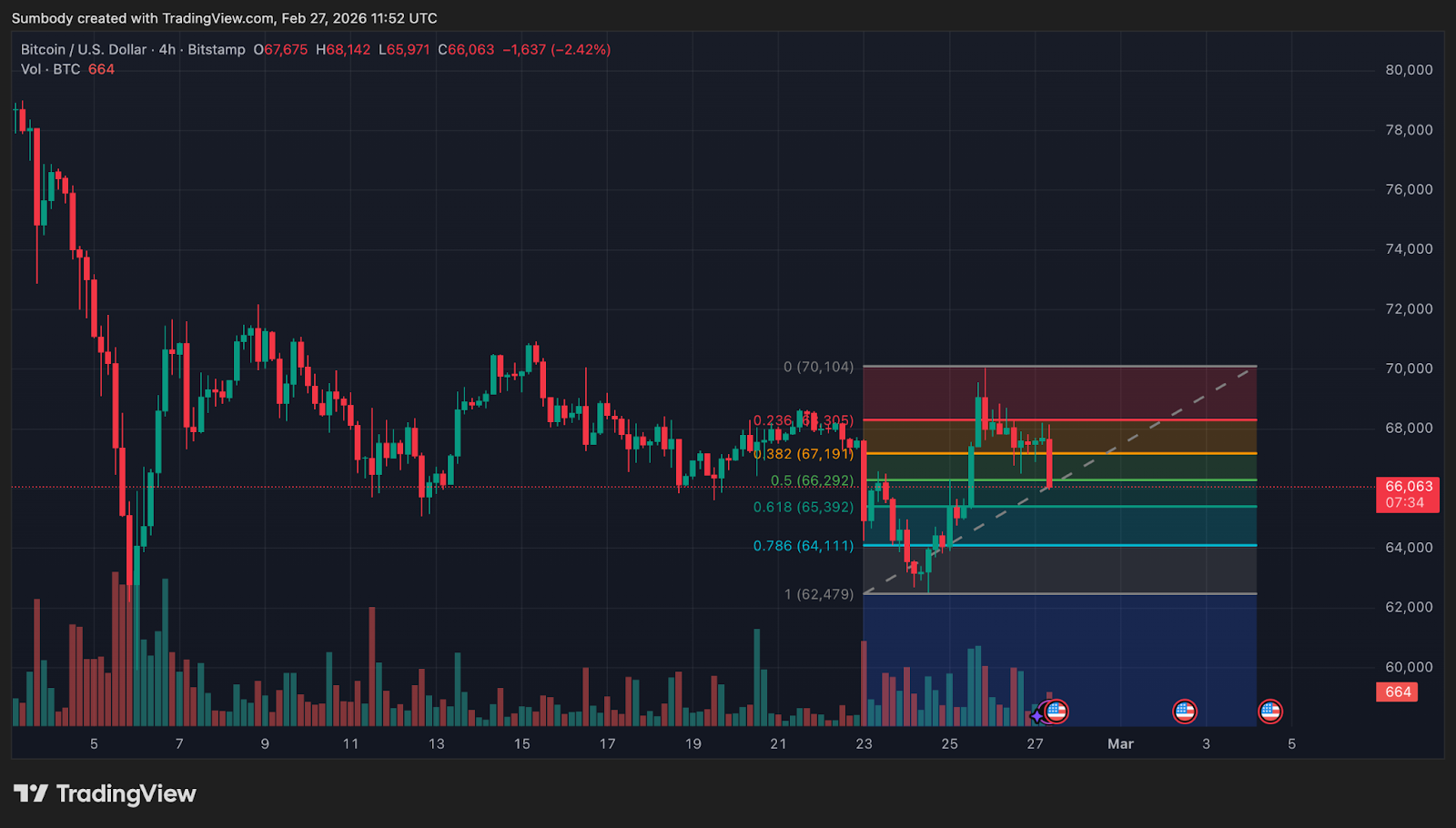
The cryptocurrency reversed after climbing above $70,000 for the first time in 10 days to trade for $66,063 at the time of writing, reflecting a sharp turnaround in market sentiment. Meanwhile, other top cryptocurrencies, including Ethereum, XRP, Solana, and Cardano, experienced similar volatility, reacting to the unfolding events in South Asia.
For instance, TradingView’s data shows that Ethereum slipped 8.6%, pulling back from Thursday’s $2,148 high to trade for $1,983 at the time of writing, while XRP declined 7.5% over the same period to trade for $1.3830.
Overall, the total crypto market cap is down 3% on Friday, reflecting an overall pullback in crypto prices as investors distance themselves from risk assets.
What Historical Patterns Suggest
It is worth noting that war breakouts typically trigger volatility, with Bitcoin behaving less like “digital gold” and more like a high-beta tech stock. For instance, the crypto dropped sharply following Russia’s invasion of Ukraine in 2022, with a similar pattern repeating during flare-ups in the Middle East in 2023 and 2024.
However, it is important to note that wars across regions cause nations to seek alternative routes to bypass capital controls. Under such circumstances, militant groups and humanitarian organizations use crypto rails to move funds. During the Russia-Ukraine conflict, Ukraine raised over $100 million in digital asset donations from across the globe, while Russians used stablecoins to bypass capital controls.
Related: Ukraine Moves to Legalize and Tax Crypto, Proposing an 18% Income Tax and a 5% Military Tax
Disclaimer: The information presented in this article is for informational and educational purposes only. The article does not constitute financial advice or advice of any kind. Coin Edition is not responsible for any losses incurred as a result of the utilization of content, products, or services mentioned. Readers are advised to exercise caution before taking any action related to the company.