- Pi Network has 17.5M KYC users, but only 28 nodes and 3 validators, raising serious decentralization concerns.
- The Pi Foundation controls roughly 90% of supply, with 1.2B tokens unlocking in 2026 adding dilution risk.
- Price must hold $0.20 and reclaim $0.25 to avoid deeper downside toward $0.15 amid fading confidence.
Pi Network trades at $0.2121 after collapsing 93% from $2.99 peak as Open Network launched February 2025, while 17.5 million KYC verifications and 15.8 million Mainnet migrations confront critical infrastructure failure—only 28 nodes and 3 validators secure the network, Pi Foundation controls 90% of 90 billion token supply, under 100 mainnet-ready applications despite $100 million ecosystem funding, and 1.2 billion tokens unlock in 2026.
Technical Setup Shows Downtrend
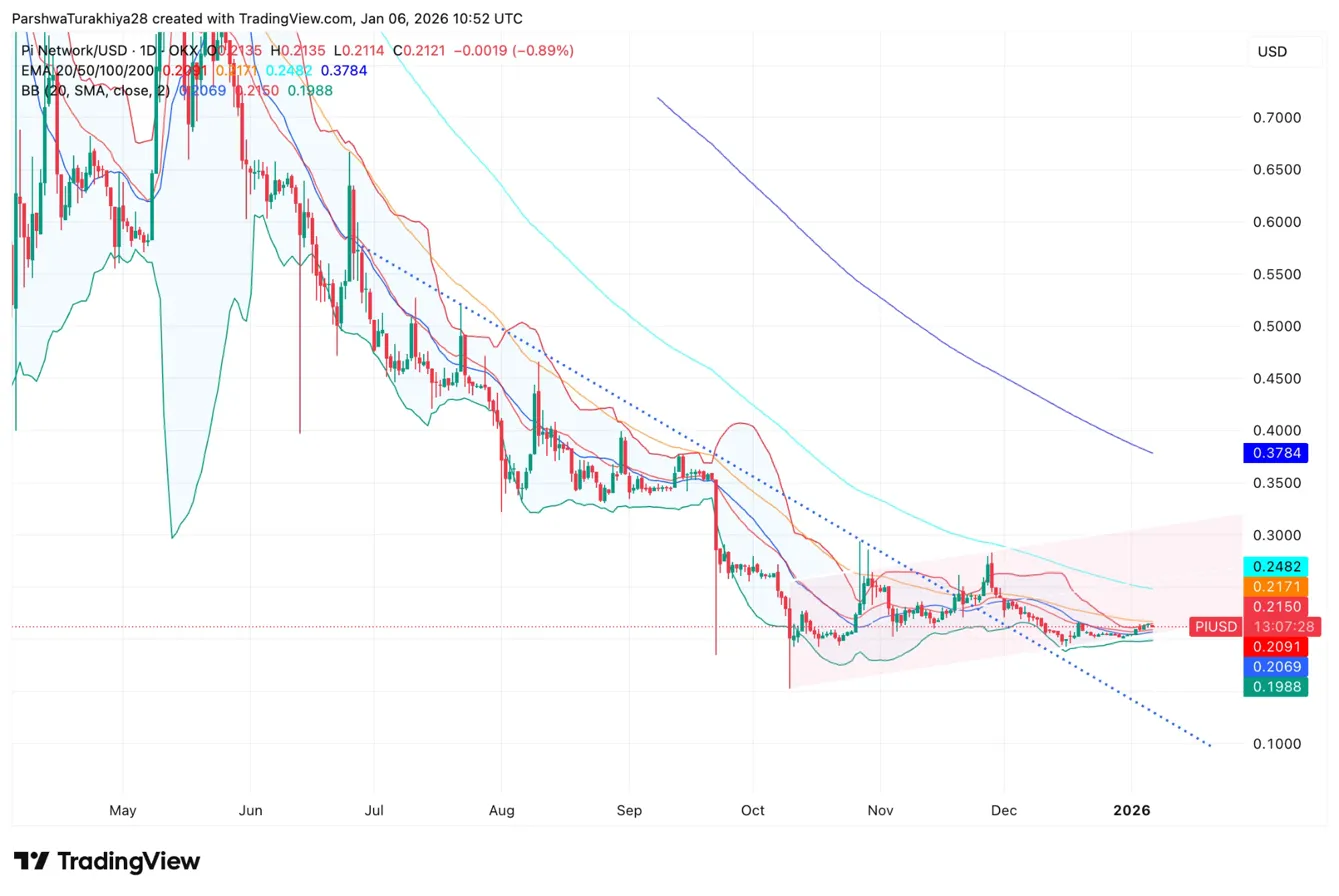
PI at $0.2121 consolidates in $0.1988-$0.2482 range after June’s $0.71 spike collapsed. EMAs at $0.2091/$0.2150/$0.2482/$0.3784 show price below upper resistance. Bollinger Bands at $0.2069/$0.2160 indicate compression.
Support at $0.1988-$0.2069. Bulls need volume above $0.2482 to challenge $0.3784 and reverse downtrend. Break below $0.1988 targets $0.15 or lower toward analyst projections of $0.15-$0.22 range.
Five Critical Problems
Decentralization Crisis—28 Nodes
Only 28 nodes and 3 validators currently secure Pi Network despite 60 million registered users. This infrastructure inadequacy contradicts blockchain’s core promise—a network controlled by 28 nodes cannot credibly claim decentralization.
With only 3 validators, Pi operates functionally as a centralized database rather than distributed ledger. This concentration exposes the network to single points of failure, governance manipulation, and regulatory classification challenges that could undermine cryptocurrency status entirely.
Foundation Controls 90% Of Supply
Pi Foundation controls over 90 billion tokens—90% of total supply—raising questions about governance transparency and long-term decentralization. Continuous issuance of new tokens plus 1.2 billion expected to unlock in 2026 risks further devaluation.
This extreme centralization gives the Foundation unilateral control over price dynamics and economic policy. The $2.99 to $0.20 collapse (93% drop) following Open Network launch reflects market recognition of these structural weaknesses.
Under 100 Mainnet-Ready Apps
Despite years of development and $100 million ecosystem funding, Pi failed to reach the critical milestone of 100 mainnet-ready applications by late 2025.
Pi has 215+ apps registered, but fewer than 100 meet mainnet-ready standards—many projects lack meaningful utility or commercial viability. Creating applications differs fundamentally from creating applications people actually use. Without compelling use cases, even millions of verified users have limited reasons to transact beyond speculation.
Open Network Transition Underwhelms
Open Network launched February 2025, removing firewall from the Enclosed Network period and allowing external connectivity to other networks, wallets, and anyone wanting to connect to Pi Mainnet.
This transition represents the culmination of six years of development enabling Pi to function as public blockchain with unrestricted transfers and exchange listings. However, 17.5 million KYC verifications and 15.8 million Mainnet migrations demonstrate scale without utility—quantity hasn’t translated to meaningful ecosystem activity beyond speculative mining.
Community Backlash On Vague Roadmap
Pi’s 2026 strategic communication triggered significant community frustration. Given lack of specifics in the roadmap announcement, comments turned negative.
One user: “Years of hype, delays, vague timelines, and zero accountability have destroyed market confidence.” Another: “Nothing good comes out of the Pi ecosystem.” This sentiment reflects accumulated disappointment from repeated delays and underwhelming deliverables.
Q1 KYC Validator Rewards
Work on distributing rewards to KYC validators continues, with first payout targeted for Q1 2026 completion, accounting for extensive analysis processing data from hundreds of millions of validation tasks accumulated since 2021.
Related: Sui Price Prediction 2026: Protocol Privacy and $441M Treasury Allocation Target $5-$8
AI upgrades improved verification speed—approval time reduced to 3-14 days from longer previous timeframes through enhanced fraud-detection and duplicate recognition.
Pi Price Prediction: Quarter-by-Quarter Breakdown
- Q1 2026: $0.18-$0.25 KYC validator rewards distributed, 1.2B token unlock begins, node count critical. Hold $0.1988 or test $0.15. Limited upside to $0.22-$0.25 without infrastructure fixes.
- Q2 2026: $0.15-$0.28 Application ecosystem assessment, unlock absorption, decentralization progress (or lack thereof). Bulls need $0.2482 break toward $0.25-$0.28.
- Q3 2026: $0.15-$0.30 PiDAO governance launch, MiCA compliance progress, user activity metrics. Challenge $0.30 requires breakthrough applications.
- Q4 2026: $0.18-$0.35 Year-end infrastructure validation, app count, Foundation transparency. Max upside $0.30-$0.35 needs radical transformation.
Pi Price Forecast Table For 2026
| Quarter | Low | High | Key Catalysts |
| Q1 | $0.18 | $0.25 | Validator rewards, unlocks, nodes |
| Q2 | $0.15 | $0.28 | Apps assessment, absorption |
| Q3 | $0.15 | $0.30 | PiDAO, MiCA, activity metrics |
| Q4 | $0.18 | $0.35 | Infrastructure validation |
Portfolio Implications
- Base case ($0.15-$0.22): Modest node growth to 50-75, Foundation reduces control to 70-80%, 150-200 mainnet apps, unlocks absorbed gradually, analysts’ $0.15-$0.22 range holds.
- Bull case ($0.25-$0.35): Radical infrastructure overhaul—100+ nodes, Foundation distributes to <50% control, 300+ quality apps, 17.5M users become active transactors, breakthrough application emerges, $0.2482 breaks toward $0.30-$0.35.
- Bear case ($0.10-$0.18): Infrastructure stays centralized at 28 nodes, Foundation maintains 90% control, app ecosystem stagnates, 1.2B unlock crushes price, $0.1988 breaks toward $0.15 then $0.10, regulatory classification as non-cryptocurrency.
Disclaimer: The information presented in this article is for informational and educational purposes only. The article does not constitute financial advice or advice of any kind. Coin Edition is not responsible for any losses incurred as a result of the utilization of content, products, or services mentioned. Readers are advised to exercise caution before taking any action related to the company.