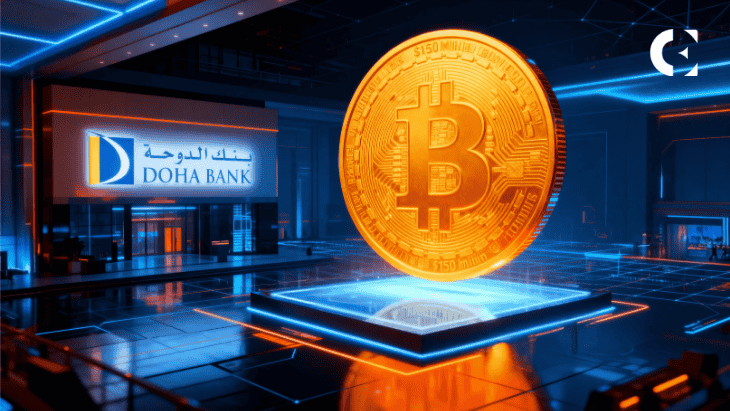
- Doha Bank has issued a $150 million digitally native bond that settles instantly (T+0), leveraging Euroclear’s DLT infrastructure to eliminate clearing delays.
- The move highlights Qatar’s “bifurcated” strategy: banning retail crypto trading while aggressively adopting institutional blockchain for debt markets.
- Standard Chartered and Citi managed the issuance, which lists on the London Stock Exchange, validating DLT for high-grade sovereign and corporate debt.
Doha Bank has completed a $150 million digitally native bond issuance, marking one of Qatar’s earliest digitally native USD bond issuances.
The floating-rate notes were listed on the London Stock Exchange’s International Securities Market with T+0 (instant) settlement with Euroclear’s Digital Financial Market Infrastructure, D-FMI.
The issuance serves as a proof-of-concept for the ‘Blockchain without Bitcoin’ principle. While Qatar maintains a strict ban on retail cryptocurrency trading, the state is aggressively pivoting toward asset tokenization.
Related: Qatar Turns to Hedera Blockchain for Islamic Finance Innovation Pilot
How Euroclear’s D-FMI Enabled Same-Day Settlement
As per a release, the bond was issued as Digitally Native Notes, meaning the entire lifecycle of the security, from issuance to settlement, took place in digital form.
Euroclear’s D-FMI uses distributed ledger technology to handle issuance, distribution, and settlement while complying fully with regulatory standards.
Standard Chartered acted as sole global coordinator and sole arranger. Meanwhile, financial giant Citi served as issuing and paying agent.
The release talked about how permissioned DLT systems are becoming preferred infrastructure for institutional digital debt.
Salman Ansari, the Global Head of Capital Markets at Standard Chartered, said that the bond shows that tokenization can improve efficiency without replacing traditional capital market structures.
According to Euroclear, the platform supports integration with secondary market trading venues, ensuring investors retain access to liquidity after issuance.
“Qatar is helping to set a steady pace for digital issuance within the GCC – providing a clear reference point for market participants in the region,” stated Sebastien Danloy, Chief Business Officer, Euroclear.
Moreover, the more than 50-year-old Commercial Bank recently launched Qatar’s first metaverse-enabled auto marketplace within its mobile app, allowing customers to explore virtual car showrooms, book test drives, and apply for vehicle loans digitally.
“This launch marks another step in redefining what modern banking can offer,” said Shahnawaz Rashid, EGM and Head of Retail Banking at Commercial Bank.
Qatar Pushes Tokenization While Keeping Tight Crypto Rules
As per a report from earlier this year, Qatar has maintained its ban on crypto trading and investment. However, the regulators are more interested in tokenization of assets.
The Qatar Financial Centre (QFC) is working towards digital financial products in a controlled legal environment using the 2024 Digital Asset Regulation and Investment Token Rulebook.
The agency also recently discussed the future of crypto via a report, published with Global Stratalogues and the Global Blockchain Business Council. The QFC remains massively optimistic when its comes to tokenization, with CEO Yousuf Mohamed Al-Jaida focusing on real-world utility of tokenization.
Related: Dubai Approves Tokenized Money-Market Fund Backed by Qatar National Bank
Disclaimer: The information presented in this article is for informational and educational purposes only. The article does not constitute financial advice or advice of any kind. Coin Edition is not responsible for any losses incurred as a result of the utilization of content, products, or services mentioned. Readers are advised to exercise caution before taking any action related to the company.