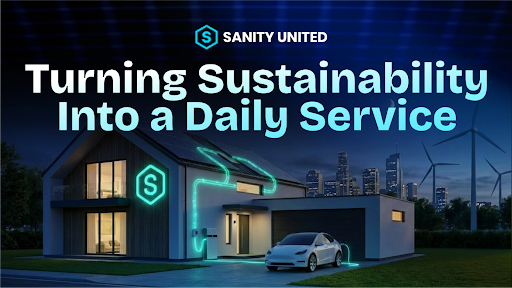
Most environmental projects promise big but often result in just one product. Sanity United takes another approach. It is building a system where electric mobility, clean energy, and AI-powered solutions come together to simplify daily tasks and reduce waste and pollution.
At the heart of this effort is Sanity United, a company based in Denmark, Copenhagen. It blends artificial intelligence and renewable energy technology to offer a green solution for handling everyday activities.
The mission stays simple and focused on people. It aims to change how tasks are handled by combining zero-emission transport, renewable energy, and automation into one seamless system rather than treating them as separate parts.
What Sanity is working to fix
Cities are full of small “micro-frictions” that pile up: picking something up from a repair shop, dropping off keys, delivering a last-minute gift, getting groceries when stores are closed, helping a friend who’s stuck at home. Traditional delivery services cover a narrow set of use cases, and they often run on fossil-fuel logistics with limited transparency.
Sanity sees this as both a practical issue and an environmental challenge. Running errands adds to traffic and pollution, while organizing tasks still hasn’t caught up with modern automation. Their solution offers an errands service designed to feel approachable and adaptable. It’s more like asking someone for help than picking items from a catalog, and it works using cleaner systems.
Breaking down the Sanity ecosystem
It helps to think of Sanity as five connected pieces, all working together:
1) Sanity Care:
Sanity Care acts as the part customers interact with. Users can share what they need, whether by speaking or texting, without worrying about language differences. The system takes care of planning routes, logistics, and costs.
Instead of using a system where every driver needs to own their car, the plan outlined in the documents talks about a partner-performer setup. In this model, the company supplies the vehicles to make it easier for people who want to take on tasks.
2) Sanity Energy: creating and keeping renewable energy
Sanity Energy runs the energy system for the fleet and mining activities. The project mentions building a hybrid station powered by both solar and wind energy on a 1-hectare lot. The energy will be stored in two separate locations, one for mining and the other for charging electric vehicles and running onboard systems.
3) Sanity Mining: managing leftover energy
Mining is shown here not as its own separate business but as a way to optimize energy use. It tries to make the best use of unused power when it’s not needed for charging vehicles or doing other services. The project highlights both stationary mining and in-vehicle mining with a centralized system managing it all.
4) Sanity AI: managing tasks ensuring safety, and improving efficiency
Sanity AI acts as the main control system. It handles tasks like assigning errands, picking resources, tracking energy production and storage, and dealing with problems. For example, it manages overheating or adjusts energy use when supply is limited.
The project also talks about making a digital twin. This means creating a virtual model of the system to predict bottlenecks and see how things change as demand increases.
5) Using blockchain to enhance transparency and manage coordination
Sanity highlights blockchain as a way to ensure clarity in transactions and ecosystem operations. It shares its token contracts and token allocation addresses . This approach helps the community track activities and join more .
Tech framework:
Sanity’s tech focus is practical, not just tech for the sake of it. It solves real-world operational challenges:
- A user sends in a task request.
- The system finds the right partner and vehicle to handle it.
- It keeps track of vehicles live.
- Central systems oversee energy use, charging, and resource management schedules.
Combining clean energy, storage, and charging
The project explains a renewable energy station that combines solar power with wind turbines. This setup aims to keep generating power during different weather conditions. The energy is kept in two main storage systems and shared according to business requirements.
On the charging side, the model supports charging up to 20 EVs at once. It is also built to handle a fleet that includes as many as 100 vehicles.
Mining equipment (fixed and in EVs)
Sanity’s mining setup includes two parts:
- A fixed mining farm near the renewable station. It plans to run 300 miners with a hashrate goal mentioned in the document.
- A second setup spread out across electric vehicles, with fleet size possibilities detailed in the specification.
The page on solar and wind specifications explains a mining farm set up to handle 350 of the latest-gen ASIC miners. It connects this setup to the centralized control framework.
Completed milestones
Sanity’s docs split what’s already in place from what’s still being developed. This includes the MVP features and proof-of-concept stages.
Recently, the team also shared an update on X confirming that they are in active discussions with a major Europe-based fund. While the partner has not yet been disclosed, the announcement signals institutional interest and suggests that further details will be shared once the agreement is finalized.

Sanity Care MVP: completed real tasks
The “Sanity Care MVP” part highlights actual tasks the team has completed for their network. Examples include delivering essentials to someone in the hospital, managing groceries during holidays, delivering flowers and a birthday gift, and sorting out a key handoff issue without needing anyone to leave work.
These measurements might be small in scale, but they prove the service idea addresses practical real-world needs. It focuses on urgent personal problems that are often tough to handle with regular delivery apps.
Sanity Energy PoC: partnering with an expert for delivery
The “Sanity Energy PoC” highlights the ability to deliver solutions by working with a partner known for handling large installations. This partner brings expertise in fields like designing, commissioning, and maintaining renewable energy projects.
It also explains why Denmark was chosen as the area of operation. Denmark’s electricity relies on renewable energy sources, with wind power being a major contributor.
Sanity Mining PoC: defining feasibility and operational approach
The mining PoC page explains how in-vehicle mining works during idle times or while charging. It also includes references to external examples and hardware details, like ASIC-class miners.
The main focus is not on “proof of profit.” Instead, it highlights documented ideas about whether this is possible, how safe it is, and how it could fit into a fleet model.
What the project connects to
Sanity views “integrations” as the key to making the system work :
- Renewable energy setup: A combined solar and wind station, linked storage, and charging facilities.
- Fleet management tools via APIs: Vehicle data and remote controls allow for centralized planning and safety.
- Transparent on-chain system: Details like the token contract and token allocation addresses are shared.
The prototype of the Care app marked as “coming soon” in the documentation, shows that the product layer is still being developed.
Community involvement and ambassador program
Sanity mentions three types of community groups:
- Customers use an invitation-rollout. Early users get rewards connected to sending invites and staying involved.
- Partners work in a setup like contractors. The company supplies vehicles, and the app works in multiple languages.
- Supporters or investors have detailed project plans regarding buying tasks and mining capacity. Readers should review the original details to understand specifics.
The team also introduced an ambassador program. To support this, they have set aside $1M in SUT tokens.

This supports the project’s goal to engage community builders by recognizing outreach, teaching, and being involved, not just using the product.
Implementation Plan
Sanity presents its roadmap as more of a practical action plan rather than just a list of features.
Pre-launch focus:
The pre-launch tasks aim to prepare in four main areas:
- Preparing the fleet (making vehicles ready, setting up tracking systems, training staff)
- Activating energy systems (starting operations setting up maintenance plans)
- Getting AI and security ready (running stress tests, checking for cybersecurity issues, connecting blockchain transactions)
- Setting up customer engagement (designing onboarding steps forming partnerships, gathering feedback)
Post-launch focus:
The plan after launch prioritizes keeping things running :
- Set up and monitor fleet operation dashboards.
- Manage energy use across charging, mining, and daily tasks.
- Assist and guide new customers in getting started.
- Conduct regular checks to maintain security and meet compliance standards.
Roadmap for the next 5 years
Starting in Year 2, the outlined plan in the documents shifts to focus on growth and automating processes.
- In year 2, grow the fleet by 50 percent, enhance storage facilities, implement better AI routing, boost mining abilities by 30 percent, and strengthen collaborations.
- In year 3, explore new services, look into IoT integrations, plan wider geographic growth, kick off hardware recycling in a circular economy system, and increase team size.
- By year 4, focus on automating fleet and energy management, make customer service better, and work on sustainability reports.
- Year 5 will aim for long-term goals like becoming a leader in AI-powered errands advancing AI features wherever regulations allow, hitting sustainability targets, and forming broader partnerships.
The best way to look at this roadmap is as a guide to the team’s goals. It shows what they aim to create and the order they plan to follow rather than promising that every goal will be achieved.
Conclusion:
Sanity United is focused on more than just creating “another app.” The goal is to create a unified system that makes daily life easier and less harmful to the environment. They use renewable energy to run operations, EVs for deliveries, AI to manage different elements, and blockchain to keep everything open and trustworthy.
The project is clearly mission-first. A cleaner city is not a side effect but the core product direction. Community initiatives, including the $1M SUT ambassador allocation, reinforce that this is designed as a shared ecosystem, not a closed platform.
For anyone looking at how Web3 connects to real-world infrastructure, Sanity shows how energy, mobility, and service delivery can come together in one coherent system.
Contact:
Email: [email protected]
Mykola Goncharov
Disclaimer: The information presented in this article is part of a sponsored/press release/paid content, intended solely for promotional purposes. Readers are advised to exercise caution and conduct their own research before taking any action related to the content on this page or the company. Coin Edition is not responsible for any losses or damages incurred as a result of or in connection with the utilization of content, products, or services mentioned.