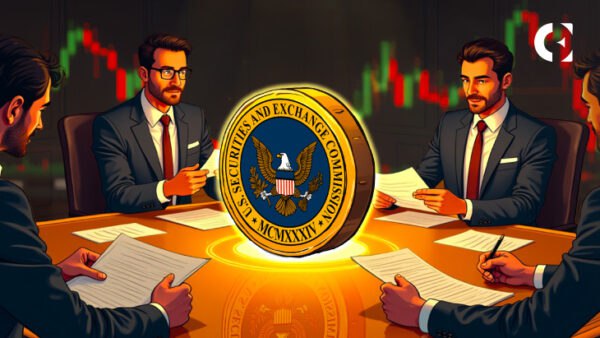
- SEC enforcement director’s exit highlights internal rifts over handling probes.
- Ryan pushed for tougher action, but faced resistance from top agency officials.
- High-profile cases involving Sun and Musk intensified internal tensions within the SEC.
The recent departure of the U.S. Securities and Exchange Commission’s enforcement director has drawn attention to internal disagreements over how the agency handles sensitive investigations, including matters linked to President Donald Trump’s circle.
Margaret Ryan, who led the SEC’s Enforcement Division for just over six months, resigned last week without publicly stating a reason.
According to reports, Ryan had pushed for a more aggressive enforcement approach, particularly in cases involving alleged fraud and misconduct. These efforts reportedly brought her into conflict with SEC Chair Paul Atkins and other senior Republican appointees, who were said to favor a different direction for the agency’s enforcement priorities.
The SEC confirmed that internal debate is part of its process, stating that decisions are based on facts, law, and policy rather than political considerations. A spokesperson added that discussions among staff and leadership are both common and encouraged.
Tensions also reflected broader changes in enforcement strategy. Under Atkins, the SEC has shifted focus away from large corporate and crypto-related crackdowns seen under prior Democratic leadership, instead prioritizing cases such as insider trading and Ponzi schemes. Additionally, commissioners have taken a more direct role, requiring enforcement staff to seek approval before launching formal investigations.
High-Profile Cases Added Pressure
According to sources, two cases contributed to internal friction involving cryptocurrency entrepreneur Justin Sun and Tesla CEO Elon Musk. Sun, who has supported the Trump family-backed World Liberty Financial venture, previously faced SEC allegations of generating more than $31 million through fraudulent trading.
A recent settlement required one of his companies to pay $10 million, without admitting or denying wrongdoing, while other charges were dropped.
Separately, the SEC is engaged in discussions with Musk over allegations tied to the delayed disclosure of his 2022 acquisition of a huge stake in Twitter, now known as X. Court filings indicate that settlement talks have involved senior officials beyond the enforcement staff handling the case.
Ryan considered both cases robust and capable of justifying stricter penalties in court. However, one enforcement official noted that evolving crypto guidance and pending legislation complicated the Sun case.
Ryan, a former Marine and military judge who previously clerked for Supreme Court Justice Clarence Thomas, was considered an unconventional choice for the role. Despite limited experience in securities law, she gained support among career staff by backing enforcement teams in ongoing investigations.
Related: Supreme Court Trump Tariff Case Puts Liquidity and Crypto in Focus
Disclaimer: The information presented in this article is for informational and educational purposes only. The article does not constitute financial advice or advice of any kind. Coin Edition is not responsible for any losses incurred as a result of the utilization of content, products, or services mentioned. Readers are advised to exercise caution before taking any action related to the company.