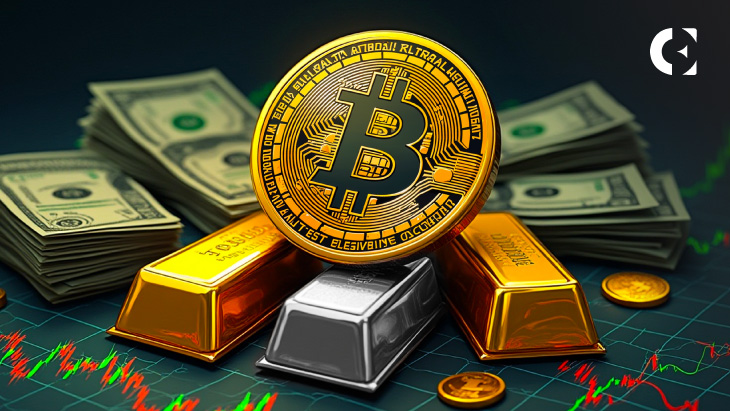
- Gold rose above $5,100 per ounce and silver climbed to a record $110.
- Central bank demand, geopolitical tensions and dollar weakness drove gains.
- Bitcoin fell below $88,000 as capital shifted toward precious metals.
Gold and silver prices reached record highs on Monday as investors sought safety. Spot gold climbed above $5,100 per ounce, while silver rose to $110. Bitcoin lagged as capital flowed out of the cryptocurrency market.
Gold Breaks $5,000 as Safe-Haven Demand Builds
Gold prices surged past the $5,000 mark on Monday, reaching an intraday high of about $5,105 per ounce. The move extended a rally that began last year and continued into 2026.
According to market data, gold is up more than 17% year to date, following a gain of roughly 65% in 2026. Analysts say the rally reflects sustained demand for safe-haven assets as geopolitical risks and currency concerns intensify.
Rich Checkan, president and chief operating officer of Asset Strategies International, said gold prices still have room to rise despite the recent gains. He pointed to global political uncertainty, high equity valuations, and concerns about the Federal Reserve’s independence as ongoing drivers of demand.
Nicholas Frappell, global head of institutional markets at ABC Refinery, said gold continues to attract investors because it is not tied to the credit risk of governments or corporations.
Related: Why Are Gold and Silver Prices Surging While Crypto Assets Slump?
Central Banks Continue Heavy Gold Buying
Central bank purchases remain a major pillar of the rally. Data from the World Gold Council shows global central banks bought a net 45 metric tons of gold in November 2025. Total purchases in 2025 reached 297 tons.
Emerging market central banks led the buying. Poland, Kazakhstan, Brazil, Turkey and China were among the largest purchasers. Poland’s central bank recently approved a plan to add up to 150 tons to its reserves, bringing its total holdings to 700 tons.
China also continued to add gold. Official data from the People’s Bank of China showed reserves rose to 74.15 million ounces by the end of December 2025. That marked the 14th consecutive month of increases.
Silver Outpaces Gold, Hits $110
Silver prices rose even faster than gold, climbing above $109 and trading near $110 per ounce. The metal is up more than 50% in 2026 after gaining about 50% last year.
Paul Williams, managing director at Solomon Global, said silver benefits from both safe-haven demand and industrial use. He cited rising demand from sectors such as renewable energy, artificial intelligence, and data centers, alongside limited supply growth.
Williams said silver offers a lower-cost entry point than gold for some investors. He added that supply shortages could persist, supporting prices in the medium term. Some analysts expect silver prices to approach $120 by 2026, though they warn of short-term volatility.
Geopolitical Tensions and Dollar Weakness Support Metals
Geopolitical risks have increased demand for precious metals. Ongoing conflicts in Ukraine and Gaza, tensions involving Venezuela, and trade disputes linked to U.S. tariff threats have unsettled markets.
Concerns about U.S. fiscal policy and the risk of a government shutdown have also weighed on investor confidence. At the same time, the U.S. dollar weakened last week, with the Bloomberg Dollar Spot Index posting its largest weekly drop since May.
Colin Cieszynski, Chief Market Strategist at SIA Wealth Management, said a softer dollar makes gold more attractive to global buyers and supports prices over the medium to long term.
Will Bitcoin Rally Next?
Market analysts remain divided on whether Bitcoin will follow gold and silver higher after their record-breaking rallies. Current data suggests Bitcoin is still consolidating rather than positioning for an immediate rebound.
Bitcoin trades at $87,687, down nearly 17% from a year ago and nearly 30% from its October peak of about $126,000.
Data showed nearly $670 million in crypto liquidations over the past 24 hours, with long positions accounting for most of the losses. Similarly, U.S. spot Bitcoin exchange-traded funds recorded net outflows of more than $1.3 billion between Jan. 19 and Jan. 23.
Glassnode analysts said Bitcoin faces heavy selling pressure above $100,000. Meanwhile, on-chain data from CryptoQuant shows long-term holders have begun selling at a loss for the first time since October 2023, while newer participants continue to enter the market. Analysts say this pattern typically reflects consolidation rather than the start of a renewed uptrend.
Derivatives Data
Derivatives data also points to caution. Futures trading volumes remain subdued, leverage levels have declined, and recent price movements have occurred on thin liquidity. Analysts note that sustained rallies usually require expanding participation, which has yet to materialize.
Some industry executives maintain that Bitcoin could recover later in the year. Founder of Binance, Changpeng Zhao, said growing institutional adoption and a more supportive policy environment in the United States could weaken Bitcoin’s traditional four-year cycle.
Similar views have been expressed by Ark Invest Chief Executive Cathie Wood and Bitwise Chief Executive Hunter Horsley, who cite institutional involvement as a potential stabilizing force.
Others remain cautious. Roukaya Ibrahim, Chief Strategist at BCA Research, said Bitcoin has not responded to the same macroeconomic forces that have driven precious metals higher.
She noted that gold continues to benefit from currency weakness and geopolitical uncertainty, while Bitcoin remains constrained by internal market dynamics. Analysts broadly agree that a sustained Bitcoin rally would likely require improved liquidity conditions, clearer regulatory signals, or a shift in monetary policy expectations.
Related: Bitcoin Falls While Gold Surges Amid Rising Yields and Market Volatility
Until then, precious metals remain the primary beneficiaries of global risk aversion, while Bitcoin continues to trade below key psychological levels.
Disclaimer: The information presented in this article is for informational and educational purposes only. The article does not constitute financial advice or advice of any kind. Coin Edition is not responsible for any losses incurred as a result of the utilization of content, products, or services mentioned. Readers are advised to exercise caution before taking any action related to the company.