
- South Korea’s crypto liquidity is shrinking fast as stablecoin balances plunge 55% across major exchanges.
- A weakening won is driving traders to exit stablecoins and rotate capital into domestic equities.
- The KOSPI rally is drawing capital, raising the risk of a sharp reversal back into crypto if stocks falter.
South Korea’s crypto market is seeing a sharp liquidity drain as stablecoin balances collapse. Meanwhile, capital is rotating into equities amid currency pressure and a booming stock market.
On-chain data reveals that stablecoin holdings tied to South Korea’s top exchanges Upbit, Bithumb, Coinone, Korbit, and GOPAX have dropped by 55% since July 2025.
South Korea Crypto Liquidity Drops 55% Across Major Exchanges
According to data from Allium Labs, balances fell from around $575 million to roughly $188 million by mid-March. The decline accelerated as the Korean won weakened past 1,500 per dollar, hitting levels not seen since the 2008 Financial Crisis.
This sharp currency move appears to have triggered a wave of outflows, with traders selling dollar-denominated stablecoins like USDT at favorable exchange rates.
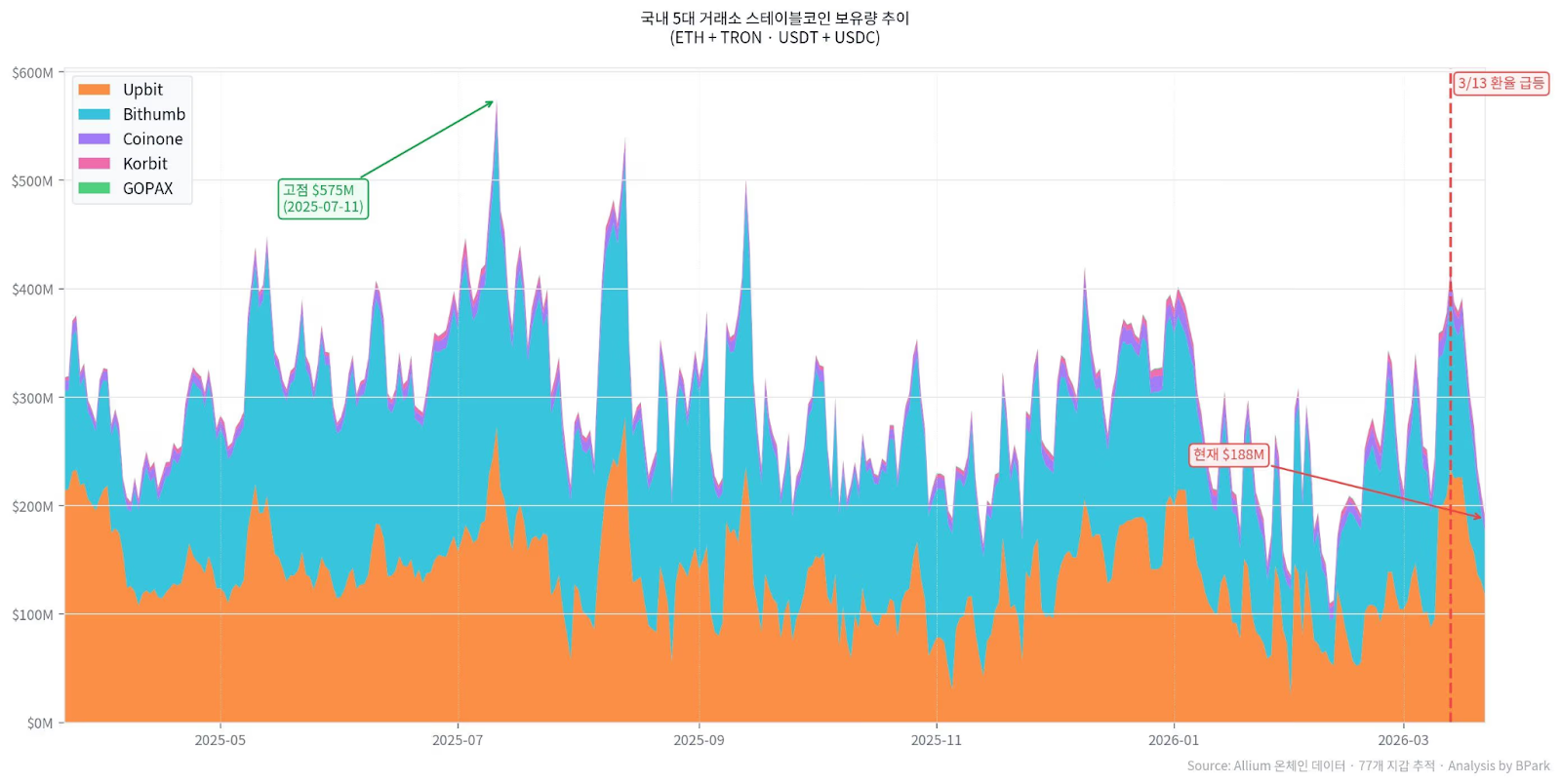
The depreciation of the won created a strong incentive for traders to exit stablecoin positions and convert holdings back into local currency. These funds were then redeployed into domestic assets, according to market observers.
Bradley Park, founder of DNTV Research, noted that the FX-driven move differs from earlier capital rotations, which were largely fueled by shifting narratives in crypto markets.
Instead of reacting to declining altcoin momentum, this latest outflow wave ties directly to macroeconomic conditions, particularly currency volatility.
Stocks Draw Capital as Government Incentives Kick In
The capital exiting crypto is not sitting idle. It is actively flowing into South Korea’s stock market, supported by government policies to boost domestic investment.
New “repatriation” programs offer up to 100% capital gains tax exemptions for investors who sell overseas assets and reinvest locally, further encouraging the shift.
This trend is reflected in falling brokerage deposits, a proxy for available buying power, which dropped from ₩131 trillion to ₩112 trillion in March, indicating active deployment into equities before stabilizing again.
KOSPI Rally Becomes a Magnet for Liquidity
South Korea’s benchmark index, the KOSPI, has emerged as a major destination for this capital. After gaining 75% in 2025, the index has surged another 37% this year, making it one of the best-performing major markets globally.
However, the rally is highly concentrated. Tech giants like Samsung Electronics and SK Hynix account for a significant share of market capitalization and projected profits, drawing both retail and institutional flows.
Regional Activity Holds Steady Despite Localized Shift
Despite the steep decline in stablecoin balances on Korean exchanges, broader activity across Asia remains resilient. Data from Artemis shows stablecoin transaction volumes have actually increased across the region over the past year.
This suggests the trend is not a regional pullback from crypto, but a localized capital rotation within South Korea.
South Korea has long been a key driver of retail-led crypto liquidity, often amplifying market cycles. The current outflows highlight the loss of one of crypto’s most active retail bases, at least temporarily.
Importantly, the capital hasn’t disappeared; it has simply moved into equities. That means a reversal could happen quickly. If the stock market rally falters, funds could rotate back into crypto markets just as rapidly as they exited.
Disclaimer: The information presented in this article is for informational and educational purposes only. The article does not constitute financial advice or advice of any kind. Coin Edition is not responsible for any losses incurred as a result of the utilization of content, products, or services mentioned. Readers are advised to exercise caution before taking any action related to the company.