
- Stablecoin market capitalization surpasses $307 billion as the sector exits niche status.
- Ripple policy director advocates central bank integration over regulatory resistance.
- Transaction volume reaches an all-time high of $33 trillion, driven by payment settlements.
Stablecoins have surpassed $300 billion in market value, signaling a shift from experimental tools to established financial infrastructure, according to data referenced by the Official Monetary and Financial Institutions Forum (OMFIF).
Ripple’s UK and Europe Policy Director Matthew Osborne highlighted the findings, arguing that central banks should integrate stablecoin momentum rather than resist it. He said the focus should be on channeling stablecoins into the regulated financial system to support stability and innovation.
Policy Framework Debate Intensifies at Scale Threshold
The $307 billion market capitalization places stablecoins at a scale demanding regulatory clarity, according to industry observers. Tokenized real-world assets have become one of the fastest-growing segments in crypto, while stablecoins continue to lead adoption metrics across on-chain finance. Analyst MANDO questioned which projects in this space warrant attention as the category expands.
Central bank digital currency development programs run parallel to stablecoin growth across multiple jurisdictions. The relationship between government-issued digital money and privately-issued stablecoins remains under debate among policymakers. Some policymakers view privately issued digital currencies as competition, while others see scope for complementary systems.
Transaction Volume Growth Driven by Settlement Activity
Stablecoin transactions reached $33 trillion, marking an all-time high according to analyst Ucan. USDC leads transaction volume among major stablecoins in the current period. The analyst questioned what drives this movement, noting the absence of speculation, NFT activity, or DeFi yield farming as primary catalysts.
“What’s actually growing is tangible: on-chain payments and settlements. Cheaper gas, more frequent transfers, smaller tickets, more addresses, and real user activity,” Ucan stated. The market decline masks infrastructure development occurring quietly through payment and settlement adoption.
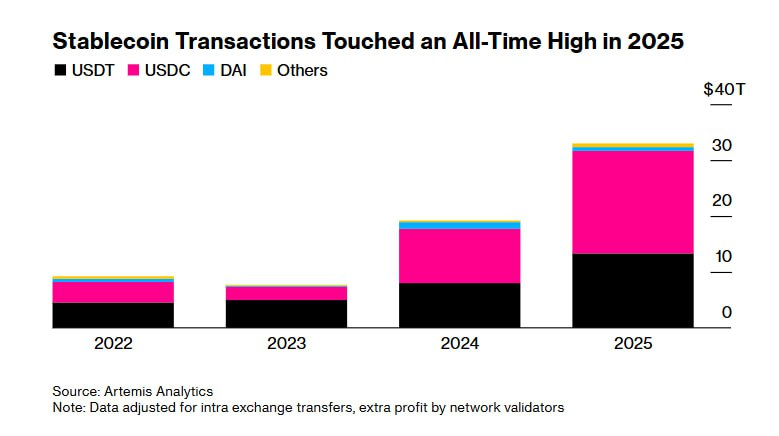
Stablecoins function as programmable cash rather than merely trading instruments or “crypto dollars,” according to this analysis. The flow patterns show genuine usage growth through payments and on-chain settlements rather than risk-aversion behavior. Lower transaction costs allow smaller-value transfers that were previously economically unviable.
The infrastructure layer supporting these transactions continues expanding despite broader market weakness. More frequent transfers, increased address activity, and smaller transaction sizes all point to retail and commercial adoption beyond speculative trading.
This usage pattern differs from previous cycles dominated by trading and yield-seeking behavior. The combination of policy discussion and usage metrics suggests stablecoins are crossing from the experimental phase to an established infrastructure requiring formal regulatory integration.
Related: Bermuda Plans to Move National Economy Onchain With Support From Coinbase and Circle
Disclaimer: The information presented in this article is for informational and educational purposes only. The article does not constitute financial advice or advice of any kind. Coin Edition is not responsible for any losses incurred as a result of the utilization of content, products, or services mentioned. Readers are advised to exercise caution before taking any action related to the company.