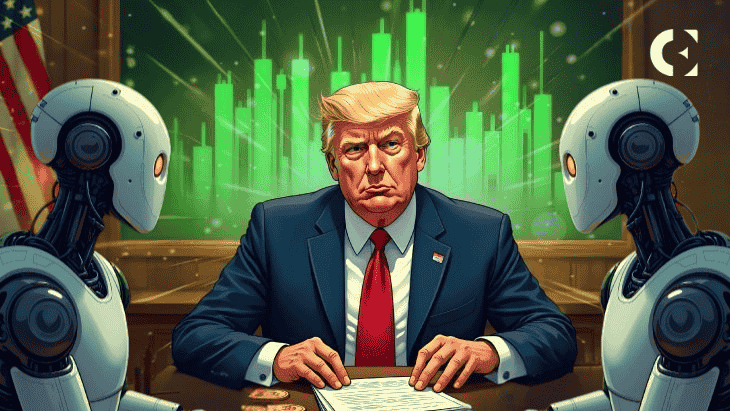
- Trump’s AI order sets a single federal rule, replacing conflicting state laws.
- Centralization favors big tech but boosts demand for decentralized AI solutions.
- Crypto tokens $ATH, $RNDR, $AKT, $TAO benefit from decentralized AI infrastructure.
President Donald Trump has signed an executive order to establish a single national rulebook for artificial intelligence, a move that could reshape how both Big Tech and blockchain-based AI projects operate in the United States.
The White House says the order is meant to prevent a growing mix of state laws from slowing innovation. More than 1,000 state-level AI bills have circulated, and tech firms have warned that dealing with separate rules in California, New York and Illinois is becoming unmanageable.
The new framework gives federal agencies the authority to challenge state rules they see as too restrictive. Trump said US companies should not have to “go to 50 different sources” to launch or update AI systems.
Related: U.S. Market Giant DTCC Gets Green Light to Put Stocks on Blockchain
Federal Preemption Raises Stakes for AI Infrastructure and Compute Markets
While the order directs to speed development, experts say it might strengthen the position of major cloud providers already dominating AI computers, including Amazon Web Services, Google Cloud and Microsoft Azure.
Crypto analysts warn that this concentration could make decentralized AI and crypto more relevant. Tokens like $ATH, $RNDR, $AKT, and $TAO could benefit as they support blockchain-based AI networks. These networks allow users to access computing power, train models, or provide data without relying on centralized providers.
AI x Crypto Expected to Grow as a 2026 Theme
The new policy could accelerate two trends at once: faster deployment of AI across the US and a parallel rise in decentralized AI networks designed to avoid central points of control.
Several analysts on crypto forums described the order as “a tailwind for Web3 AI,” arguing that every push toward federal centralization creates an opportunity for blockchain-based alternatives.
“When centralization accelerates this fast, decentralized alternatives become necessary infrastructure. Trump’s acceleration creates demand for alternatives and firms want hedges against monopolies, rate limits, or outages,” one analyst said.
They expect “AI x crypto” to become one of the major narratives of 2026 as both industries move toward larger infrastructure battles.
Related: CFTC CEO Council Zeros In On Crypto, Tokenization And 24/7 Markets
Disclaimer: The information presented in this article is for informational and educational purposes only. The article does not constitute financial advice or advice of any kind. Coin Edition is not responsible for any losses incurred as a result of the utilization of content, products, or services mentioned. Readers are advised to exercise caution before taking any action related to the company.