
- Zcash considers dynamic fees to replace static pricing as network usage and costs rise.
- New model uses median action fees, synthetic load, and priority lanes to manage demand.
- ZEC trades above $400 with higher volume, reflecting stronger activity during discussions.
Zcash developers have formally proposed a structural overhaul of the privacy network’s economic model, publishing a blueprint for a dynamic fee market designed to replace the legacy static pricing system. The move signals a strategic shift for the decade-old protocol, prioritizing spam resistance and economic sustainability as on-chain activity accelerates.
Related: Zcash’s 1,335% Rally in 5 Weeks: What is Behind the Latest Push?
Developers Revisit Fee Structure After Static Model Shows Limits
For most of its history, Zcash has relied on fixed fees, initially set at 10,000 zatoshi, later reduced to 1,000. The structure remained effective during lower-volume periods but contributed to “sandblasting” incidents where spam transactions clogged wallets and strained the chain.
ZIP-317 later introduced action-based accounting, assigning a uniform fee per transaction component to limit abuse. While that method aligned costs with activity, it kept fees predictable and low, offering no mechanism to adjust in periods of elevated load.
Proposal Introduces Comparables, Priority Lane, and Phased Rollout
The New Model: 50-Block Medians and Priority Lanes
The draft released by Shielded Labs outlines a stateless dynamic model that uses “comparables,” defined as the median fee per action over the previous 50 blocks. To prevent data gaps, the system incorporates synthetic transactions to ensure the fee baseline reflects a constant level of congestion.
The resulting median forms a standard fee that is grouped into powers-of-ten buckets to reduce linkability and limit information leakage. During periods of tension, users could opt into a temporary priority lane, priced at ten times the standard rate, providing a competitive option without requiring redesign of core protocol logic.
Phased Rollout and Consensus Strategy
Developers propose deploying the system in stages: first through off-chain monitoring, then as an optional wallet policy, and eventually, pending community approval, as a simple consensus update featuring expiry-height safeguards and defined fee buckets.
Additional ideas under discussion include referencing mining difficulty as a heuristic to estimate USD-aligned fee stability over longer periods.
ZEC Holds Above $400 as Market Activity Strengthens
Alongside the fee debate, ZEC continued its upward price movement. The asset was trading at $405.08 at the time of writing, representing a 3.39% increase over the prior 24 hours, with the market capitalization rising to $6.65 billion.
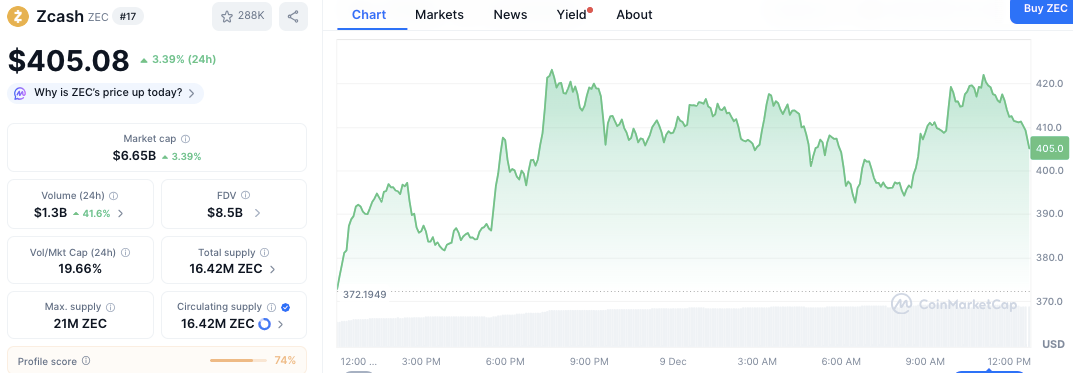
The trading volume reached $1.3 billion, a 4.6% increase, while the circulating supply remained at 16.42 million out of a total of 21 million.
Related: Zcash Extends Strong Breakout as Traders Track ZEC/BTC Momentum and Renewed Warnings
Disclaimer: The information presented in this article is for informational and educational purposes only. The article does not constitute financial advice or advice of any kind. Coin Edition is not responsible for any losses incurred as a result of the utilization of content, products, or services mentioned. Readers are advised to exercise caution before taking any action related to the company.