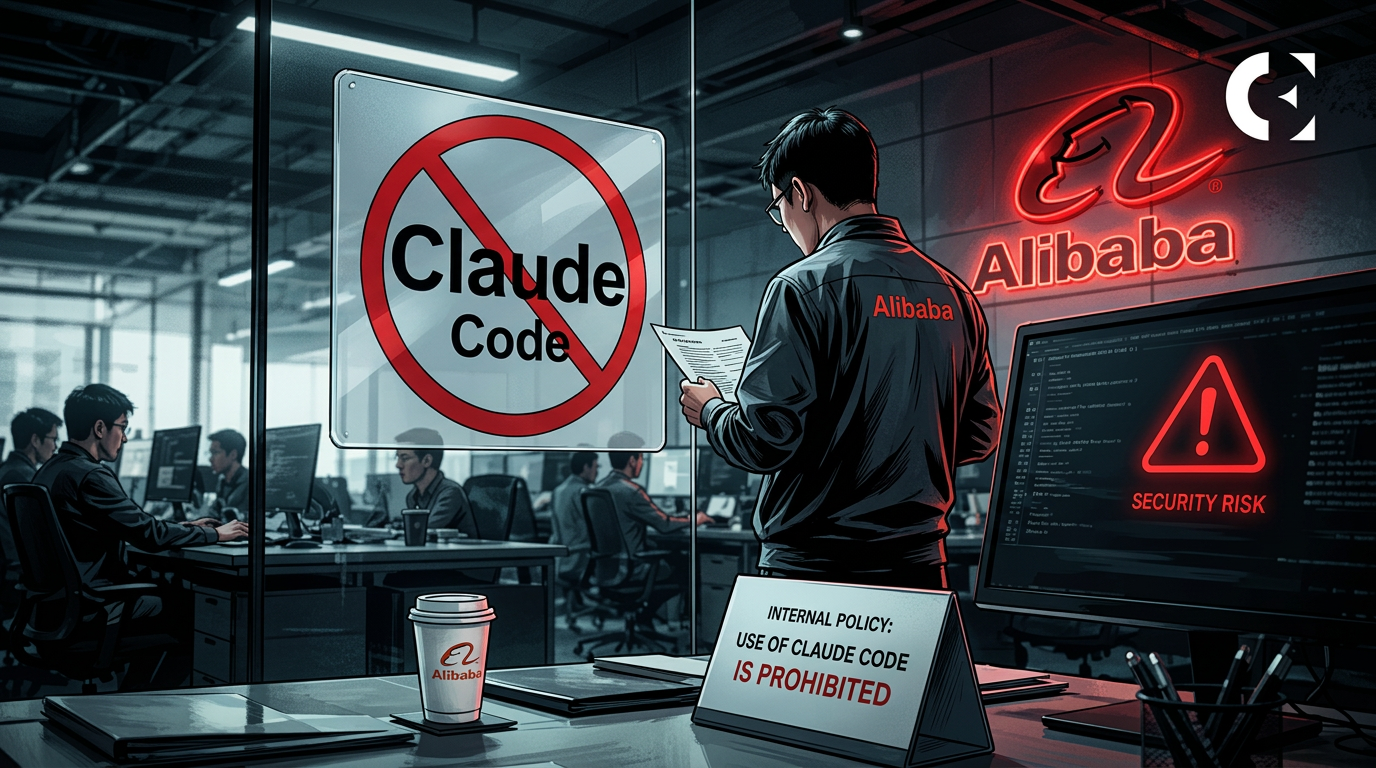

- Alibaba banned Claude Code after flagging security risks tied to hidden tracking tools.
- Anthropic accused Alibaba of using Claude outputs in a major AI distillation attack.
- The dispute shows rising compliance pressure around cross-border AI model access.
Alibaba Group Holding has moved to block employees from using Claude Code at work, escalating a dispute with Anthropic over security, access control, and AI model distillation. The ban follows internal concerns that the coding tool carried “backdoor risks” after developers identified hidden mechanisms linked to user environment checks.
In a Thursday internal notice seen by the South China Morning Post, Alibaba said Claude Code had been added to its high-risk software list after a security review. The company said office use would be prohibited from July 10, and employees were told to uninstall Anthropic models and agent products.
Claude Code Ban Follows Hidden Tracking Backlash
The decision came after developers said Claude Code inspected user environments, including timezone and proxy-related information. They also said the tool inserted subtle markers into prompts sent to Anthropic’s servers.
An Anthropic employee later wrote on X that the feature was an experiment launched in March. The employee added that it was designed to prevent account abuse by unauthorized resellers and protect against model distillation.
However, the disclosure triggered criticism as the mechanism appeared to monitor user settings without clear visibility. That concern became more sensitive given that Anthropic’s terms already restrict Chinese companies and other “adversarial nations” from using its models.
In response, Alibaba also directed employees toward its own AI assistant, Qoder. The move reflects a wider shift among Chinese cloud and AI firms toward domestic and open-source systems, including Qwen, DeepSeek, Moonshot, and Zhipu.
Anthropic Accusation Deepens AI Distillation Fight
The ban also followed Anthropic’s June letter to the U.S. Senate Committee on Banking, Housing, and Urban Affairs. In that letter, the company accused Alibaba of “brazenly” and “illicitly” attempting to extract its AI capabilities.
Per reports, Anthropic described the incident as the largest known distillation attack against it to date. The company said the effort involved training a weaker model on outputs from a stronger system.
According to the letter seen by Reuters, the alleged distillation would help accelerate China’s access to advanced Mythos Preview capabilities. The dispute therefore, places Claude Code inside a broader conflict over model protection, cross-border access, and enforcement limits.
A person familiar with the ban told Reuters that restrictions targeting China are difficult to enforce against individuals using U.S.-based servers. Even so, companies face clearer legal and compliance risks when using restricted AI tools at work.
Related: Alibaba AI Agent ROME Runs Unauthorized Crypto Mining During Training
Disclaimer: The information presented in this article is for informational and educational purposes only. The article does not constitute financial advice or advice of any kind. Coin Edition is not responsible for any losses incurred as a result of the utilization of content, products, or services mentioned. Readers are advised to exercise caution before taking any action related to the company.