



- Bitcoin is down roughly 25% in November 2026, heading toward December after losing key support levels.
- BTC’s Dec. path hinges on ETF flows, key technical levels, US jobs data, Fed policy, CPI, the dollar, and yields.
- The key focus now is what would support a December recovery, and what could keep Bitcoin under pressure.
Bitcoin (BTC) has plunged about 25% in November 2026 after hitting a two-year low of around $57,000, its lowest level since September 2024, amid a broad risk-off move.
However, with $2.4 billion in crypto futures liquidated, Bitcoin heads into December after losing key support levels, with BTC ETF flows, U.S. jobs data, Fed policy, Dec. 10 CPI, the dollar, and Treasury yields likely to shape its next move.
Is Bitcoin’s November Sell-Off Stabilizing or Could the Decline Extend Into December?
Bitcoin’s November 2026 downturn, which has erased 25%, marks one of its weakest monthly performances on record, shattering seasonal “Upvember” expectations as prices test two-year lows near $55,300.
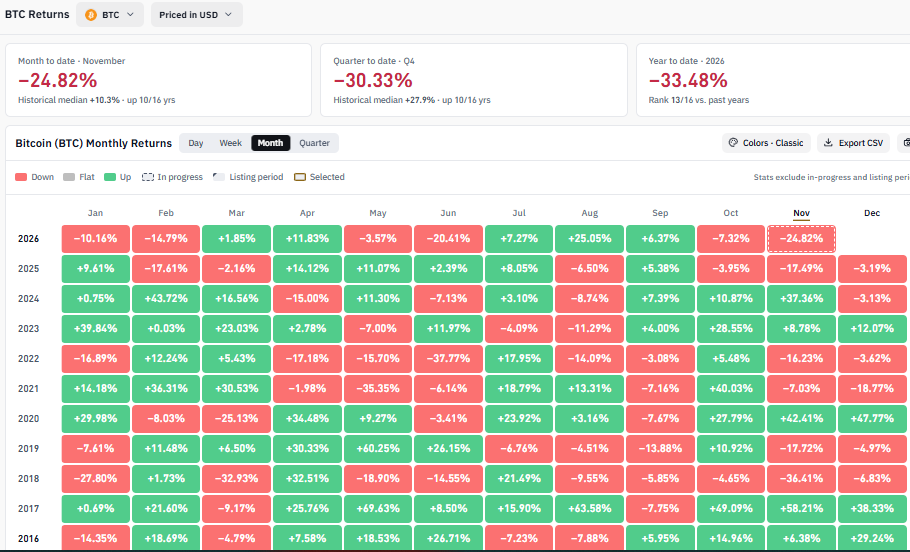
Early signs of a short-term stabilisation are emerging, propelled by deeply oversold technical indicators, a $2.4 billion derivative leverage flush, and spot buyer defense around the $55,000-$58,000 zone. But the possibility of an extended December decline is still high.
That said, Bitcoin remains at risk of further declines, as persistent selling from U.S. spot ETFs, close correlation with risk-off tech stocks, and broken long-term support levels leave it vulnerable to further downside.
Follow us on X for real-time crypto updates.
What Could Determine Bitcoin’s December Direction?
Several interlocking factors will likely shape Bitcoin’s path next month. Spot Bitcoin ETF flows are a leading indicator of institutional demand, as net outflows have persisted in November. For instance, on Nov. 20, there was a single-day net outflow of about $669 million, bringing cumulative monthly redemptions to approximately $4.1 billion. A shift to steady inflows would offer significant relief, while further outflows would add to the downside pressure.
Technically, Bitcoin must recapture its recently lost levels around $60,000-$62,000 to improve its near-term structure. A break below the $50,000 zone will result in a test of the lower supports.
Macro data will also be a critical factor. The U.S. Employment Situation report for November is due on December 4. Any easing in labour market conditions may ease rate concerns, while stronger data could hold policy expectations tight. The Federal Reserve’s December 8–9 FOMC meeting (rate decision and new projections on December 9) and the December 10 CPI release for November will further influence rate-path pricing.
In addition, the U.S. dollar and Treasury yield movements are still closely correlated with risk appetite. A stronger dollar or rising real yields have weighed on Bitcoin in recent weeks; any reversal could help stabilise or lift prices.
What Would Support a December Recovery, and What Could Keep BTC Under Pressure?
A December recovery will be backed by a decisive reversal in ETF flows into net inflows, a sustained reclaim of the $60,000 level, softer than anticipated labour outcomes and a Fed outcome that reduces the risk of further tightening. Easing dollar strength and declining yields would amplify any positive move.
Conversely, persistent ETF outflows, failure to recover key technical levels, firm labour or CPI data, a hawkish Fed, dollar strength, and higher Treasury yields could keep BTC under pressure.
Subscribe to our YouTube channel for the latest crypto news.
Related: Bitcoin Price Prediction: Why Benjamin Cowen Sees Risk Below $54,000
Disclaimer: The information presented in this article is for informational and educational purposes only. The article does not constitute financial advice or advice of any kind. Coin Edition is not responsible for any losses incurred as a result of the utilization of content, products, or services mentioned. Readers are advised to exercise caution before taking any action related to the company.