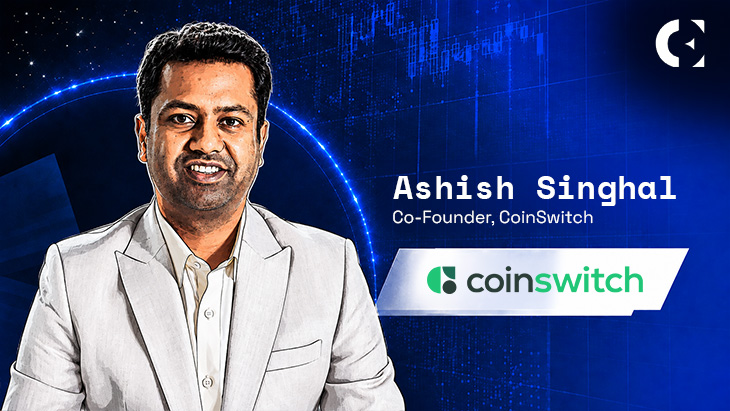

CoinEdition spoke with Ashish Singhal, Co-Founder of CoinSwitch, ahead of CoinFest Asia 2026 to discuss the future of crypto adoption in India and Asia. In this interview, Singhal outlines what regulatory clarity could unlock, how investor behavior is evolving, and why the convergence of crypto, AI, and financial infrastructure may define the next phase of the industry.
1. India has emerged as one of the world’s largest crypto adoption markets despite regulatory uncertainty. What do you think is the single biggest policy or infrastructure change that could unlock the next 100 million Indian crypto investors?
The single biggest change would be regulatory clarity, particularly around the classification of digital assets, who would regulate them, and how. Clear rules can give users greater confidence while enabling businesses to build responsibly and invest for the long term. It would also create a standardized and level playing field for all participants, with clear accountability and consistent expectations around consumer protection, disclosures, custody, and compliance. When the rules are clear and applied consistently, businesses can innovate with greater confidence and users can participate with greater trust.
2. With global markets increasingly reacting to geopolitical events—from U.S.–China tensions to conflicts affecting energy and trade—how should crypto investors think about Bitcoin and digital assets today: as a risk asset, a hedge, or something entirely different?
Bitcoin today is best viewed as a distinct macro asset, rather than simply a risk asset or a safe haven. During sudden geopolitical shocks, it can behave like a risk asset as investors move towards liquidity and reduce exposure to volatility. Over a longer horizon, however, its global accessibility, limited supply and independence from any single sovereign make it relevant as a diversification asset. For investors, the key is to look beyond the headline event and track its impact on liquidity, interest rates, inflation and risk appetite. Bitcoin’s role is evolving, and investors should approach it with a long-term, diversified perspective.
3. AI is rapidly transforming financial services. How do you see AI changing the way retail investors discover opportunities, manage risk, and build long-term wealth over the next five years?
Over the next five years, AI will make investing more personalized, contextual, and disciplined. It can help retail investors cut through information overload, identify opportunities aligned with their goals and risk appetite, and better understand what is driving market movements. AI can also strengthen risk management by identifying portfolio concentration, behavioral biases, and patterns such as overtrading or chasing momentum. The real opportunity is not for AI to tell investors what to buy, but to help them make better-informed decisions and stay disciplined through market cycles. Ultimately, AI should augment investor judgment, not replace it, while making sophisticated financial intelligence accessible to more Indians.
4. Many retail investors entered crypto during the bull market, experienced a downturn, and are now returning with more caution. What has fundamentally changed in the Indian investor mindset since the last major crypto cycle?
Every crypto cycle creates a new generation of investors, while those who entered in the previous cycle become more experienced and measured. Investors who went through the last downturn have seen firsthand how volatility works and are now approaching the asset class with greater awareness around risk, security, taxation, and portfolio allocation. At the same time, newer investors are experimenting with crypto, and their understanding will evolve as they experience different market cycles. This is a natural maturation process. With every cycle, the investor base becomes more informed, expectations become more realistic, and participation gradually shifts from speculation towards more thoughtful, long-term investing.
5. Tokenized real-world assets and on-chain financial infrastructure are gaining global momentum. Which of these trends do you believe will have the biggest impact on emerging markets such as India and Southeast Asia?
For markets like India and Southeast Asia, tokenized bonds, funds, commodities, and private credit can broaden access, improve liquidity, and enable faster, programmable settlement. The real opportunity is to connect these assets with robust digital identity, payments, and compliance rails already being built across the region. Over time, this could make capital markets more accessible and interoperable across borders. The winners will be markets that combine blockchain’s efficiency with strong regulatory frameworks, investor protection and trusted settlement infrastructure. That is where tokenization can move from experimentation to meaningful economic impact.
6. As someone building both CoinSwitch and Lemonn, how do you think traditional investing and crypto investing will converge? Will the future investor even distinguish between stocks, crypto, and tokenized assets?
As investing evolves, the lines between traditional assets and digital assets will increasingly blur. The future investor is unlikely to think in silos of stocks, crypto, or tokenized assets; they will think in terms of goals, risk, and returns, and choose the right asset for each need. We’re already seeing this convergence through products, technology, and changing investor behavior. Tokenization could further accelerate it by making traditionally illiquid assets more accessible and programmable. Ultimately, the winning platforms will be those that give investors a seamless, trusted experience across asset classes, while helping them understand the risks and opportunities unique to each.
7. CoinFest Asia brings together builders from across Asia, where regulation varies dramatically from country to country. Do you believe Asia can become the global center of Web3 innovation, and what role should India play in that ecosystem?
Asia has the opportunity to become the global engine of Web3 innovation because it combines deep technical talent, entrepreneurial ambition, and some of the world’s most digitally active populations. While regulatory approaches differ, that diversity can help shape more nuanced, innovation-friendly frameworks. India has a particularly important role to play. With its strong technology ecosystem, digital public infrastructure, and large, young investor base, India can help bridge Web3 innovation with responsible mainstream adoption.
The priority should be clear, consistent regulation that protects users while giving builders room to experiment, scale, and create globally relevant products. The opportunity now is to encourage more talent to build from India for the world. India has already shown that technology built here can reach population scale. The next step is to bring that ambition to Web3, particularly across financial infrastructure, tokenization, and digital ownership, where products can be designed for global markets from day one.
8. If you were speaking directly to founders and investors attending CoinFest Asia Bali 2026, what is the one trend in crypto, fintech, or AI that you believe is still being underestimated by the market today?
The most underestimated trend is the convergence of crypto, AI, and financial infrastructure. We’re moving from crypto as an asset class to crypto as programmable financial infrastructure, while AI is making financial products more intelligent, personalized, and accessible. The real opportunity lies at this intersection, where AI agents can transact, crypto enables machine-to-machine payments, and financial services become embedded into everyday digital experiences. Markets often focus on the next token or model, but the bigger shift is structural: who owns the rails through which autonomous systems transact and exchange value. Founders building for that future could define the next generation of financial infrastructure.
Disclaimer: The information presented in this article is for informational and educational purposes only. The article does not constitute financial advice or advice of any kind. Coin Edition is not responsible for any losses incurred as a result of the utilization of content, products, or services mentioned. Readers are advised to exercise caution before taking any action related to the company.