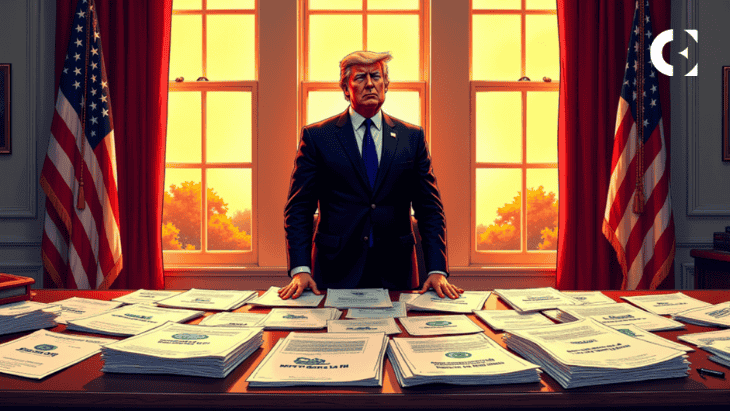

- Trump will host top mining executives to secure critical mineral supplies for the US.
- Critical minerals power advanced weapons, AI, electric cars, and crypto hardware.
- As demand rises, we may see more domestic mining and more supply chain alliances.
US President Donald Trump is set to host a meeting with top mining company leaders at the State Department on August 7 to discuss securing supplies of critical minerals for the United States and its allies.
Companies on the reported attendee list include Rio Tinto, BHP, Freeport-McMoRan, MP Materials, and Energy Fuels. The administration is said to be preparing announcements on supply pacts and memoranda of understanding (MOUs).
Why Critical Minerals Have Become So Important
For many years, rare earths and specialty minerals were seen as industrial commodities.
Today, they’re essential components to everything from advanced weapons and AI to electric cars, renewables, telecommunications networks, and even crypto mining hardware.
The worry is that the world relies too much on a handful of countries for these materials, especially China, which controls most rare earth processing.
Then, the AI boom is also fueling demand.
Massive AI systems need tons of computing power, including GPUs, accelerators, servers, networking gear, and data centers. All of that hardware depends on specialized materials.
Crypto mining is often discussed in terms of software or electricity, but the hardware side relies on the same global supply of specialty minerals.
For instance, Bitcoin mining runs mostly on ASICs (Application-Specific Integrated Circuits), and making these machines requires advanced semiconductor tech and specialty metals. The chips inside ASIC miners rely on many of the same supply chains that go into making AI processors.
With GPU miners, it’s similar because companies producing AI chips and GPUs are already facing huge demand, meaning crypto miners increasingly compete indirectly with AI companies for hardware supply.
Additionally, modern military systems depend on specialized minerals, especially rare earths. They’re used in a wide range of military hardware, from smart missiles and fighter jets to radar and sensors.
How Geopolitical Competition Could Reshape Supply Chains
China currently holds a strong hand in rare earth processing and supply chains for several key minerals.
When you also take huge demand into account and the fact that a country might have the mines but still depend on someone else to refine materials and turn them into components, we may see increased domestic mining, more supply chain alliances, and overall, larger government involvement.
If that happens and more competition surfaces, it could end up pushing prices higher for AI data centers, crypto mining sites, chipmaking plants, and consumer gadgets. Also, if mineral supplies tighten up, companies could see hardware prices go up and longer waits for equipment.
Related: Trump Warns US Cannot Lose Crypto and AI Race to China
Disclaimer: The information presented in this article is for informational and educational purposes only. The article does not constitute financial advice or advice of any kind. Coin Edition is not responsible for any losses incurred as a result of the utilization of content, products, or services mentioned. Readers are advised to exercise caution before taking any action related to the company.