

- Eastern Europe’s crypto economy fell 7.9% to $642.1 billion despite growing retail activity.
- Retail transfers below $10,000 increased 8.3%, while domestic P2P volume surged 330%.
- Poland and Romania drove 92% of Eastern Europe’s crypto ATM growth.
Eastern Europe’s crypto economy contracted even as everyday use expanded, pointing to a shift in how people access digital assets rather than a uniform retreat. In its November 17 report, Chainalysis put the region’s crypto economy at $642.1 billion for the year ending June 2026, down 7.9% from $697.1 billion. The decline exceeded the global 1.6% contraction, but retail transfers, stablecoin remittances, and cash-based services moved in the opposite direction.
The contraction was concentrated in larger transfers, while smaller users continued to rely on crypto for payments, cross-border support, and cash access.
Retail Transfers Hold Up as Large Flows Fall
Transfers below $10,000 made up 13.1% of Eastern Europe’s crypto service flows, above the 10.1% global average. Their value increased 8.3%, while transfers of $10,000 or more fell from $591.5 billion to $488.6 billion. Domestic peer-to-peer volume also climbed 330%.
The figures show why a shrinking regional total does not necessarily mean everyday crypto use is fading. Activity became more retail-weighted as high-value transfers declined.
Ukraine’s Diaspora Shapes Stablecoin Routes
Cross-border wallet-to-wallet stablecoin remittances into Ukraine reached $12 billion during the period. Ukraine was the leading destination for retail stablecoin P2P transfers from 16 of 21 nearby markets with at least $5 million in outbound activity. The median market sent 27.7% of its outbound retail stablecoin P2P value to Ukraine.
Countries with larger Ukrainian populations generally sent more crypto to Ukraine. Moldova directed nearly 45% of its cross-border wallet transfers there, linking crypto activity to displacement and family support.
Follow us on X for real-time crypto updates.
Poland’s Crypto ATM Boom Meets MiCA Uncertainty
Eastern Europe’s cash-heavy crypto services grew 1.5%, against a 25.6% global decline. ATM value nearly doubled from $17.3 million to $33.9 million, with Poland and Romania accounting for 92% of the increase. Poland represented about 39% of regional ATM value; 90% of its ATM transactions involved stablecoins.
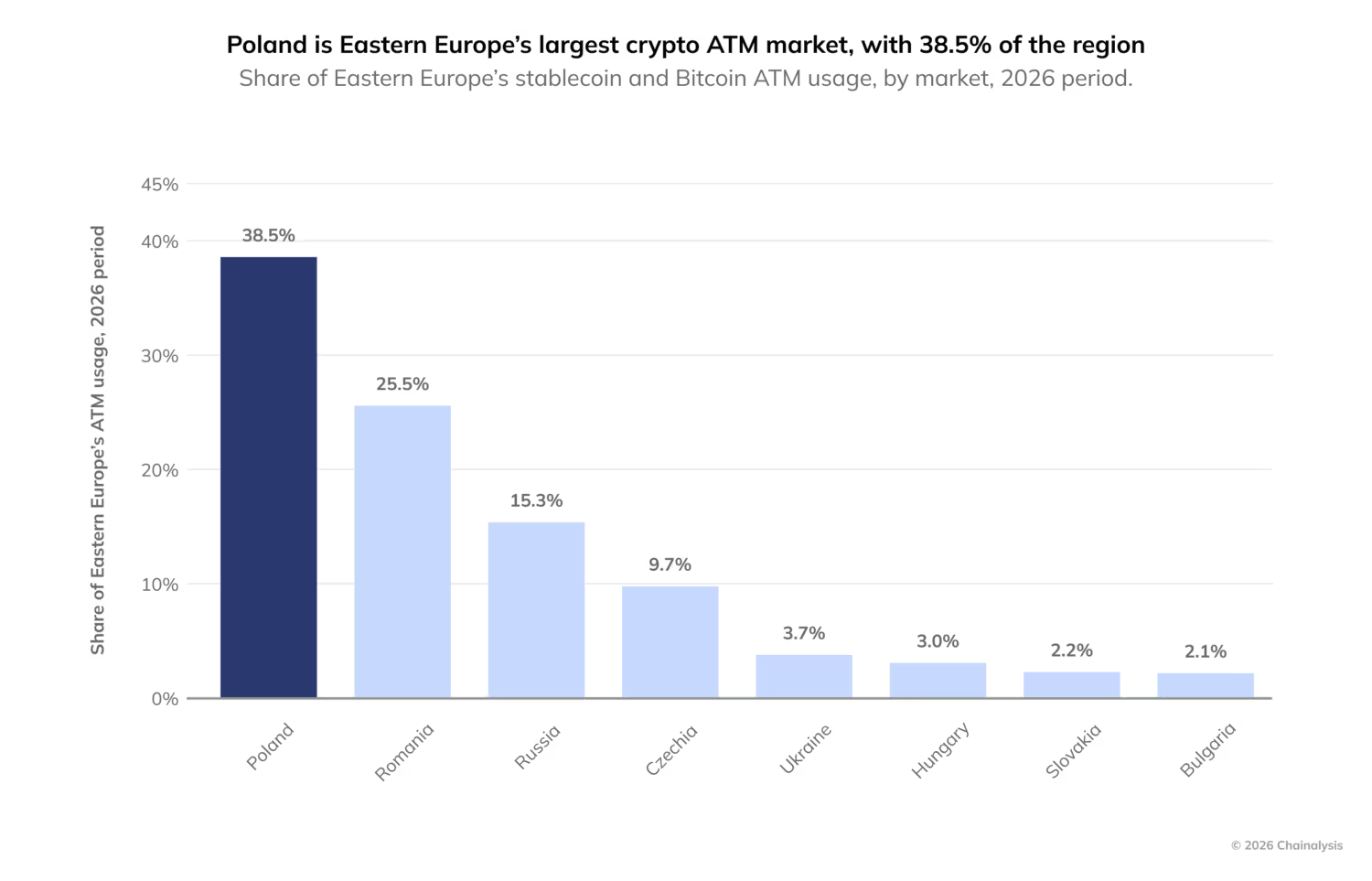
Polish ATM transactions rose 120% as centralized-exchange activity fell 5%. The growth coincided with MiCA uncertainty: as of October 2026, Poland had not designated a national competent authority. Since the EU transition ended July 1, legacy VASP registration alone no longer authorized regulated crypto services. ATMs remain subject to MiCA and anti-money laundering rules.
Romania’s Tax Change Coincided With a Trading Shift
After Romania announced in July 2025 that the tax on individual crypto gains would rise from 10% to 16%, instant-exchange activity increased 59%, from $26.4 million to $41.8 million. About 60% of the period’s instant-exchange volume arrived between July and December 2025.
Use of exchange alternatives rose above the regional average in the two quarters after the announcement, then returned toward the mean after the higher rate took effect in January 2026. The timing suggests users adjusted their routes around the policy change, although the data alone cannot prove the tax increase caused the shift.
Eastern Europe’s downturn therefore masks a change in usage. Larger transfers were contracted, but retail payments, remittances, and cash access remained active. The region’s crypto market is adapting to local financial needs even as its overall value declines.
FAQs
It fell 7.9% to $642.1 billion in the year ending June 2026, compared with $697.1 billion in the previous period.
Cross-border wallet-to-wallet stablecoin remittances reached $12 billion during the period Chainalysis studied.
Polish ATM transactions grew 120% as centralized-exchange activity declined 5%. The increase coincided with uncertainty over the country’s MiCA implementation.
Subscribe to our YouTube channel for the latest crypto news.
Related: Hyperliquid Urges UK to Shield Blockchain Developers From Crypto Rules
Disclaimer: The information presented in this article is for informational and educational purposes only. The article does not constitute financial advice or advice of any kind. Coin Edition is not responsible for any losses incurred as a result of the utilization of content, products, or services mentioned. Readers are advised to exercise caution before taking any action related to the company.