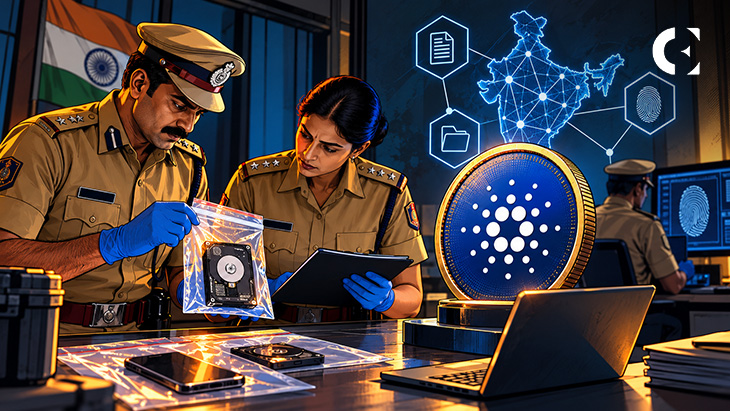

- Uttar Pradesh Police use Cardano to track forensic evidence.
- The system uses blockchain records to help detect data tampering.
- The project highlights Cardano’s potential in government services beyond crypto.
The Cardano blockchain is finding its way into India beyond crypto and payments. Uttar Pradesh police are using the technology to track forensic evidence and protect its handling records from tampering. This approach puts the focus on data integrity rather than crypto, highlighting how blockchain could be used to improve government systems.
Uttar Pradesh Police Use Cardano to Track Forensic Evidence
Cardano Foundation took to X to share details of the blockchain network’s new milestone. According to the X post, the Indian police are exploring the blockchain to improve tracking forensic evidence during criminal investigations.
As noted by Cardano, the system helps record the movement of evidence and keeps track of who handles it at different stages. This procedure is important as investigators must show that evidence has been properly managed and its records are trustworthy.
Notably, the system is called the Forensic Management System (FMS). It was developed by TrivolveTech with Quixy. The system uses blockchain to help protect the digital records linked to evidence handling. Thus, the system uses Cardano beyond crypto payments or token transfers and focuses on maintaining a reliable record of forensic evidence.
How Cardano Helps Protect Forensic Records
Cardano’s forensic system uses separate identifiers to track people involved in handling forensic evidence. This helps maintain a clear record of who accessed or transferred the evidence at each stage. This also limits direct links between different records, adding another layer of privacy.
Also, the system uses cryptographic hashes to protect digital records. A hash works like a digital fingerprint created from available information. When an officer records an evidence transfer, the system can later use this to check whether the information has changed. The record on the Cardano blockchain could be verified independently.
However, it is important to mention that the blockchain cannot guarantee that evidence was collected correctly or prevent every form of tampering. The main role of the system is to make changes to recorded information easier to detect and improve accountability throughout the evidence-handling process.
The police are expected to continue using a regular digital application. At the same time, Cardano works in the background. Sensitive evidence details are not simply published on the public blockchain. Instead, the system uses blockchain records to support verification and accountability.
Does This Show a More Practical Path for Blockchain Adoption?
Interestingly, the Indian police show how blockchain could be used without involving crypto. The latest development is one of the biggest examples that government departments can use the technology to improve recordkeeping, verify information, and make their processes more transparent.
Crypto exchange Binance has also helped Indian investigators to track crypto-related criminal activities multiple times. This also shows that governments are using blockchain technology to make their investigations easier.
Similar systems could also be used for land records, court documents, government certificates, and supply chain tracking. However, blockchain is not the only way to secure digital records. Its value depends on whether it offers better verification, accountability, and security.
(adsbygoogle = window.adsbygoogle || []).push({});What This Means for Cardano and Its Adoption in India
Significantly, the Uttar Pradesh police’s use of Cardano is a major milestone for the blockchain platform. It could give Cardano another real-world use case beyond crypto transfers. The move shows that the blockchain can support public services. It expands beyond the adoption of its native cryptocurrency, ADA.
However, wider ADA adoption in the country depends on practical results, including data security, operating costs, ease of use, and the ability to work with existing government systems.
Related: India’s ED Tracks Crypto Trail in International Drug Hawala Network
Disclaimer: The information presented in this article is for informational and educational purposes only. The article does not constitute financial advice or advice of any kind. Coin Edition is not responsible for any losses incurred as a result of the utilization of content, products, or services mentioned. Readers are advised to exercise caution before taking any action related to the company.