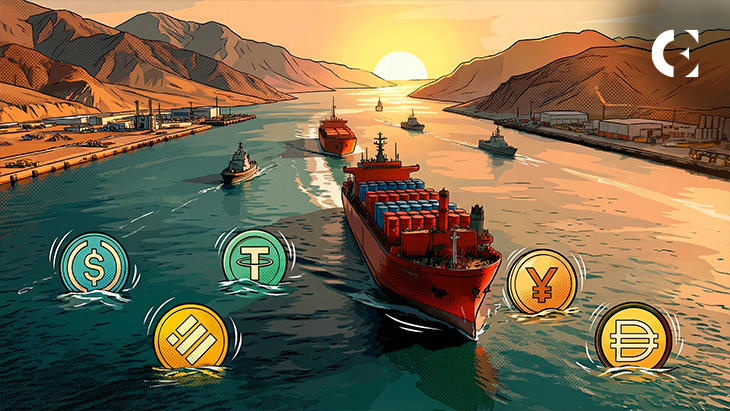

- Iran codified Hormuz tolls, with reports saying Bitcoin may be one payment option.
- On-chain data has not shown Bitcoin moving at the scale needed for tanker tolls.
- Polymarket priced a 62% chance of a permanent U.S.-Iran deal by May 31.
Iran’s parliament has codified a toll system for the Strait of Hormuz, and reports claim Bitcoin is among the payment options. The development has drawn attention because the waterway carries about 21 million barrels of oil a day, or nearly one-fifth of global supply.
Iran Formalizes Hormuz Tolls as BTC Claim Fades
The new law, called the Strait of Hormuz Management Plan, was approved on March 30, 2026. It formalized a transit fee system that the Islamic Revolutionary Guard Corps had reportedly been operating since mid-March.
The plan applies to vessels seeking safe passage through the chokepoint. Reported fees are near $1 per barrel, which means a fully loaded supertanker could face a toll of about $2 million.
At the upper end, daily collections from oil tankers alone could reach $20 million. That has raised fresh focus on how such payments are being settled.
Early Western coverage said the toll system used Chinese yuan and stablecoins. A later account added Bitcoin to the list, citing a spokesperson for Iran’s Oil, Gas, and Petrochemical Products Exporters’ Union.
That Bitcoin claim has received much of the attention. However, the broader account also noted that on-chain data has not shown Bitcoin moving at the scale needed to settle repeated tanker tolls.
The discussion pointed instead to a more established role for stablecoins in Iran-linked crypto activity. The report said the main settlement layer in these flows has been USDT on Tron rather than Bitcoin.
Iran Mining Growth, Crypto Pressure, and Deal Odds
Iran has used digital assets as a sanctions workaround since 2018, after the U.S. withdrawal from the nuclear deal cut Tehran off from dollar settlement. In 2019, parliament legalized industrial Bitcoin mining, opening another route for the country to build digital asset reserves.
At one point, Iran accounted for as much as 4.2% of the global hash rate, according to the report. It also said U.S. and Israeli strikes later knocked most of its 427,000 mining devices offline.
State mining reportedly produced Bitcoin at an all-in cost of nearly $1,300 per coin. That gave Iran a way to build value outside the traditional financial system while offsetting oil-revenue pressure.
At the same time, enforcement pressure increased. After OFAC’s September 2022 designations of IRGC-linked cyber operators, U.S. authorities also targeted offshore exchange activity linked to the IRGC.
The report said IRGC-linked flows through UK-registered exchanges rose from $24 million in 2023 to $619 million in 2024. It added that TRM Labs attributed about $3 billion in total IRGC crypto activity since 2023.
The report also noted that Bitcoin holds a different position from stablecoins because it has no issuer and no intermediary that could freeze balances. That feature has kept Bitcoin in focus even as stablecoins appear to handle more of the transactional flow.
Meanwhile, prediction market platform Polymarket showed that traders were assigning a 62% chance to a permanent U.S.-Iran peace deal being reached by May 31, 2026.
Related: US Oil Falls Below $94 as Bitcoin Tops $76K Amid Iran-US Talk Optimism
Disclaimer: The information presented in this article is for informational and educational purposes only. The article does not constitute financial advice or advice of any kind. Coin Edition is not responsible for any losses incurred as a result of the utilization of content, products, or services mentioned. Readers are advised to exercise caution before taking any action related to the company.