

- Nvidia-linked perpetual futures have plunged nearly 9% in after-hours trading on Hyperliquid.
- Traders react to reports that the board is planning to remove CEO Jensen Huang over a second affair.
- The key question now is whether Hyperliquid is becoming an overnight price-discovery venue for US equities.
As of November 12, 2026, NVIDIA Corp. (NVDA) perpetual futures have fallen approximately 9% on Hyperliquid as traders react to reports that the company’s board is considering replacing Chief Executive Officer (CEO) Jensen Huang.
The uncertainty follows revelations on November 8, when Huang admitted to having a second extramarital affair.
Why Are Nvidia Perpetual Futures Down Nearly 9% on Hyperliquid?
Nvidia perpetual futures on Hyperliquid, mainly the xyz: NVDA contract, settled in USDC, have plunged about 9% to 161.21 as traders react to news that the firm is actively discussing replacing its longtime CEO, Jensen Huang.
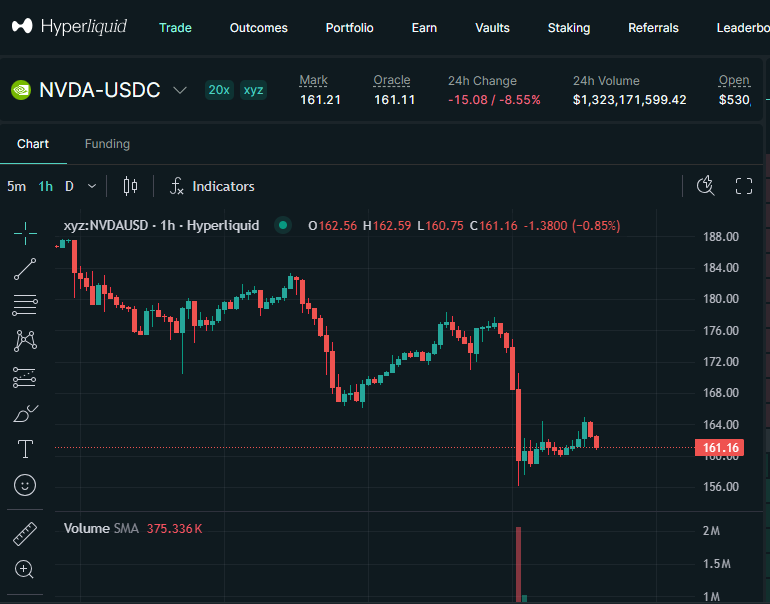
According to multiple sources, the panic follows reports that Huang allegedly had a second relationship with Kimberly Powell, an Nvidia vice president. The CEO is already under scrutiny after reports of an affair with a different woman who was allegedly working as a spy for China, with the board hiring a law firm to investigate.
Meanwhile, before the overnight futures slide, NVIDIA’s stock had already tumbled roughly 10% over two trading sessions after the initial scandal and is down 20% to 30% from its early October 2026 all-time high.
Prediction markets are also reflecting the uncertainty, with odds of Huang being axed rising sharply. On Polymarket, Jensen Huang’s departure is becoming the base case, with a 59% probability that Huang announces his resignation or removal by TODAY.
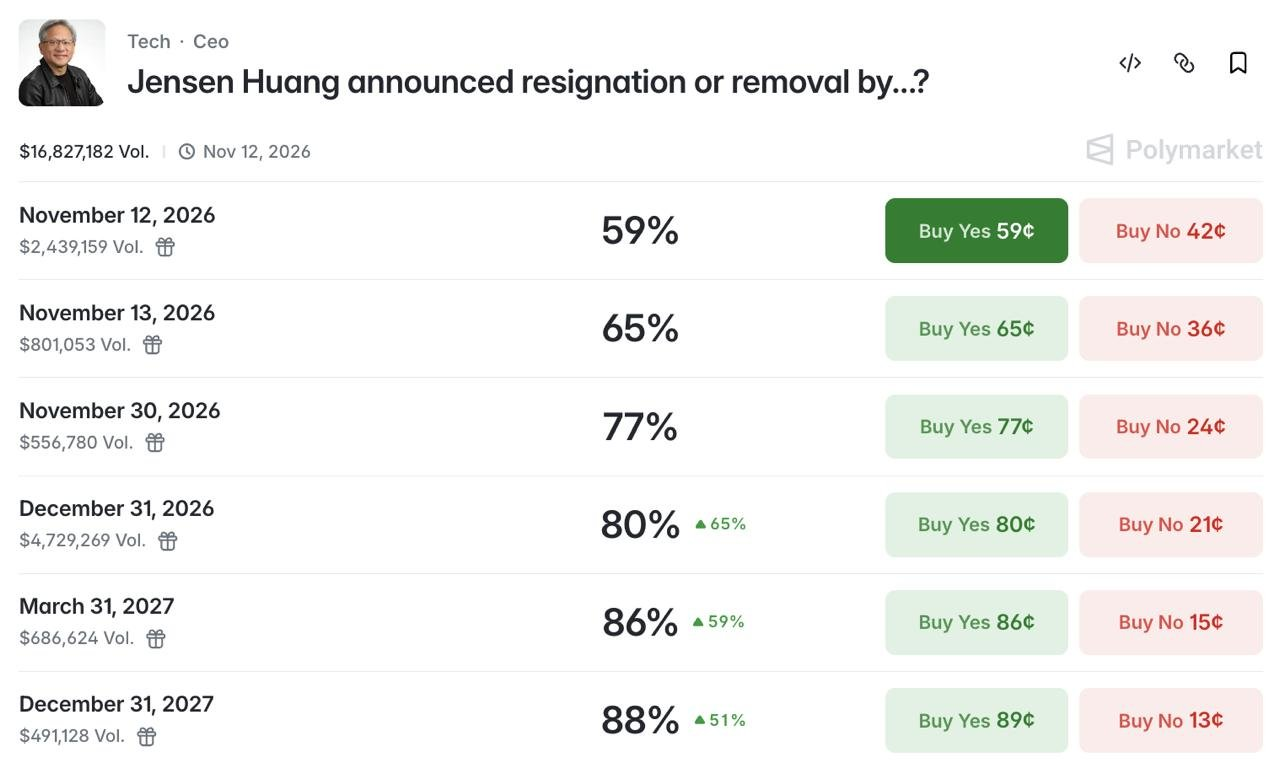
However, Huang, who co-founded Nvidia in 1993 and has led it since, has no clear public successor. That said, the market reaction indicates investor fears over key-man risk at the leading AI chip supplier.
Follow us on X for real-time crypto updates.
Is Hyperliquid Evolving Into an Overnight Price-Discovery Venue for US Equities?
This episode is a clear example of the decentralized perpetuals acting as a 24/7, continuous price-discovery platform for major U.S. equities during periods of market closure or restrictions. Hyperliquid’s XYZ: NVDA contract is a continuous trading contract that settles in USDC, providing leveraged exposure without actually owning the underlying shares.
When the Huang scandal intensified over the November 8–9 weekend, Nvidia perpetual futures began moving lower on Sunday afternoon (US time), hours before pre-market equity trading and the regular Nasdaq session. Trading volume jumped as traders priced in the board investigation and the national-security allegations.
Later, after news of a potential ouster, the same contracts reacted immediately in after-hours and overnight sessions, following the same trend as after-hours equity trading and tokenized stock products. This trend shows that continuous trading, leverage, and global crypto-native capital enable decentralized venues to price corporate news outside official equity market hours.
Does Thin Liquidity Magnify Nvidia’s Price Move?
High available leverage and relatively thin liquidity appear to amplify price movements in Hyperliquid’s contracts compared with the deep cash equity market. Despite XYZ: NVDA registering high trading volume, its open interest and resting book depth are low compared to the institutional liquidity in Nasdaq-traded Nvidia shares.
Furthermore, leverage of up to 20x also increases liquidation risks. As a result, when concentrated selling occurs, cascading liquidations and thinner order books outside normal US trading hours can generate bigger percentage moves in response to corporate news.
Subscribe to our YouTube channel for the latest crypto news.
Related: Nvidia Board Reportedly Considers Removing CEO Jensen Huang
Disclaimer: The information presented in this article is for informational and educational purposes only. The article does not constitute financial advice or advice of any kind. Coin Edition is not responsible for any losses incurred as a result of the utilization of content, products, or services mentioned. Readers are advised to exercise caution before taking any action related to the company.