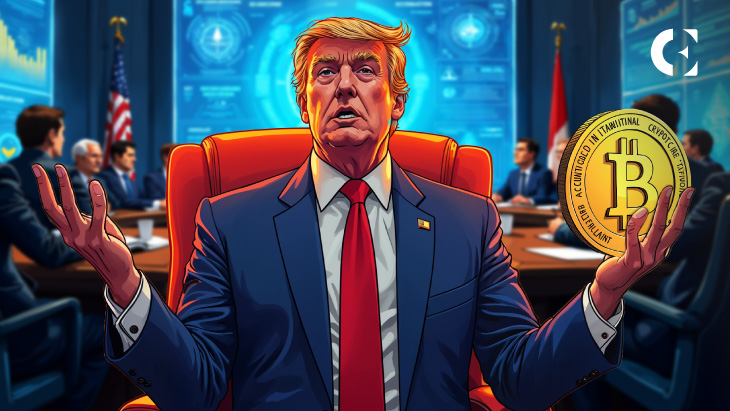

- President Donald Trump signed an executive order on advanced AI innovation and security.
- The order directs agencies to strengthen cyber defenses across national security and civilian systems.
- Healthcare AI use is rising quickly, while clinicians remain concerned about deskilling and errors.
President Donald Trump has signed an executive order aimed at promoting advanced artificial intelligence innovation and security across the United States. The order directs federal agencies to strengthen cyber defenses, work with AI developers, and protect American technology from criminal actors and foreign threats.
Of note, the move comes as AI investment and adoption accelerate across several sectors. Market attention remains focused on AI infrastructure spending, while healthcare providers are increasing AI use even as they raise concerns about clinical deskilling and inaccurate outputs.
AI Order Targets Cyber Defense
The White House order frames AI as both an economic driver and a national security priority. It says the United States will promote AI innovation by working with the private sector to modernize government and private-sector systems while hardening them against external threats.
Under the order, the Committee on National Security Systems must prioritize cyber defense for national security systems within 30 days. The Secretary of War must also move quickly to strengthen defense information systems.
Meanwhile, the Department of Homeland Security, through CISA, must issue guidance to improve cyber defense across civilian federal systems. The order also calls for expanded access to AI-enabled cybersecurity tools for agencies, state and local authorities, and critical infrastructure operators such as rural hospitals, community banks, and local utilities.
Related: AFI Pauses afiUSD Vault After $480K Mainnet Exploit
Frontier Models Face Security Review
The order also directs federal agencies to create a classified benchmarking process for advanced AI models. This process will help determine when an AI system should be treated as a “covered frontier model” under the order.
Additionally, the Treasury, NSA, CISA, and other agencies must design a voluntary framework with AI developers. The framework would allow developers to work with the federal government before releasing covered frontier models to trusted partners.
However, the order says it does not create mandatory licensing, preclearance, or permitting requirements for AI model development, publication, release, or distribution. That provision keeps the framework voluntary while giving agencies a path to assess high-end cyber capabilities.
The Attorney General must also prioritize enforcement against people who use AI to illegally access, damage, or breach computer systems. That includes cases involving AI agents used to obtain data for criminal purposes.
Related: Polymarket Raises Netanyahu Exit Odds After Reported Trump Call
AI Adoption Adds Urgency
The order arrives as investors continue to track AI infrastructure growth. A Fox Business segment highlighted strong market interest in companies tied to AI servers and NVIDIA-linked infrastructure. The discussion noted that Hewlett Packard Enterprise gained after a strong earnings beat, while Marvell also rose after bullish commentary tied to AI demand.
Healthcare also shows how quickly AI is moving into daily work. A Wolters Kluwer Health survey found that nearly three-quarters of doctors and 70% of nurses now use AI at least once a week. Last year, 38% of doctors and 46% of nurses reported weekly use.
Even so, the same survey showed concern about overreliance. 74% of clinicians said losing critical thinking or decision-making skills is one of the biggest AI risks. Many also cited concerns about hallucinations and unclear workplace governance policies.
Trump’s order now places AI security at the center of federal policy while adoption keeps rising across markets, government systems, and healthcare.
Disclaimer: The information presented in this article is for informational and educational purposes only. The article does not constitute financial advice or advice of any kind. Coin Edition is not responsible for any losses incurred as a result of the utilization of content, products, or services mentioned. Readers are advised to exercise caution before taking any action related to the company.