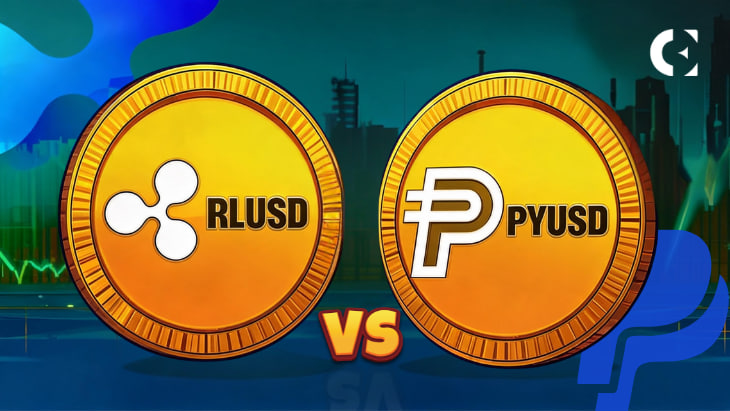

- PYUSD leads RLUSD in users, active addresses, and monthly transfer volume.
- RLUSD has fewer active users but far more transfers per active address.
- PYUSD has broader chain and DeFi adoption, while RLUSD targets institutional finance.
Ripple’s RLUSD has crossed the $2 billion market-cap milestone this month, which now puts the stablecoin much closer to PayPal USD (PYUSD), which has a market value of about $2.9 billion.
But market capitalization alone doesn’t show which stablecoin is used more. On-chain activity suggests PYUSD still has the larger user base and generates more transfer volume. Meanwhile, RLUSD shows a different pattern: fewer active addresses but high activity relative to its supply.
RLUSD Is Smaller, But Its Supply Is Moving
As of August 24, RWA.xyz data puts RLUSD’s market cap at about $2.02 billion, with 84,514 holders. Its monthly transfer volume stands at roughly $11.60 billion, generated through 1.28 million transfers and 7,982 active addresses.
That means RLUSD’s monthly transfer volume is roughly 5.7 times its circulating supply. The figure is significant because it shows the $2 billion supply is not simply sitting in wallets.
RLUSD also has a relatively high number of transfers per active address. Dividing its 1.28 million monthly transfers by 7,982 active addresses produces roughly 160 transfers per active address.
That points to a network with a relatively small active user base but frequent activity.
PYUSD Has the Bigger User Base and More Volume
PYUSD remains ahead on almost every broad usage metric. RWA.xyz currently puts PYUSD’s market cap at about $2.89 billion, with 160,889 holders and 59,657 monthly active addresses. Its monthly transfer volume is approximately $27.5 billion across 957,693 transfers.
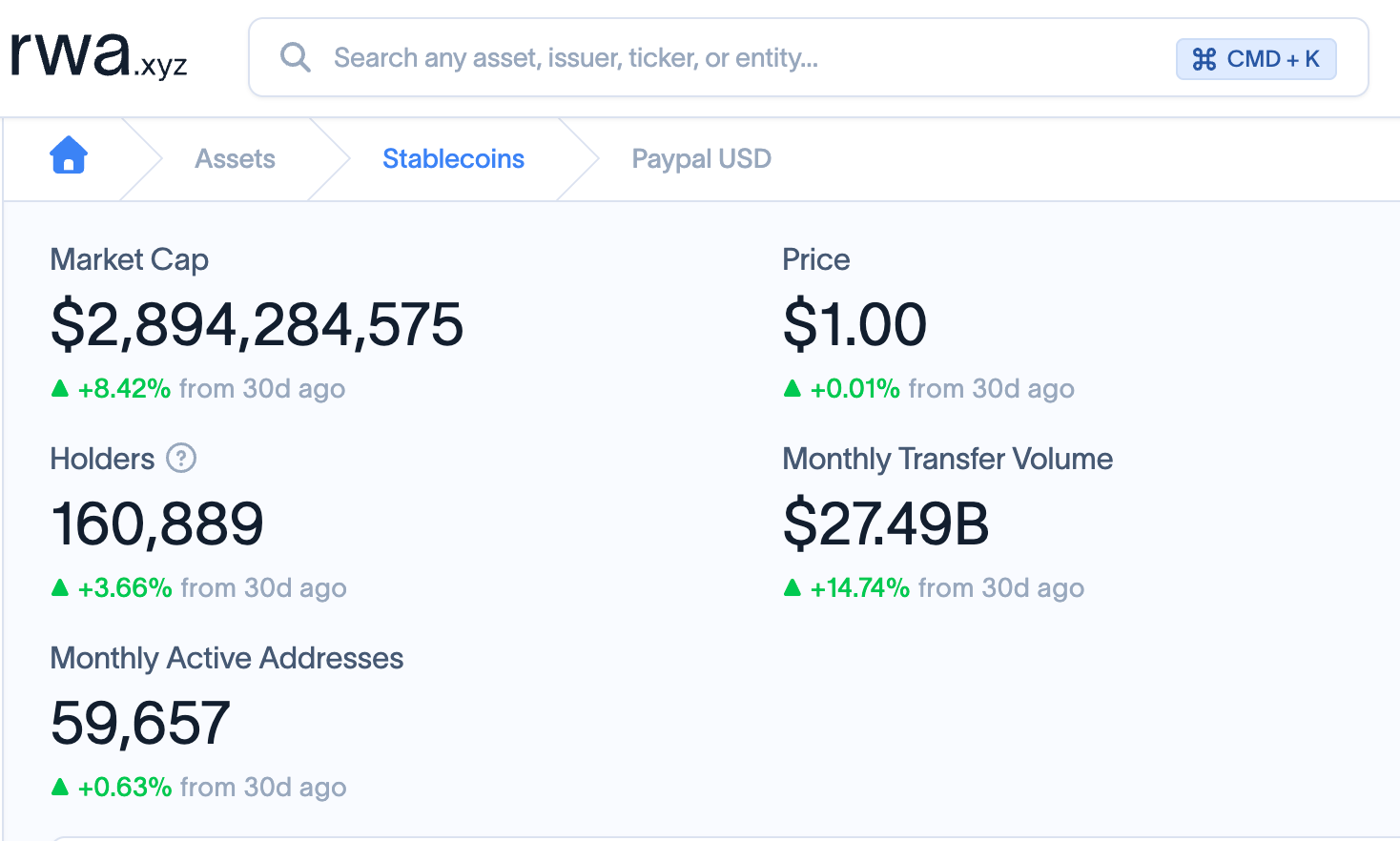
On a supply-adjusted basis, PYUSD moves about 9.7 times its circulating supply each month, considerably higher than RLUSD’s roughly 5.7x turnover. PYUSD also has more than seven times as many monthly active addresses as RLUSD.
Interestingly, RLUSD records more monthly transfers despite having far fewer active addresses. That gives RLUSD a much higher transfer frequency per active address.
The difference is partly reflected in the average size of recorded transfers. RLUSD’s monthly volume divided by its transfer count works out to roughly $9,100 per transfer, compared with about $29,300 for PYUSD.
Chain Distribution Tells Another Story
RLUSD’s supply is concentrated primarily on Ethereum and the XRP Ledger. RWA.xyz shows approximately $1.03 billion of RLUSD on Ethereum and about $988 million on XRPL, meaning the two networks account for virtually the entire current supply.
PYUSD is more broadly distributed. Current RWA.xyz data shows roughly $1.96 billion on Ethereum, $708 million on Solana, $220 million on Arbitrum, and nearly $8 million on Stellar.
That wider distribution gives PYUSD access to more ecosystems, particularly Solana, where cheap transactions have made the token attractive for payments and DeFi applications.
DeFi Gives PYUSD a Broader Footprint
PYUSD is used across DeFi venues including Aave, Curve, Morpho, and Kamino, with Solana playing an important role in its expansion.
RLUSD also has a growing DeFi presence. On Ethereum, for example, Sentora operates an RLUSD lending vault on Morpho, and FXRP was recently added as collateral, allowing users to borrow RLUSD against an XRP-linked asset without selling their XRP.
A Curve USDC-RLUSD pool has also reached tens of millions of dollars in liquidity, showing that RLUSD is developing a meaningful secondary market inside DeFi.
Exchange Liquidity Favors Neither on Every Measure
CoinMarketCap currently shows RLUSD trading volume at roughly $510 million over 24 hours, while PYUSD is closer to $42 million. That snapshot suggests RLUSD can see much heavier exchange activity during periods of increased demand or liquidity shifts.
Both tokens are also available through major trading venues including Kraken, ByBit, OKX, and Bitget.
The Real Difference Is the Use Case
The strongest distinction may not be raw transaction numbers but what each issuer is trying to make the stablecoin do.
PYUSD has a natural distribution advantage through PayPal and is designed for payments, transfers, and conversions within the PayPal/Venmo ecosystem. PayPal also allows eligible users to earn rewards on PYUSD balances.
Meanwhile, RLUSD serves institutional settlement, cross-border payments, and financial-market infrastructure, while Ripple’s broader ecosystem includes institutional custody, trading, and lending applications.
The takeaway is that PYUSD currently has the broader user and transaction footprint, while RLUSD is concentrated around high-frequency and higher-value financial activity.
As both approach the same $2 billion-plus market-cap neighborhood, the more important battle will therefore be over how efficiently each dollar of stablecoin supply is actually put to work, rather than simply which token has the bigger supply.
Related: How XRP Holders Can Borrow RLUSD Without Selling—and the Risks of FXRP Lending
Disclaimer: The information presented in this article is for informational and educational purposes only. The article does not constitute financial advice or advice of any kind. Coin Edition is not responsible for any losses incurred as a result of the utilization of content, products, or services mentioned. Readers are advised to exercise caution before taking any action related to the company.