



- Scotland’s High Court jails Robert Barr for 8 years over a £2M crypto theft plot planned from his prison cell.
- They planned to force a crypto startup co-founder to install AnyDesk, but a doorbell camera exposed them.
- Accomplices Sean Favier and Iain Doyle received 4 and 5 years, as crypto wrench attacks exceed $30M in H1 2026.
On November 10, 2026, Scotland’s High Court jailed Robert Barr to eight years in prison after an attempted £2 million cryptocurrency theft orchestrated from his prison cell. The plot involved sending two accomplices to the victims’ home to force them to install remote-access software.
Scotland’s High Court Jails Robert Barr for 8 Years Over £2M Crypto Theft Plot
Scotland’s High Court in Glasgow has sentenced Robert Barr, 29, to eight years in prison for orchestrating an attempted £2 million ($2.7 million) cryptocurrency theft from his prison cell at HMP Edinburgh. Barr orchestrated the plot during his 21-month jail term on fraud and possession of illegal mobile phones.
Prosecutors described Barr as a very “sophisticated cybercriminal” skilled in coordinating crypto criminal schemes rarely seen in investigations. His accomplices, Sean Favier, 26, and Iain Doyle, 37, received four and five years in prison, respectively. All three had pleaded guilty to involvement in organised crime.
Lord Cubie said the attempted theft was a combination of computer skills and conventional housebreaking. He referred to the conviction of Barr on a crypto-related fraud and his illegal utilization of in-prison communications as aggravating circumstances. The eight-year term of Barr will commence on the expiry of his previous sentence on 25 August 2025. Meanwhile, the court will have a serious crime prevention order hearing against Barr on November 17, 2026.
Follow us on X for real-time crypto updates.
How the Criminals Planned to Force the Crypto Startup Co-Founder to Install AnyDesk
Barr spent several months planning the attack. This included gathering intelligence on the victim through cryptocurrency-related social media activity. The information showed that the man had been involved in the sector since its early days and that his “own coin” was valued at around £1 million. Barr also provided images and location details, arranged reconnaissance and planned an approach under cover of darkness.
The plan relied on Favier and Doyle entering the victim’s home. They were to force him to access his computer, click a link, and quickly install AnyDesk. The remote-access software would enable Barr to operate the computer remotely in prison. He would then input receiving crypto addresses and transfer the assets of the victim to accounts controlled by him.
Meanwhile, messages recovered from Barr’s seized phone revealed the plan. These included instructions to “send u a website for the boys to make him go on” and “WHEN THEY’RE IN HIS HOUSE GONNA NEED GET HIM ON TO HIS PC FAST N DOWNLOAD ANYDESK RAPID.” The court accepted that the exchanges contemplated threats and/or violence. Barr had also messaged an associate about previously having the man’s house robbed by “boys in here.”
In addition, the April 2024 attempt was unsuccessful, as the victims spotted hooded individuals on their doorbell camera. They spoke through the intercom but denied them any access to the door. One of them asked, “Is that a camera right in front of me?” before both fleeing away.
What’s Next for Crypto Security as Wrench Attacks Exceed $30M in H1 2026?
The Scottish case highlights the increasing risks of physical coercion attacks, also referred to as crypto wrench attacks. According to Chainalysis, criminals have stolen over $30M across 46 reported cases in the first half of 2026 (H1 2026). This puts the year on track to exceed the previous record of $58 million stolen in 2025. Home invasion accounts for 37% of incidents of home invasions, while kidnappings remain the largest category.
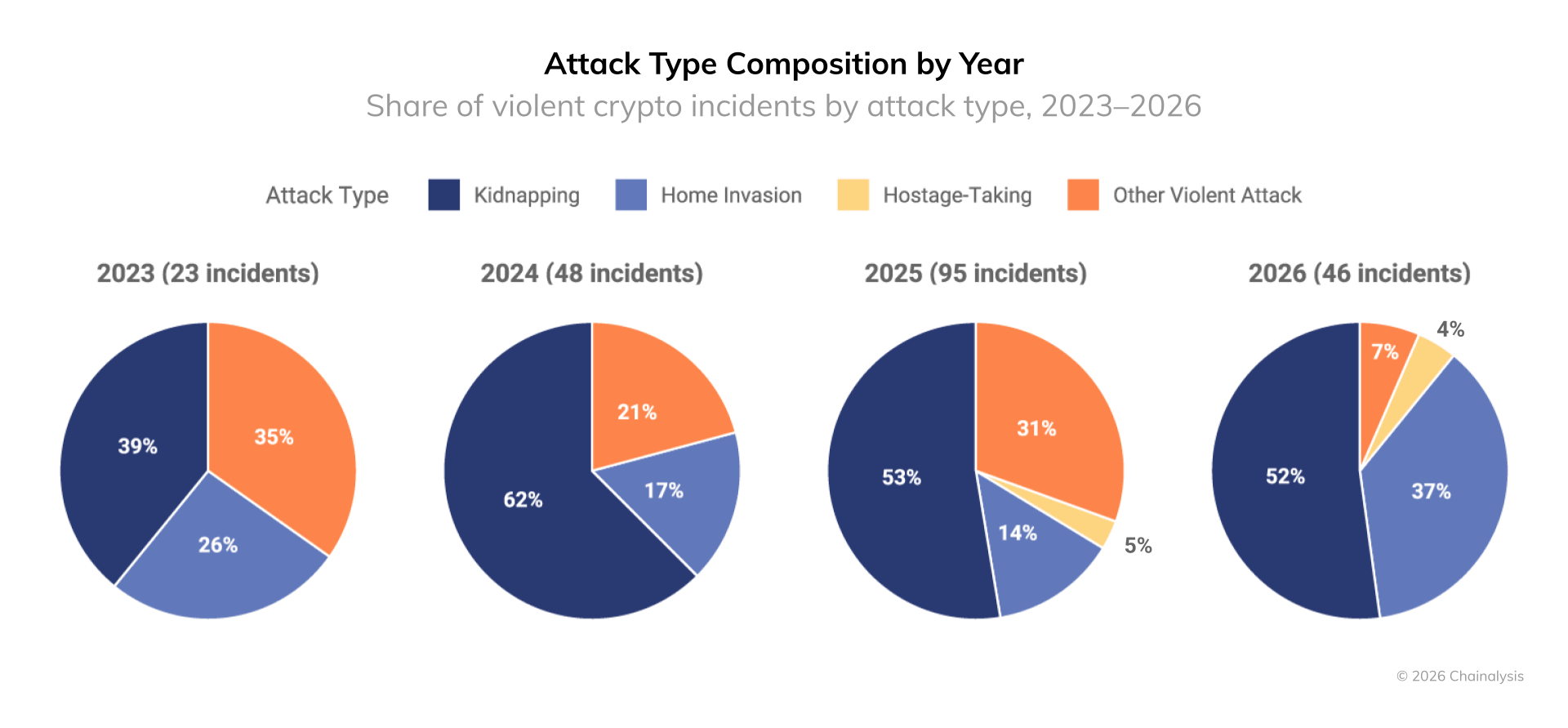
Furthermore, the escalating risk implies that crypto security should not be limited to digital wallets and keys protection. Holders must also implement greater home security, guard personal data, and reduce exposure of their cryptocurrency holdings to others.
That said, additional protection against coercion can be offered by measures like duress PINs or multi-party wallet controls. Faster coordination between blockchain analytics firms, exchanges and law enforcement will also be important for freezing stolen assets and improving recovery efforts.
Subscribe to our YouTube channel for the latest crypto news.
Related: Robbers Attack Family in Vendin-le-Vieil, Steal €40,000 in Cryptocurrency
Disclaimer: The information presented in this article is for informational and educational purposes only. The article does not constitute financial advice or advice of any kind. Coin Edition is not responsible for any losses incurred as a result of the utilization of content, products, or services mentioned. Readers are advised to exercise caution before taking any action related to the company.