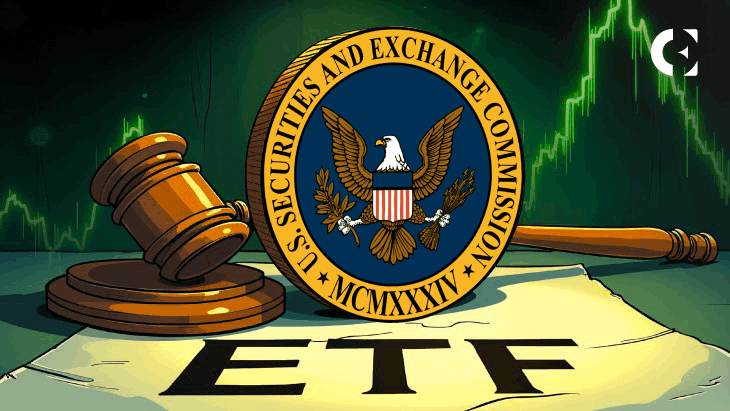

- SEC delays signal deeper scrutiny over risk, structure, and retail exposure.
- Prediction ETFs blend speculation with access, raising misuse concerns.
- Strong demand persists despite regulatory friction and approval uncertainty.
The U.S. Securities and Exchange Commission has delayed the launch of the first prediction-market exchange-traded funds, extending review timelines for more than two dozen filings. Fund issuers had expected approvals this week after meeting the standard 75-day waiting period.
However, regulators requested additional details on structure, disclosures, and risk frameworks. Consequently, the products remain in limbo as firms attempt to package event-driven betting markets into accessible investment tools for retail traders.
Rising Demand Meets Regulatory Scrutiny
Roundhill Investments, GraniteShares, and Bitwise submitted proposals in February to capitalize on growing interest in prediction markets. These funds aim to track outcomes tied to elections, recessions, and industry-specific events. Additionally, some filings include contracts linked to crude oil surpassing $120 per barrel this year.
Prediction markets gained traction after platforms like Kalshi and Polymarket accurately reflected the outcome of the 2024 U.S. presidential election involving Donald Trump. Besides, brokerages such as Interactive Brokers and Robinhood have expanded into the space, signaling broader institutional interest.
However, lawmakers have raised concerns about potential misuse. Some officials warn that event-based contracts could create incentives tied to geopolitical or economic instability.
Moreover, federal prosecutors have examined whether insider information influences certain trades. These concerns have pushed regulators to examine the proposed ETFs more closely.
How the Proposed ETFs Work
The proposed funds rely on derivatives that track binary outcomes in regulated event contracts. These contracts typically pay $1 if an event occurs and nothing otherwise. Hence, investors effectively trade probabilities rather than traditional assets.
Additionally, the ETFs allow users to roll positions into future contracts. This structure mirrors strategies used in options and futures markets. Consequently, retail investors gain easier access to complex event-driven strategies without directly trading on specialized platforms.
Some market participants view these products as tools for hedging. For example, traders may offset exposure to bonds or commodities using event-based positions. However, the simplicity of ETF trading may also attract speculative flows.
Risks and Market Potential
Regulatory filings highlight several risks tied to these products. Investors could face sharp losses if predictions fail. Moreover, disputes over event outcomes may not reverse financial losses. This structure leaves participants with limited recourse.
Still, industry voices see strong demand. Matt Hougan, chief investment officer at Bitwise, has indicated that innovative ETFs often face delays before approval. He pointed to the earlier path of crypto-linked funds as a reference. Similarly, Dave Nadig, director of research at ETF Trends, has noted that issuers constantly search for new market themes.
Related: Tether Gold Reserves Rise 36% as XAU₮ Market Value Tops $3.3B
Disclaimer: The information presented in this article is for informational and educational purposes only. The article does not constitute financial advice or advice of any kind. Coin Edition is not responsible for any losses incurred as a result of the utilization of content, products, or services mentioned. Readers are advised to exercise caution before taking any action related to the company.