
- Standard Chartered partners with Circle to become the first G-SIB offering USDC minting and redemption.
- The partnership removes the need for direct Circle accounts through a single onboarding experience.
- The service will launch through the bank’s DIFC, signaling growing stablecoin integration into Tradi-Fi.
Standard Chartered has partnered with Circle to become the first Global Systemically Important Bank (G-SIB) to offer institutional clients seamless USDC minting and redemption. The service is available through the bank’s DIFC operations, enabling eligible clients to access USDC directly through Standard Chartered, eliminating the need for separate Circle accounts.
Standard Chartered Becomes First G-SIB to Offer USDC Minting Service
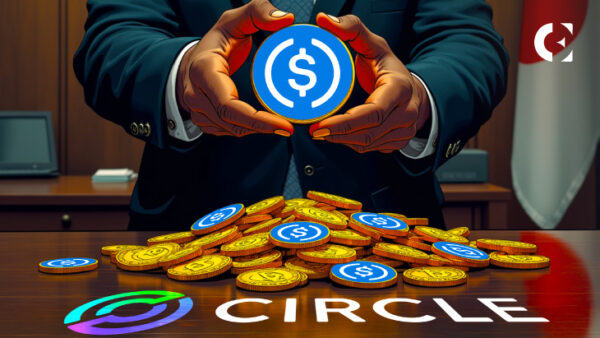
On July 2, 2026, Standard Chartered announced a partnership with Circle Internet Group, Inc. (NYSE: CRCL) to allow institutional clients to mint and redeem USDC directly through the bank. The service will be powered by Circle, the issuer of USDC through its regulated entities.
The launch makes Standard Chartered the first licensed G-SIB to offer eligible institutional clients access to USDC minting and redemption service. The partnership also builds on joint efforts in initiatives like the Circle Payments Network (CPN), where the bank contributes expertise in cross-border efficiency, security, and compliance.
Related: Standard Chartered Maps $4T Shift to Onchain Finance
Why Standard Chartered Partnered with Circle
Standard Chartered’s collaboration with Circle aims to accelerate its digital asset strategy and address the growing demand for regulated stablecoins from institutional investors. The partnership strengthens the connection between traditional finance and blockchain technology.
The partnership integrates Circle’s USDC infrastructure into the bank’s global banking platform, allowing institutional clients to mint and redeem USDC through a single banking relationship. Eliminating the need for separate Circle accounts simplifies onboarding while enabling faster liquidity management, cross-border payments, treasury operations, and on-chain settlement.
Roberto Hoornweg, CEO of the Corporate and Investment Banking division at Standard Chartered, emphasized the significance of the move, stating, “Digital assets are an increasingly critical part of the global financial infrastructure, and institutional clients expect the same level of trust and governance found in traditional markets, and with this launch, we are bringing those standards to a new and evolving area of the financial system.”
What’s Next for Stablecoin Adoption in Banking?
Standard Chartered’s launch as the first G-SIB to offer integrated USDC minting and redemption could accelerate stablecoin adoption across global banking. Beginning through the UAE’s DIFC, the service provides a blueprint for other banks seeking regulated blockchain payment solutions, faster settlements, and greater efficiency in cross-border transactions.
Growing regulatory clarity is expected to accelerate this trend. With governments providing clearer guidance on stablecoins like the GENIUS Act, banks are feeling more at ease with providing digital asset services. This transition is fueling the focus on tokenized deposits, digital custody, and blockchain-based payment solutions, as institutions gear up to meet evolving customer and market demands.
Furthermore, industry forecasts signal strong momentum for stablecoin adoption. Standard Chartered forecasts the stablecoin market could hit $2T by 2028, while Mordor Intelligence expects it to reach $1.16T by 2031. However, financial stability and deposit disintermediation challenges remain, but banks that will adopt regulated stablecoins like USDC are likely to gain a competitive advantage in digital finance.
Related: Circle and Nomura to Launch USDC Digital Asset Settlement Service in Japan by 2027
Disclaimer: The information presented in this article is for informational and educational purposes only. The article does not constitute financial advice or advice of any kind. Coin Edition is not responsible for any losses incurred as a result of the utilization of content, products, or services mentioned. Readers are advised to exercise caution before taking any action related to the company.