
- US forces launched “self-defense” strikes in southern Iran targeting missile sites.
- Iran and US negotiators met in Qatar for peace talks as Trump warned fighting could return if talks fail.
- Brent crude climbed to near $98 while Bitcoin, gold, and global markets reacted to rising Middle East tensions.
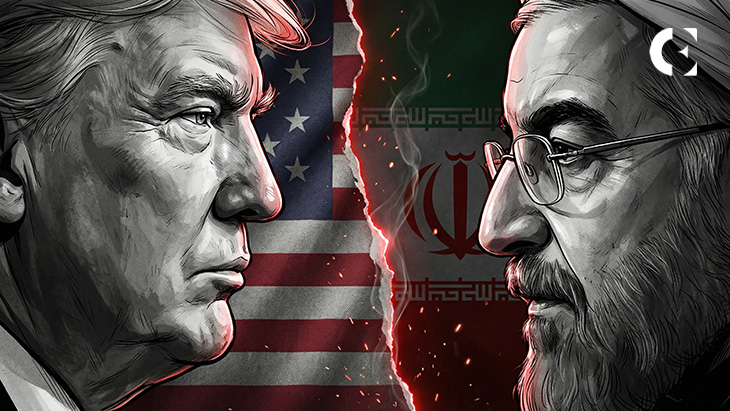
The United States military says it carried out fresh “self-defense” strikes in southern Iran. It targeted missile launch sites and vessels allegedly attempting to lay mines near the Strait of Hormuz
Notably, these new strikes come even as Iranian negotiators arrived in Qatar for talks aimed at ending the conflict.
“Self-Defense” Strikes
In a statement, the US Central Command (CENTCOM) described the attacks as defensive operations to protect American troops from threats posed by Iranian forces during the ongoing ceasefire.
“US Central Command continues to defend our forces while using restraint during the ongoing ceasefire,” US Navy Captain Tim Hawkins, a CENTCOM spokesperson, said.
The strikes reportedly targeted missile launch locations and mine-laying boats in southern Iran. Earlier in the day, Iranian media reported explosions near the Strait of Hormuz and in Bandar Abbas, though officials initially said the cause was unclear.
Iranian news agencies reported multiple explosions around Bandar Abbas, Sirik, and Jask, all located near the strategic shipping route. Later, sources said the situation in Bandar Abbas was under control, and there was “no cause for concern.”
Iran Claims Drone Interception as Gulf Tensions Rise
Iranian officials also claimed that the country’s air defense systems had downed a “hostile” stealth drone over the Persian Gulf. According to anonymous officials, the interception showed that “no more stealth drones can penetrate the skies of the Persian Gulf.”
The latest developments come despite a ceasefire observed by US and Iranian forces since April 8.
Tensions around the Strait of Hormuz remain high as Iran continues maintaining controls on Gulf shipping routes while the US Navy enforces a naval blockade on Iranian ports.
Last week, CENTCOM said the blockade had redirected 100 vessels and disabled four others. CENTCOM commander Admiral Brad Cooper stated that the operation was “allowing zero trade into and out of Iranian ports”. He stressed that the measures had significantly increased economic pressure on Iran.
The US military also revealed that more than 200 aircraft and warships, including guided missile destroyers, are supporting the mission in the region.
Fresh Strikes Overshadow Qatar Peace Talks
The military escalation came just hours after Iran’s foreign minister and top negotiator arrived in Doha, Qatar, to discuss a possible agreement with Washington with Qatar’s prime minister.
However, officials on both sides appeared cautious about the chances of an immediate breakthrough.
US President Donald Trump said negotiations with Iran were “proceeding nicely,” but warned there would either be a “great and meaningful” deal or “no deal.”
Trump added that if talks collapsed, it would be “back to the battlefront and shooting, but bigger and stronger than ever before.”
US Secretary of State Marco Rubio also said Washington would continue giving diplomacy a chance before considering “another way” of dealing with Iran.
Rubio stated there was a “pretty solid thing on the table” involving reopening the Strait of Hormuz and entering a “very real, significant, time-limited negotiation” over Iran’s nuclear program.
Trump also pushed regional diplomacy further by encouraging Saudi Arabia, Qatar, Pakistan, Turkey, Egypt, and Jordan to join the Abraham Accords.
Oil Prices Climb as Markets Fear Supply Disruptions
Global markets reacted quickly to the renewed tensions. Brent crude futures rose 2% to $98.26 per barrel during Asian trading. Meanwhile, US West Texas Intermediate crude traded at $91.73 per barrel.
Swiss investment bank UBS warned that the global oil market is becoming more strained as inventories keep falling amid shipping disruptions in the region. UBS said global oil inventories fell by 246 million barrels in March and April combined, while total production losses could pass 1 billion barrels by the end of May.
The bank said the oil market is “strongly undersupplied,” with crude and fuel stockpiles on land shrinking even though oil stored on tankers is rising because exports are being rerouted.
Gold Slips While Crypto Markets Feel Pressure
The geopolitical tensions also weighed on gold and cryptocurrency markets.
Spot gold fell between 0.6% and 0.7%, trading around $4,537 to $4,544 per ounce. Analysts said rising oil prices increased concerns about longer-lasting inflation, reducing demand for gold as investors adjusted interest rate expectations.
Meanwhile, U.S. gold futures for June delivery rose slightly by 0.3% to 0.5%, highlighting a divide between short-term market fears and longer-term investor positioning.
Crypto markets also reacted negatively.
Bitcoin fell 0.84% over the past 24 hours to $76,596, underperforming the broader crypto market. Analysts linked the decline partly to continued institutional selling through U.S. spot Bitcoin ETFs.
Data showed spot Bitcoin ETFs recorded $1.26 billion in net outflows last week, marking the largest weekly redemption since January 2026. BlackRock’s iShares Bitcoin Trust (IBIT) alone reportedly saw more than $1 billion in outflows.
Meanwhile, oil-linked perpetual futures on the decentralized trading platform Hyperliquid surged more than 5% after the U.S. strikes. This shows how geopolitical events are increasingly affecting both traditional and crypto-linked financial markets.
Related: Nasdaq, S&P 500 Near Record Highs as Trump Iran Deal Hopes Lift Markets
Disclaimer: The information presented in this article is for informational and educational purposes only. The article does not constitute financial advice or advice of any kind. Coin Edition is not responsible for any losses incurred as a result of the utilization of content, products, or services mentioned. Readers are advised to exercise caution before taking any action related to the company.