

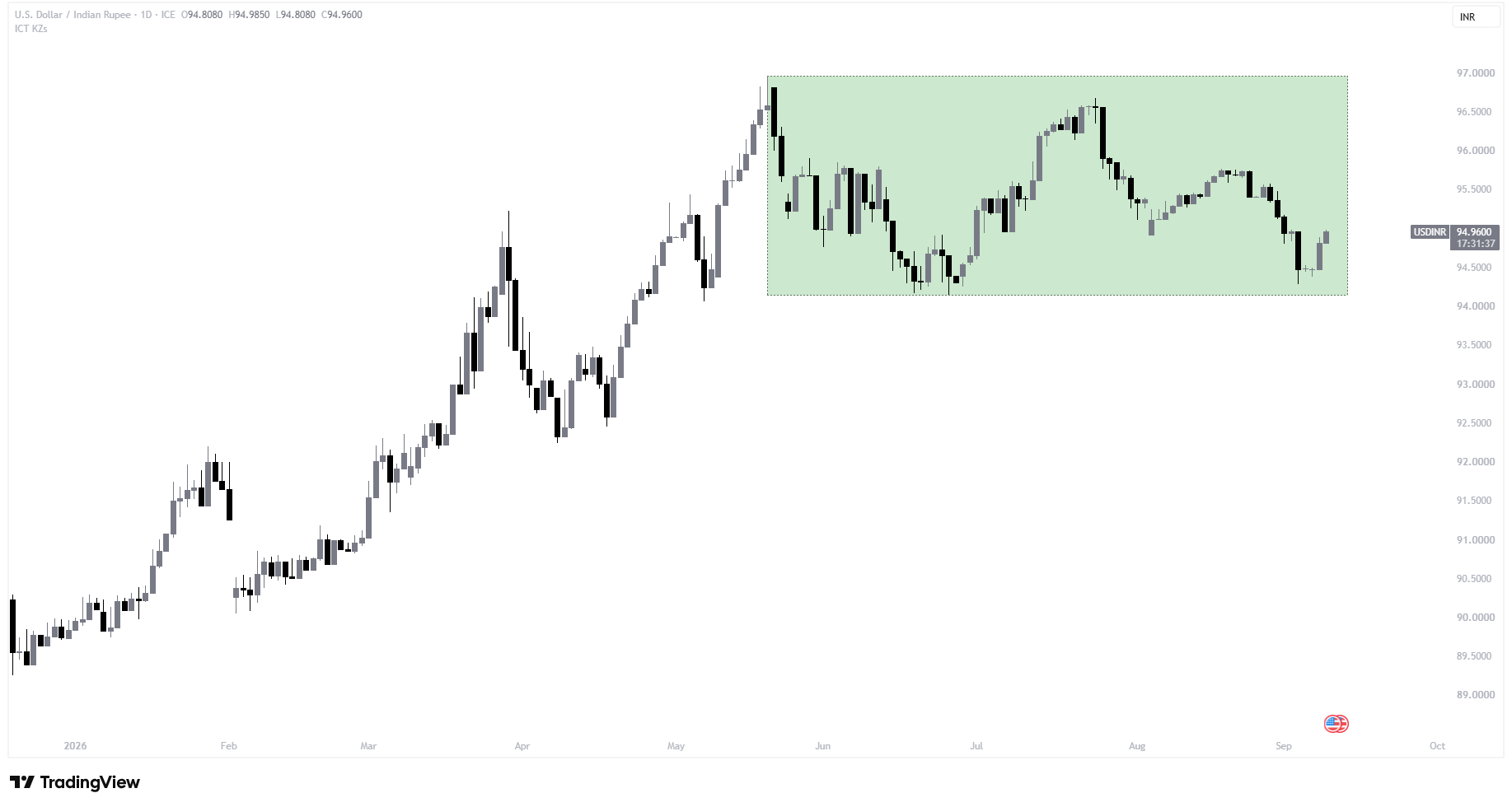
- USD/INR has held ₹94.2-₹96.9 since late May as RBI action absorbs dollar pressure.
- Brent near $100 and higher U.S. yields could test the Rupee’s ₹96.5-₹96.9 resistance zone.
- A move in USD/INR from ₹94.5 to ₹97 would lift BTC-INR by about 2.6% if Bitcoin stays flat.
The Indian rupee has spent months inside a tight corridor despite shifts in oil prices, capital flows, and U.S. rate expectations. Since late May, USD/INR has traded between roughly ₹94.2 and ₹96.9, as competing pressures offset each other.
Source: TradingView
That stability does not mean pressure has disappeared. External dollar demand, investment swings, and higher energy costs have instead been absorbed, largely through Reserve Bank of India intervention. With Brent crude near $100, that balance faces a test.
Why Opposing Forces and RBI Action Have Kept USD/INR Trapped
Several forces have pushed the currency weaker without a sustained breakout. India’s April-June current-account deficit widened to $4.2 billion, or 0.5% of GDP, while the merchandise trade deficit rose to $86.1 billion.
At the same time, higher crude prices have increased dollar demand as importers need more foreign currency to pay for energy. Capital flows have partly offset that pressure, with overseas investors buying $3.1 billion of Indian equities in August, the strongest monthly inflow in 23 months.
However, those inflows have not fully reversed the broader trend. Equity outflows for 2026 still stood at $24.6 billion, leaving USD/INR caught between renewed foreign investment and persistent external dollar demand.
Against that backdrop, the RBI has remained the strongest stabilizing force. Special measures introduced in June generated more than $136 billion of foreign-currency inflows, giving the central bank greater capacity to manage volatility.
In addition, bankers estimated that the RBI sold at least $8 billion, and possibly as much as $15 billion, during the week before September 7. That support helped absorb dollar demand, although pressure on the rupee remained.
Oil and Dollar Demand Could Decide the Next USD/INR Break
Even with RBI intervention, oil remains the clearest pressure point. Brent holding near or above $100 would increase domestic dollar needs. At the same time, a stronger U.S. dollar, higher Treasury yields, renewed foreign outflows, and lighter RBI intervention could add further pressure.
Together, those forces could test the upper end of the established USD/INR range. Bankers have also warned that a USD/INR move toward ₹96-₹97 could trigger additional dollar buying. Indian banks have raised more than $127 billion through overseas deposits, while much future interest exposure remains unhedged.
That leaves ₹96.5-₹96.9 as the key upside boundary. Conversely, cheaper oil, softer U.S. yields, stronger inflows, and continued RBI support could push the pair below ₹94.2-₹94.5. For Indian crypto investors, either move would have a direct pricing effect.
If Bitcoin remains unchanged in dollar terms while USD/INR rises from ₹94.5 to ₹97, then BTC-INR increases by about 2.6%. Likewise, a weaker rupee raises the INR cost of dollar-linked exposure, which can influence USDT and USDC demand.
However, local liquidity and spreads can cause stablecoin prices to deviate from interbank rates. Therefore, oil prices, RBI intervention, foreign flows, and the range boundaries remain key signals for investors tracking rupee-denominated crypto returns.
Related: India’s State Debt Is Rising: What It Means for the Rupee, Investors, and Crypto
Disclaimer: The information presented in this article is for informational and educational purposes only. The article does not constitute financial advice or advice of any kind. Coin Edition is not responsible for any losses incurred as a result of the utilization of content, products, or services mentioned. Readers are advised to exercise caution before taking any action related to the company.