
Complete Analysis & Pricing Guide for Solana Developers and Builders
Solana blockchain is commonly referred for its fast transactions, processing over 2,000 to 5,000 transactions per second (TPS). It uses Proof of History, as well as leverages Sealevel and Turbine for processing transactions simultaneously and transmitting massive amounts of data across nodes.
By offering mature tools for developers Solana remains as a reliable tool for developers to develop dApps. Building on Solana requires reliable data including wallet balances, SPL token holdings, DEX trades, and DeFi positions all live on-chain. Parsing raw transactions, indexing program logs, and maintaining token metadata takes serious infrastructure.
There are a plethora of options to choose the right API depending on the needs to pull the necessary data.
This guide compares six leading Solana APIs. The dimensions covered: data coverage, technical capabilities, pricing, and ideal use cases.
Quick Comparison Overview
| Provider | Best For | Starting Price | Coverage | Key Strength |
| CoinStats Solana API | Aggregated Solana wallet, DeFi, and market data | Free (credit-based) | SPL tokens, 10,000+ DeFi protocols, 200+ exchanges | Unified Solana data plus MCP Server for AI agents |
| Phantom | Wallet integration and transaction signing | Free | Solana, EVM, Sui, Bitcoin | Embedded wallet SDK with social login |
| Birdeye | Token price and DEX trade analytics | $39/mo | Solana, Sui, EVM chains | OHLCV, trade history, WebSocket streams |
| DexterLab | Solana RPC and raw data | Custom | Solana mainnet, SVM rollups | Bare-metal archival RPC and real-time streams |
| The Graph | Custom on-chain indexing via subgraphs | Pay-per-query (GRT) | Solana, EVM chains | Decentralized indexing protocol with Substreams |
| Raydium | Raydium pool and swap data | Free | Solana (Raydium pools only) | Direct access to Raydium pool state |
Table of Contents
- Detailed Provider Analysis
- Comparison by Use Case
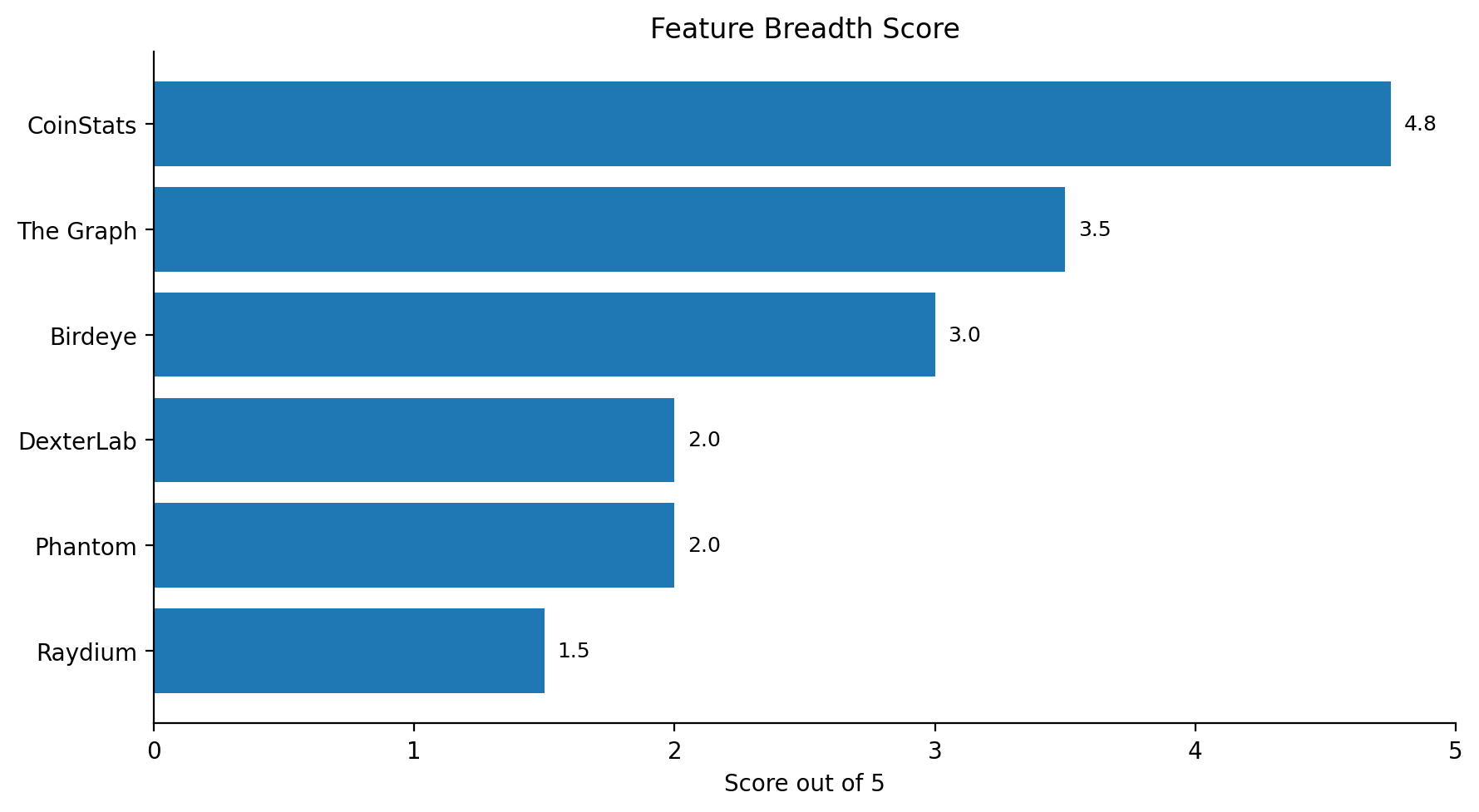
- Coverage Snapshot
- Pricing Comparison
- Decision Framework
- Conclusion & Recommendations
Detailed Provider Analysis
1. CoinStats Solana API
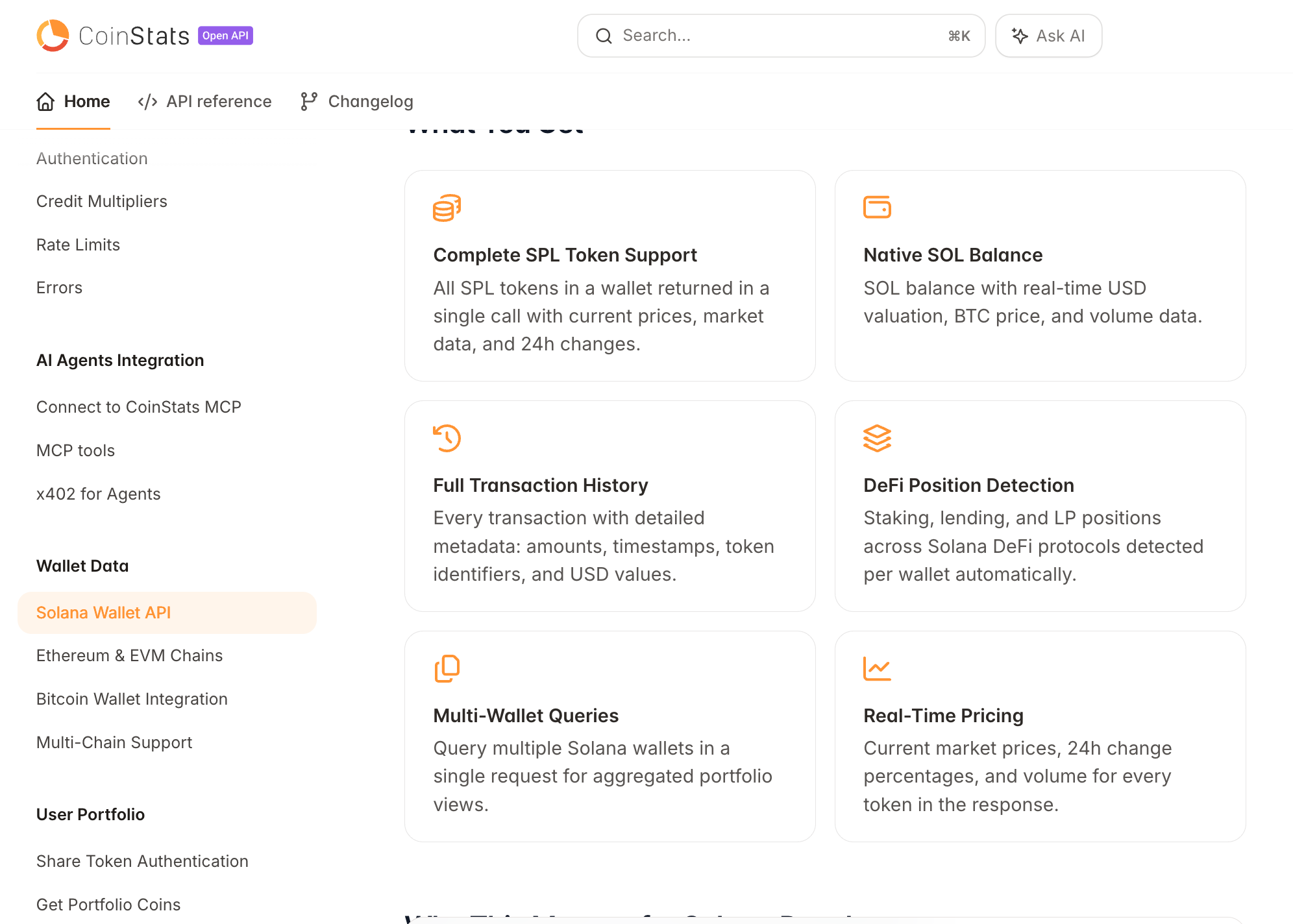
Company Overview: CoinStats Solana API is one of the best fit for most Solana use cases. It returns aggregated wallet data, SPL token balances, transaction history, and DeFi positions through one endpoint. The same infrastructure powers the CoinStats app, used by over 1M people every month. Developers get pre-structured JSON instead of parsing raw on-chain data themselves.
Core Strengths
- Comprehensive Solana coverage: Native SOL balance, all SPL tokens, full transaction history, and DeFi positions returned in a single call. Auto-detected protocols include Raydium, Orca, Jupiter, and Marinade.
- Aggregated market data: Real-time prices, market caps, volumes, and 24h changes for 100,000+ coins. Data is sourced from 200+ centralized and decentralized exchanges, including Binance, Coinbase, and Hyperliquid.
- Cross-chain consistency: Same endpoint format and response schema across 120+ blockchains. Code written for Solana works on Ethereum, Bitcoin, or any other supported chain by changing the connectionId parameter.
- DeFi position detection: Staking, lending, and LP positions across 10,000+ DeFi protocols resolved per wallet automatically. No protocol-specific integrations required.
- Multi-wallet queries: Pull balances and transactions for multiple Solana addresses in one request. Useful for portfolio trackers and aggregated dashboards.
- MCP Server for AI agents: Model Context Protocol server exposes the same Solana data to AI assistants and LLM workflows. Compatible with Claude, Cursor, VS Code, and other MCP clients.
- Reliable: Built on the data stack behind a 1M+ monthly user app, making it feasible for production workloads.
Data Specifications
- Solana coverage: SOL, all SPL tokens, DeFi protocol positions
- Cross-chain support: 120+ blockchains via the same API key
- Exchanges: 200+ CEX and DEX market data sources
- API type: REST API + MCP Server
- Authentication: API key (and ShareToken for portfolio access)
- Documentation: coinstats.app/api-docs/
Pricing
Credit-based pricing with a free tier included at signup. Credit usage scales with endpoint complexity and request parameters. A single Solana balance lookup costs 40 credits. Transaction history retrieval costs 30 credits per request. Basic market data calls cost 1-2 credits each, so high-frequency polling stays cost-effective. Paid plans unlock higher credit limits and rate limits.
Best Suited For
Typical fits include portfolio trackers, DeFi dashboards, and tax tools. Multi-chain wallet explorers and AI-powered crypto assistants also fit. Embedded fintech widgets work too. The replaced stack typically includes a Solana RPC node and a market data provider. A DeFi aggregator and a transaction parser usually round it out.
Limitations
- Not designed for ultra-low-latency or microsecond-scale high-frequency trading
- Does not expose raw blockchain RPC or node-level access
- Transaction data requires a sync step before retrieval
Documentation Quality: Well-organized Mintlify-based docs hub with endpoint references, code examples, and credit cost tables. The Solana wallet documentation at coinstats.app/api-docs/wallet/solana/ includes cURL, JavaScript, and Python examples.
Cross-chain coverage beyond Solana is its own evaluation. CoinStats has a full crypto API comparison guide for that. It covers multi-chain providers in more detail.
2. Phantom
Company Overview: Phantom is a multi-chain wallet for Solana, EVM chains, Sui, and Bitcoin. It is best known as the dominant consumer wallet on Solana. Phantom offers a developer SDK suite for wallet integration, transaction signing, and embedded wallet functionality. The API surface is wallet-focused rather than data-focused.
Core Strengths
- Wallet SDK suite: React, React Native, and browser SDKs for connecting Phantom and other wallet-standard wallets to applications.
- Embedded wallet: Wallet UI hosted in an iframe with social login (Google, Apple) and built-in onboarding flow.
- Multi-chain transaction signing: One SDK signs Solana, EVM, Sui, and Bitcoin transactions.
- MCP Server: Phantom MCP integration for Claude Desktop, Cursor, and Claude Code.
- Wallet standard compatibility: Connects with Solflare, Backpack, and other wallet-standard wallets through the same hooks.
Best Suited For
Application developers integrating wallet connect flows, transaction signing, or embedded wallet experiences. Phantom is positioned around wallet UX rather than aggregated market or on-chain data delivery.
Limitations
- Not a market data or on-chain analytics API.
- Embedded wallet is in active development as a beta product.
- Does not return aggregated DeFi position data across protocols.
Pricing
Free.
Documentation Quality: Comprehensive developer docs at docs.phantom.com with SDK comparison guides, starter templates, and code examples.
3. Birdeye
Company Overview: Birdeye Data Services delivers token price, OHLCV, trade history, and wallet portfolio data across Solana, Sui, Ethereum, and other major EVM chains. Birdeye is widely used in the Solana token discovery space and offers WebSocket streaming on higher tiers. The API is priced by compute units (CUs).
Core Strengths
- Token price and OHLCV data: Real-time and historical price feeds, including tick-level trade data by token and pair.
- DEX coverage on Solana: Trade data from 20+ Solana DEXs and AMMs.
- Wallet portfolio endpoints: Wallet portfolio and historical trade data on higher-tier plans.
- WebSocket streaming: Real-time updates via WebSocket on Premium Plus and Business tiers.
- Multi-chain support: Solana, Sui, Ethereum, and additional EVM chains under one API key.
Best Suited For
Token analytics platforms, trading dashboards, and DEX trade history tools. Applications needing tick-level Solana DEX data are a good match.
Limitations
- Compute unit consumption can scale quickly under heavy usage.
- Some endpoints (e.g., multi-token batch APIs) restricted to Business tier or higher.
- Wallet portfolio data is one feature among many, not the central focus.
Pricing
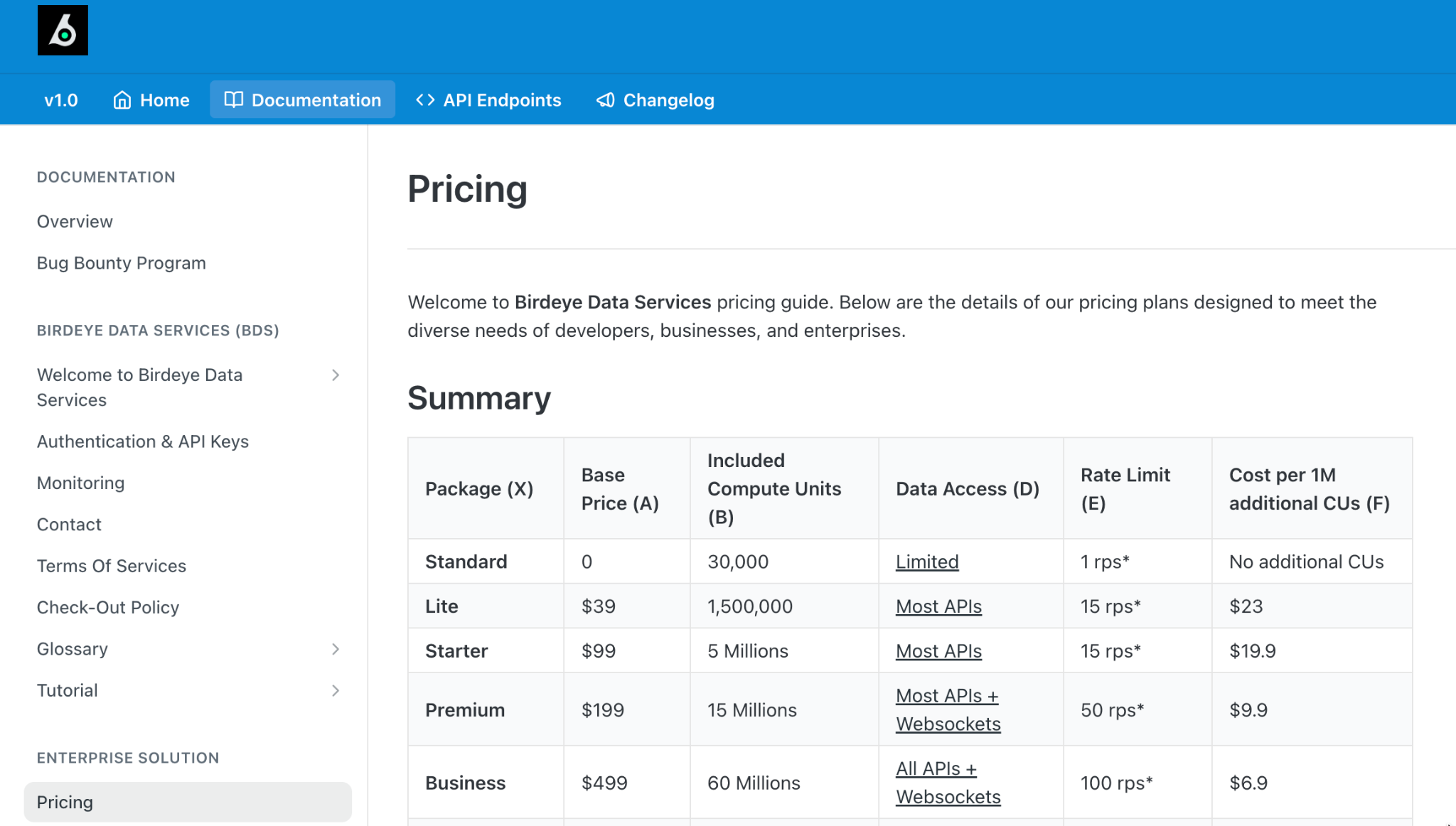
- Lite: $39/mo (1.5M CUs, 15 RPS)
- Starter: $99/mo (5M CUs, 15 RPS)
- Premium Plus: $250/mo (20M CUs, 50 RPS, WebSocket access)
- Business: $699/mo (100M CUs, 100 RPS, 2,000 WebSocket connections)
- Enterprise: Custom
Documentation Quality: REST API documentation at docs.birdeye.so with endpoint references, sample requests, and a compute unit cost table.
4. DexterLab
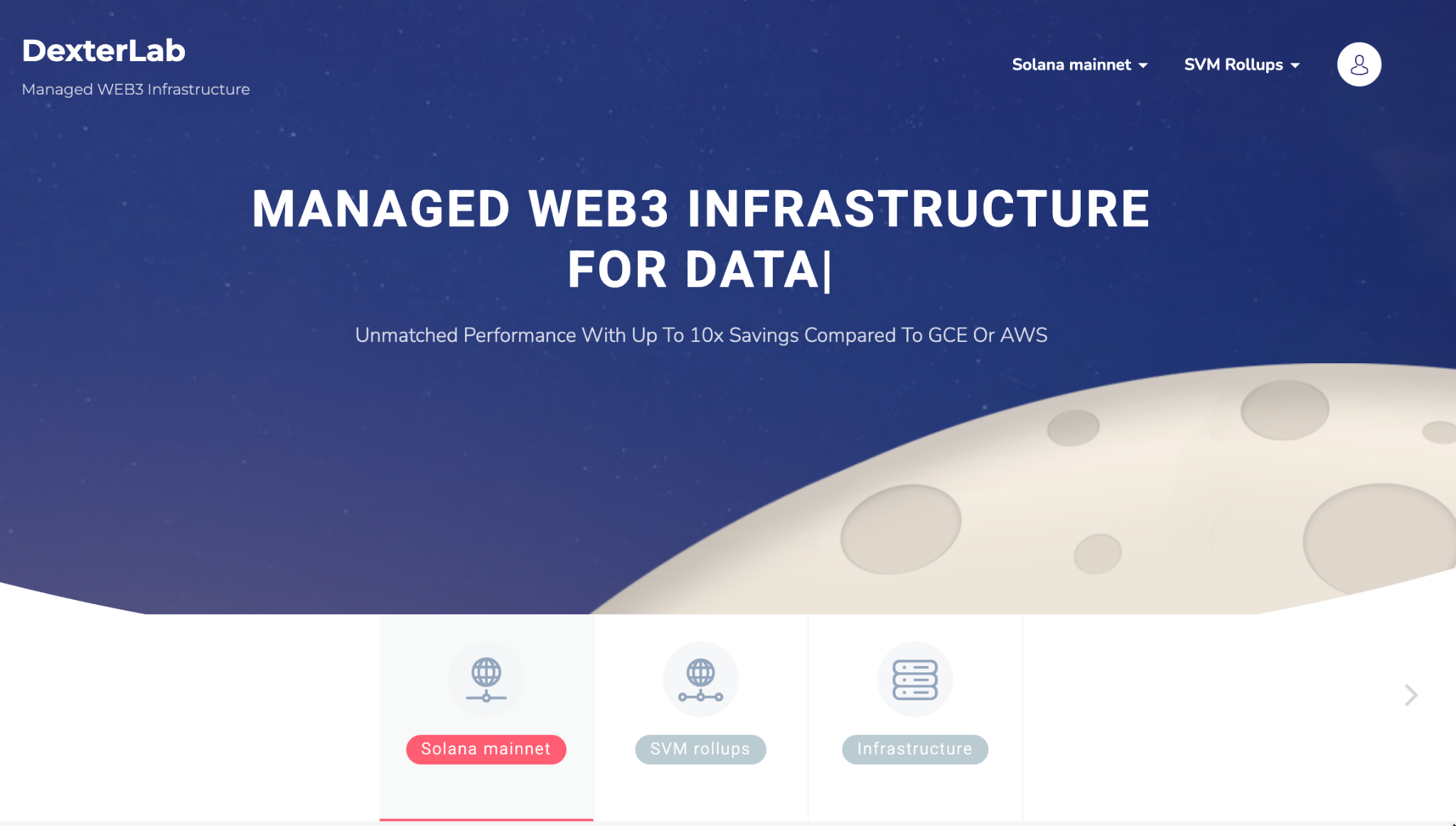
Company Overview: DexterLab provides managed Web3 infrastructure focused on Solana. Its services include Solana archival RPC, raw block data access, historical data streams, and real-time data streams. The infrastructure runs on bare-metal servers, which the team positions as cheaper than equivalent cloud RPC setups. DexterLab also handles SVM rollup archival data and backups.
Core Strengths
- Solana archival RPC: Shared or dedicated archival nodes for high-demand RPC providers and apps.
- Raw block access: All Solana blocks delivered in 250-block-per-archive gzip files.
- Real-time data streams: On-chain activity streams with a 100% delivery guarantee.
- Historical data streams: Backfill datasets from the genesis block, useful for analytics platforms.
- Managed Kafka and ClickHouse clusters: For teams running their own data pipelines.
- Open-source approach: Code is open-source for transparency and self-hosting flexibility.
Best Suited For
RPC providers, analytics platforms, and SVM rollup operators. Teams that need raw Solana block data at scale are also a fit. DexterLab is infrastructure-layer rather than application-layer.
Limitations
- Pricing requires contacting sales; no public self-serve plans.
- Lower-level abstraction means teams handle data parsing and indexing themselves.
- Not aimed at wallet, portfolio, or aggregated DeFi data use cases.
Pricing
Custom. Contact sales.
Documentation Quality: Service overview pages on dexterlab.com with links to GitHub repositories for self-hosted components.
5. The Graph
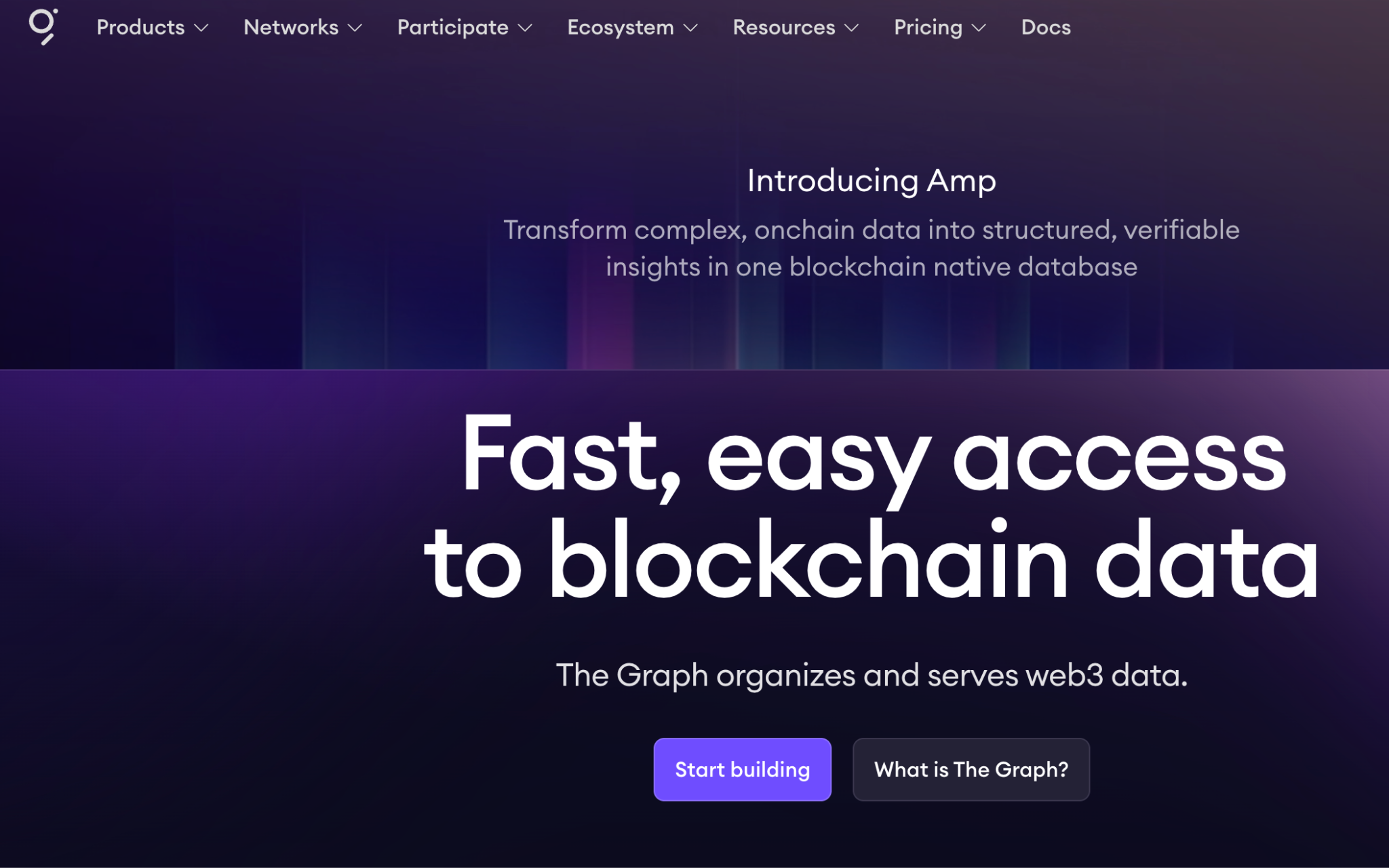
Company Overview: The Graph is a decentralized protocol for indexing and querying blockchain data. Subgraphs are custom APIs built by developers to extract structured data from a chain. The Graph supports Solana through Substreams, a streaming-first indexing layer developed by StreamingFast. Substreams are written in Rust and compiled to WebAssembly. Query fees are paid in GRT, the network’s native token.
Core Strengths
- Custom subgraphs: Developers define the exact data schema and entities they need.
- Substreams for Solana: Parallel data processing with high historical indexing throughput.
- Decentralized network: Queries served by a network of independent Indexers.
- Cross-chain coverage: Ethereum, Solana, Arbitrum, Optimism, Base, Polygon, and others.
- Token API beta: Real-time token balances, transaction histories, and holder data via Substreams (currently EVM-focused).
- MCP server support: Token API includes schema access for AI assistants.
Best Suited For
Teams building custom indexing pipelines. dApps with specific data shape requirements also fit well. Projects familiar with GraphQL and Rust get the most value. The Graph rewards teams that invest in custom subgraph development.
Limitations
- Solana support relies on Substreams, which requires Rust expertise to build modules.
- Token API beta is currently centered on EVM chains, not Solana.
- Pay-per-query model in GRT adds token-management overhead.
- Higher learning curve than REST API providers.
Pricing
Pay-per-query in GRT for production queries. Free tier available in Subgraph Studio for development and testing. Query costs depend on Indexer pricing and subgraph signal.
Documentation Quality: Extensive documentation at thegraph.com/docs covering Subgraphs, Substreams, indexing, and curation.
6. Raydium API
Company Overview: Raydium is the largest AMM and liquidity protocol on Solana, operating since 2021. Raydium exposes a public API for pool data, token lists, and swap routing. The V3 API at api-v3.raydium.io supports pool queries, token metadata, and basic monitoring. For real-time data and production trading, the Raydium SDK V2 and gRPC subscriptions are recommended.
Core Strengths
- Direct pool data: Pool reserves, fees, and token pair information from Raydium’s CLMM and CPMM pools
- Token metadata: Lists of supported tokens across Raydium pools
- Routing engine access: Smart routing across Raydium pools via API or SDK
- Free public API: No authentication required for read-only endpoints
- SDK V2: TypeScript/JavaScript library for swaps, liquidity provision, and farm interactions
Best Suited For
Applications that interact directly with Raydium pools. Use cases include swap integrations, LP dashboards, and routing optimizers. The API works best as one piece of a larger Solana data stack.
Limitations
- Limited to Raydium pools only; no data from Orca, Jupiter, Phoenix, or other Solana DEXs
- Public REST endpoints are not designed for real-time monitoring (the docs recommend gRPC for that)
- No wallet balance, portfolio, or aggregated DeFi position data
- Not suitable as a sole data layer for Solana applications
Pricing
Free.
Documentation Quality: Developer documentation at docs.raydium.io covers the V3 API, SDK V2 usage, and pool creation flows.
Comparison by Use Case
Solana Portfolio Trackers
CoinStats Solana API fits this use case well. The balance endpoint returns SOL plus every SPL token in one call. Each response includes current prices, 24h changes, and market cap rankings. DeFi positions across Raydium, Orca, Jupiter, and Marinade are detected automatically per wallet. Pair the balance endpoint with transaction history to calculate PnL and cost basis. No protocol-specific integrations required.
Alternative Options:
- Birdeye: Wallet portfolio endpoints on Premium Plus tier and higher
- The Graph: Custom subgraphs if specific data shape is required
Wallet Connect and Transaction Signing
Phantom is the natural choice. Its SDK suite handles wallet connection, transaction signing, and social login. Coverage spans Solana, EVM, Sui, and Bitcoin. Phantom Connect supports the broader wallet standard. Solflare, Backpack, and other compatible wallets work through the same hooks.
Token Discovery and DEX Analytics
Birdeye covers Solana DEX trade data across 20+ AMMs. Coverage includes OHLCV and tick-level trade history. Premium Plus and Business tiers add WebSocket streams for real-time updates.
Tax and Accounting Tools
Crypto tax reporting needs complete transaction histories across every chain a user holds. CoinStats Solana API returns full transaction data per wallet. Each record includes timestamps, token amounts, and USD values at the time of transaction. The same endpoint format extends to 120+ other chains. This matters for multi-chain users.
Raw RPC and Block Data
DexterLab serves this layer. The offering covers bare-metal archival nodes, raw block archives, and Solana data streams. Teams running their own indexing pipelines or RPC services are the natural audience.
Custom On-Chain Indexing
The Graph fits projects that need a custom data schema. Teams comfortable writing Rust Substreams modules benefit most. Unusual data shapes and strict decentralization requirements both fit well here.
Raydium-Specific Pool Data
Raydium API is the direct source for Raydium pool state, fees, and routing. Most production builds pair it with another data provider. Standalone use is rare.
Coverage Snapshot
Pricing Comparison
Free or Free-Tier Plans
CoinStats Solana API Free
- Credit-based free plan on signup
- Access to all Solana endpoints
- Cross-chain access using the same API key
- MCP Server included
Best for: Teams testing or shipping early-stage Solana products
Phantom SDK
- Free
- Wallet integration, signing, and embedded wallet beta
- Multi-chain support
Best for: Front-end wallet connection flows
Raydium V3 API
- Free
- Public read-only endpoints
Best for: Raydium pool data lookups
Mid-Range Plans ($39-$250/month)
Birdeye Lite
- $39/mo
- 1.5M compute units
- 15 RPS
Best for: Token analytics with moderate volume
Birdeye Premium Plus
- $250/mo
- 20M compute units
- WebSocket access, 500 concurrent connections
Best for: Real-time DEX trade streams
Custom and Enterprise
DexterLab
- Contact sales
- Solana archival RPC, raw block access, real-time streams
Birdeye Business
- $699/mo
- 100M compute units, 2,000 WebSocket connections
The Graph
- Pay-per-query in GRT
- Free Subgraph Studio for development
Conclusion & Recommendations
Top Picks by Category
Best Overall for Solana Development
CoinStats Solana API
- Aggregated wallet, DeFi, and market data
- SPL tokens, transactions, and DeFi positions per wallet
- 120+ chains accessible through the same API key
- MCP Server for AI agents
Starting: Credit-based, free tier included
Best for Wallet Integration
Phantom
- React, React Native, and browser SDKs
- Multi-chain transaction signing
- Embedded wallet with social login
Free
Best for DEX Trade Analytics
Birdeye
- Token price and OHLCV data
- Tick-level Solana DEX trades
- WebSocket streams on higher tiers
Starting: $39/mo
Best for Raw Infrastructure
DexterLab
- Solana archival RPC
- Raw block access and historical streams
- SVM rollup infrastructure
Custom pricing
Final Thoughts
The Solana API market spans different layers of the stack. Some providers deliver raw block data. Others aggregate wallet, DeFi, and market data into application-ready responses. A few specialize in narrow use cases like DEX analytics or Raydium pool data.
For most Solana applications, CoinStats Solana API covers the data layer in one integration. Portfolio trackers, DeFi dashboards, tax tools, and multi-chain wallet explorers all fit. AI assistants benefit from MCP Server access. The same data infrastructure powers a 1M+ monthly user app. Teams needing raw infrastructure or custom indexing can pair it with specialized providers. The same applies to wallet UX flows.
Free tiers are a sensible starting point. Most successful Solana applications combine multiple data sources to balance breadth, depth, and latency.
Disclaimer: The information presented in this article is for informational and educational purposes only. The article does not constitute financial advice or advice of any kind. Coin Edition is not responsible for any losses incurred as a result of the utilization of content, products, or services mentioned. Readers are advised to exercise caution before taking any action related to the company.