

- BIP-110 support is growing among some miners, but signaling remains far below the 55% activation threshold.
- Supporters say the proposal would reduce blockchain bloat and reinforce Bitcoin’s focus as money.
- Adam Back argues BIP-110 lacks broad consensus and warns a contentious fork could split the network.
Debate over Bitcoin’s proposed BIP-110 soft fork intensified this week. Supporters reported growing miner participation, while Bitcoin pioneer Adam Back argued the proposal still lacks the consensus needed for activation.
Dathon Ohm, a leading BIP-110 advocate, said the initiative has seen a “flurry” of new signaling blocks. According to him, the proposal’s hashrate has roughly doubled since the previous measurement period.
Ohm credited miners, including BIP110, Roughnecks110, and 234 Alberta, for producing blocks that signal support for the proposal.
He said the campaign aims to achieve 100% signaling among participating miners by early August. Ohm described the effort as a push for “sound, permissionless money” and claimed that larger mining operations are gradually joining the initiative.
BIP-110 Seeks to Limit Blockchain Data
BIP-110 is a proposed temporary Bitcoin soft fork that would restrict the size of certain arbitrary data fields embedded in transactions.
Supporters argue the change would reduce blockchain bloat, lower costs for node operators, and help refocus Bitcoin on its role as a monetary network rather than a data storage platform.
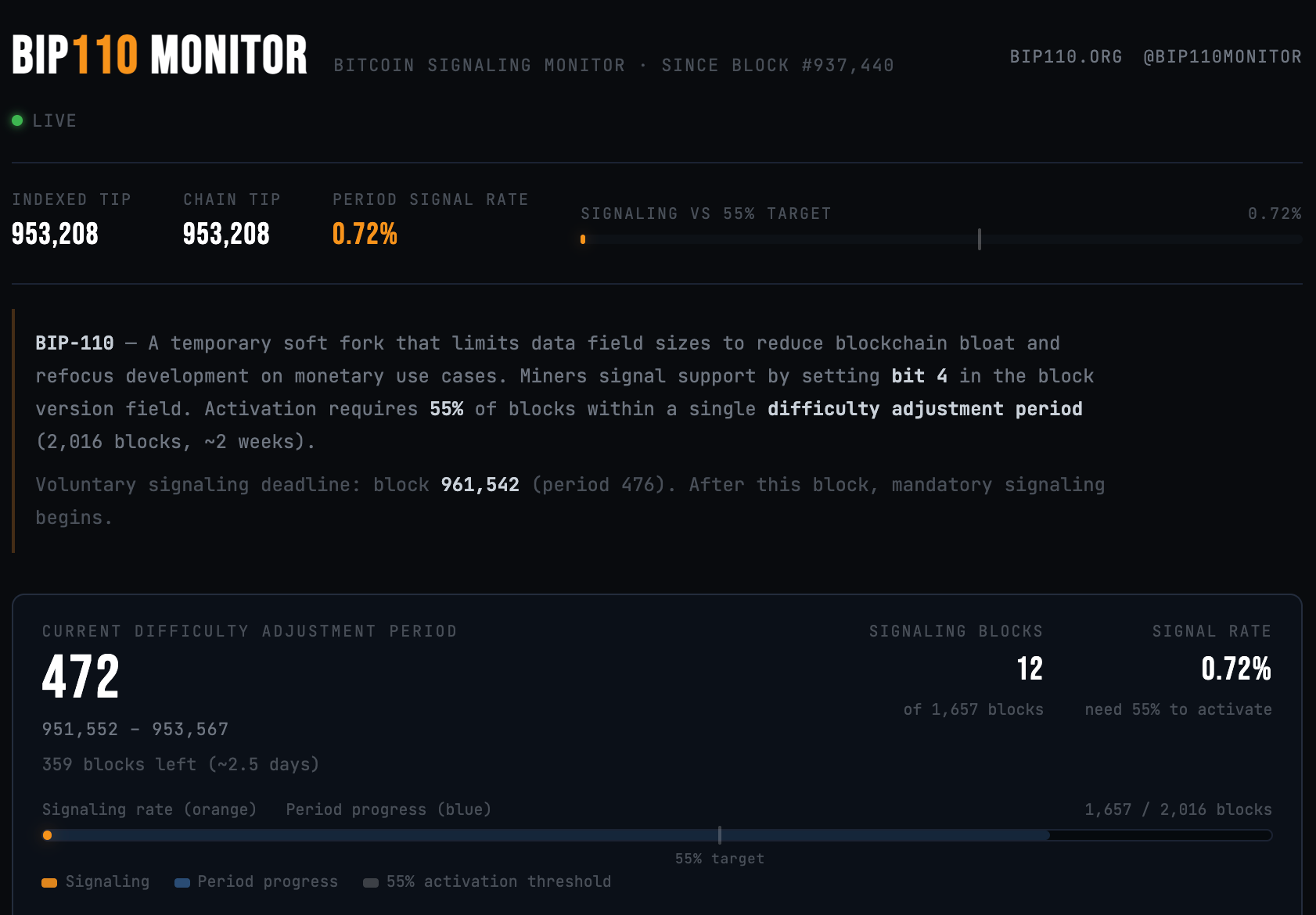
The proposal relies on miner signaling for activation. Miners indicate support by setting bit 4 in the block version field. Activation would require support from 55% of blocks within a single difficulty adjustment period of 2,016 blocks, or roughly two weeks.
Current data shows support remains well below that threshold. In the ongoing difficulty adjustment period, only 12 of 1,656 blocks have signaled support. That represents a signaling rate of about 0.72%.
The voluntary signaling phase is scheduled to end at block 961,542. Under the BIP-110 framework, mandatory signaling would begin afterward.
Supporters Point to Growing Momentum
Despite the low signaling rate, supporters insist the proposal is gaining traction.
Bitcoin commentator, Majorian / BIP-110, responded to critics by noting that many observers initially believed BIP-110 would attract little or no support. He described the movement as a grassroots campaign driven largely by individual Bitcoin users rather than major mining pools.
Supporters argue that the recent increase in signaling reflects growing concern about blockchain data usage and Bitcoin’s long-term scalability.
Adam Back Rejects Consensus Claims
Adam Back pushed back against the idea that rising signaling validates the proposal.
He said the “simple fact” is that BIP-110 does not currently have consensus among Bitcoin participants. According to Back, supporters should focus on improving the proposal and building broader agreement rather than attempting to force a protocol change.
Back also warned that moving forward without consensus could result in a separate chain through a contentious fork.
Referring to previous Bitcoin fork disputes, he argued that Bitcoin’s resistance to change is intentional and remains one of the network’s key strengths.
When another user claimed BIP-110 supporters were resisting harmful changes to Bitcoin’s development direction, Back responded that BIP-110 itself is the proposed change.
He added that users who want stricter transaction policies can already implement them through node settings. In his view, a network-wide consensus change is unnecessary.
Back further argued that Bitcoin’s immutability would be weakened if protocol rules could be changed whenever a minority group disagreed with the broader network.
Long Road to Activation
The debate highlights BIP-110’s biggest challenge: gaining sufficient support.
Supporters point to increasing miner participation and growing grassroots interest. However, the proposal remains far from the 55% signaling threshold required for activation.
With less than 1% of blocks currently signaling support, advocates still need to convince a much larger share of Bitcoin’s mining ecosystem.
Meanwhile, critics such as Adam Back maintain that any proposal seeking to alter Bitcoin’s consensus rules must first demonstrate overwhelming agreement across the network.
Related: Quantum Threat to Bitcoin Not Immediate, Says Blockstream’s Adam Back
Disclaimer: The information presented in this article is for informational and educational purposes only. The article does not constitute financial advice or advice of any kind. Coin Edition is not responsible for any losses incurred as a result of the utilization of content, products, or services mentioned. Readers are advised to exercise caution before taking any action related to the company.