



- Bitcoin fell below $60K despite the Nasdaq’s 6.5% rally amid weakness in crypto.
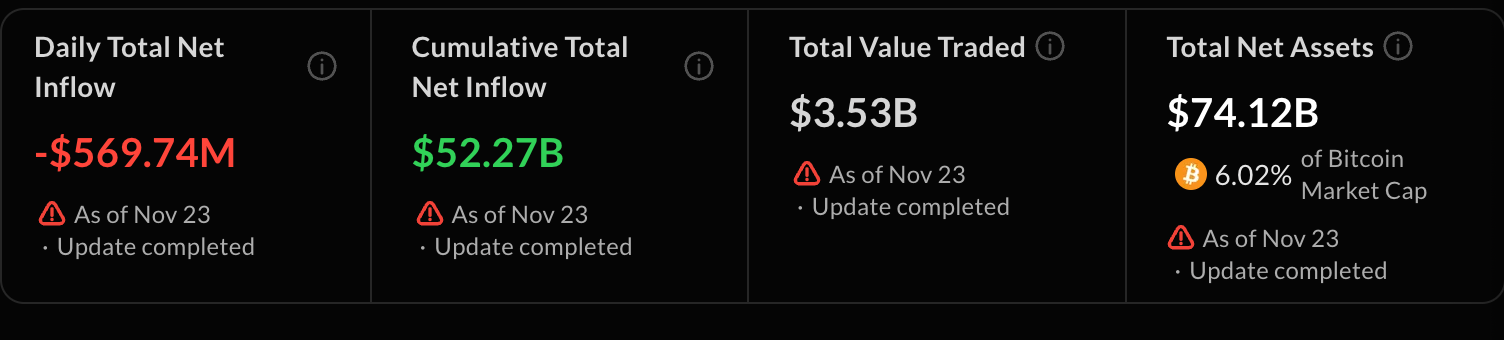
- Bitcoin ETFs recorded $579 million in daily outflows, while stablecoin liquidity continued to decline.
- Traders are watching $60K support and U.S. inflation data for clues about Bitcoin’s next move.
Bitcoin fell below $60,000 despite a strong recovery in U.S. stock markets. On Monday, the Nasdaq Composite surged 6.51%, while Bitcoin also climbed above $64,000 before falling below $60,000 later that day. The initial surge marked a massive 15% rebound from the November 21 low of $55,130.
The Nasdaq’s rally followed Nvidia’s reinstatement of Jensen Huang as CEO, just 11 days after his resignation. Nvidia shares jumped 31.48%, marking their biggest single-day gain since 2003 and adding nearly $1 trillion to the company’s market value.
Other technology stocks also rallied, with the Philadelphia Semiconductor Index gaining approximately 14% and the S&P 500 rising 4.73%.
Bitcoin, however, failed to fully benefit from the market recovery. After dropping toward $55,000 over the weekend, it rebounded to around $64,500 before losing momentum. Ethereum followed a similar pattern, falling toward $1,700.
Bitcoin Faces Weak Demand and Liquidity Outflows
One of the biggest obstacles to Bitcoin’s recovery is the lack of fresh buying demand. U.S. spot Bitcoin ETFs recorded another outflow of $570 million yesterday, bringing their month-to-date BTC sales to $4.71 billion.
The Coinbase Bitcoin premium has also remained negative for 60 consecutive days, indicating weak buying demand among U.S. investors.
Meanwhile, stablecoin liquidity continues to decline. Data from DeFiLlama shows that the total stablecoin market capitalization fell to $280.5 billion, down 1.56% in seven days.
Because stablecoins provide liquidity for cryptocurrency trading, a shrinking supply reduces the capital available to support prices and absorb selling pressure.
Together, these indicators point to a crypto market struggling with capital outflows as traditional technology stocks attract renewed investor interest.
Follow us on X for real-time crypto updates.
Liquidations and Institutional Selling Add Pressure
Trading activity has also contributed to Bitcoin’s volatility. Wintermute reported that $68.8 million in short positions were liquidated within one hour on November 21, compared with just $1.6 million in long liquidations.
This suggests that part of Bitcoin’s rebound was driven by short sellers being forced to close their positions rather than a surge in new buying demand.
Although Strategy and some other institutions continue accumulating Bitcoin, their purchases have not been enough to offset ETF withdrawals and broader selling pressure.
Is Bitcoin Decoupling From the Nasdaq?
Bitcoin’s recent underperformance does not necessarily signal a permanent break from technology stocks. Instead, crypto-specific pressures are currently outweighing market sentiment.
While Nvidia’s rally helped drive gains across the Nasdaq and semiconductor stocks, Bitcoin remains dependent on capital inflows and investor demand.
The $60,000 level is an important price point to watch, as a break below it could expose Bitcoin to further declines toward $58,000 and $55,000. On the upside, a recovery into the $63,000–$65,000 range could ease some of the selling pressure.
Investors are also watching Wednesday’s U.S. October PCE inflation report for clues about inflation trends, interest-rate expectations, and the Federal Reserve’s next policy decisions.
Subscribe to our YouTube channel for the latest crypto news.
Related: Bitcoin Price on Black Friday 2026: Will BTC Rally or Crash Again?
Disclaimer: The information presented in this article is for informational and educational purposes only. The article does not constitute financial advice or advice of any kind. Coin Edition is not responsible for any losses incurred as a result of the utilization of content, products, or services mentioned. Readers are advised to exercise caution before taking any action related to the company.