

- JPMorgan says Bitcoin has traded below its production cost for five straight months.
- More than 20% of Bitcoin miners are now unprofitable as margins shrink and operating costs remain high.
- Despite stress in the mining sector, whale accumulation and lower exchange reserves are bullish signs.
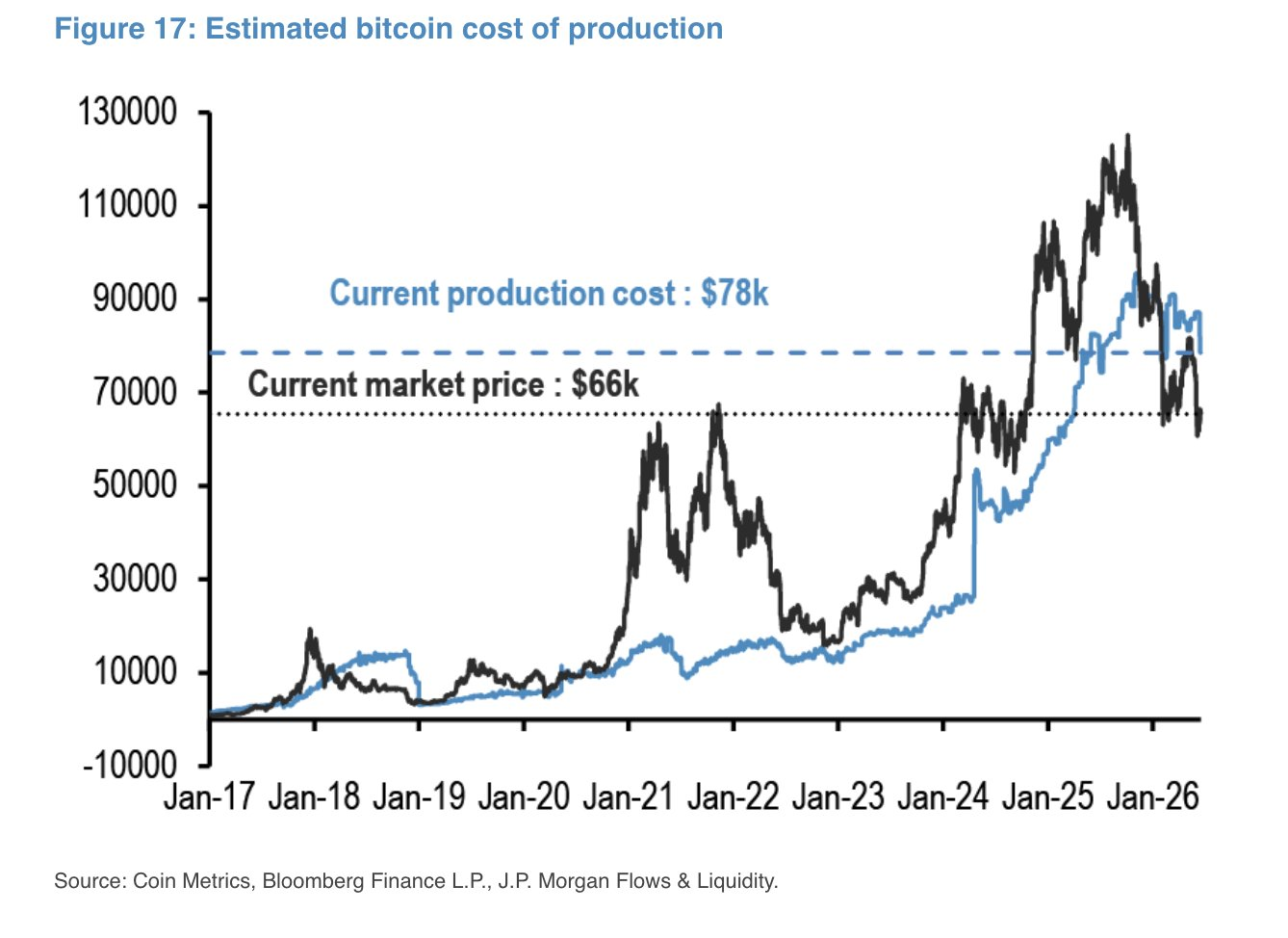
Bitcoin mining economics have deteriorated sharply this year. According to a new JPMorgan report, Bitcoin has traded below its estimated production cost for five straight months, putting increasing financial pressure on miners.
Bitcoin Trading Below Production Cost
JPMorgan estimates that it currently costs about $78,000 to mine one Bitcoin. Meanwhile, Bitcoin is trading near $62,500. The gap between production costs and market price has shrunk profit margins. As a result, many miners are operating at a loss.
Citing data from CoinShares, JPMorgan analysts led by managing director Nikolaos Panigirtzoglou estimate that roughly 20% of Bitcoin miners are now unprofitable.
The bank said the pressure has forced many mining companies to look for alternative sources of liquidity.
Publicly traded Bitcoin miners sold more than 32,000 BTC during the first quarter of 2026 to cover operating expenses. That figure exceeded their total Bitcoin sales for all of 2025, highlighting the growing strain on the sector.
Mining Network Reacting More Quickly to Price Changes
JPMorgan said Bitcoin’s hashrate and mining difficulty have become more sensitive to price movements this year. Over the past six months, the beta of mining difficulty relative to Bitcoin’s price has risen to 0.62.
This suggests more miners are operating close to breakeven levels. So, they are quicker to switch mining equipment on or off as market conditions change.
When Bitcoin trades below production cost, higher-cost miners shut down operations. This reduces the network’s total computational power (hashrate). Mining difficulty then adjusts downward to compensate.
That trend was visible during the second week of June, when mining difficulty fell by 10%. It was the second drop of that size this year, following a similar adjustment in January.
Older Miners Face Growing Challenges
The report noted that older mining equipment and operations with high electricity costs are particularly vulnerable.
Hashprices, a measure of mining revenue per unit of computational power, are currently ranging between $28 and $30 per PH/s/day.
According to CoinShares’ first-quarter mining report, operations paying more than about $0.06 per kilowatt-hour for electricity are finding it increasingly difficult to stay profitable.
JPMorgan expects hashrate sensitivity to remain elevated. The bank also anticipates large and more frequent adjustments to difficulty if Bitcoin remains under its production cost.
Could It Become a Bullish Signal?
Despite the current situation, JPMorgan suggested that negative sentiment toward the mining sector may later become a contrarian bullish signal.
The bank’s view comes as several market indicators are turning positive. These include whale accumulation and declining exchange reserves, even as miners face one of the most challenging economic environments in recent years.
Related: Bitcoin Trades Above 200-Week MA That Historically Delivered 113% Returns
Disclaimer: The information presented in this article is for informational and educational purposes only. The article does not constitute financial advice or advice of any kind. Coin Edition is not responsible for any losses incurred as a result of the utilization of content, products, or services mentioned. Readers are advised to exercise caution before taking any action related to the company.