

- Bitcoin is down 54.3% from its $126K peak, with the current drawdown at 268 days.
- NYDIG models a $38K to $39K potential cycle low for early October as a scenario.
- Bitcoin fell 32.9% in H1 2026 while tech equities gained 43.5% over the same period.
Bitcoin is down 54.3% from its all-time high, the drawdown has stretched to 268 days, and a new quarterly report from NYDIG has raised the question: could this cycle produce one more leg down before the bottom is in?
Pattern That Keeps Repeating
NYDIG’s analysis places the current drawdown alongside the three prior major cycle resets of 2014, 2018, and 2022. Each one followed a broadly similar structure. Bitcoin peaked, corrected sharply, attempted a recovery that failed to hold, and then made a final lower low before the next cycle began.
The two most recent bear markets lasted 363 and 376 days respectively and reached trough depths of 84.3% and 77.6% from their peaks.
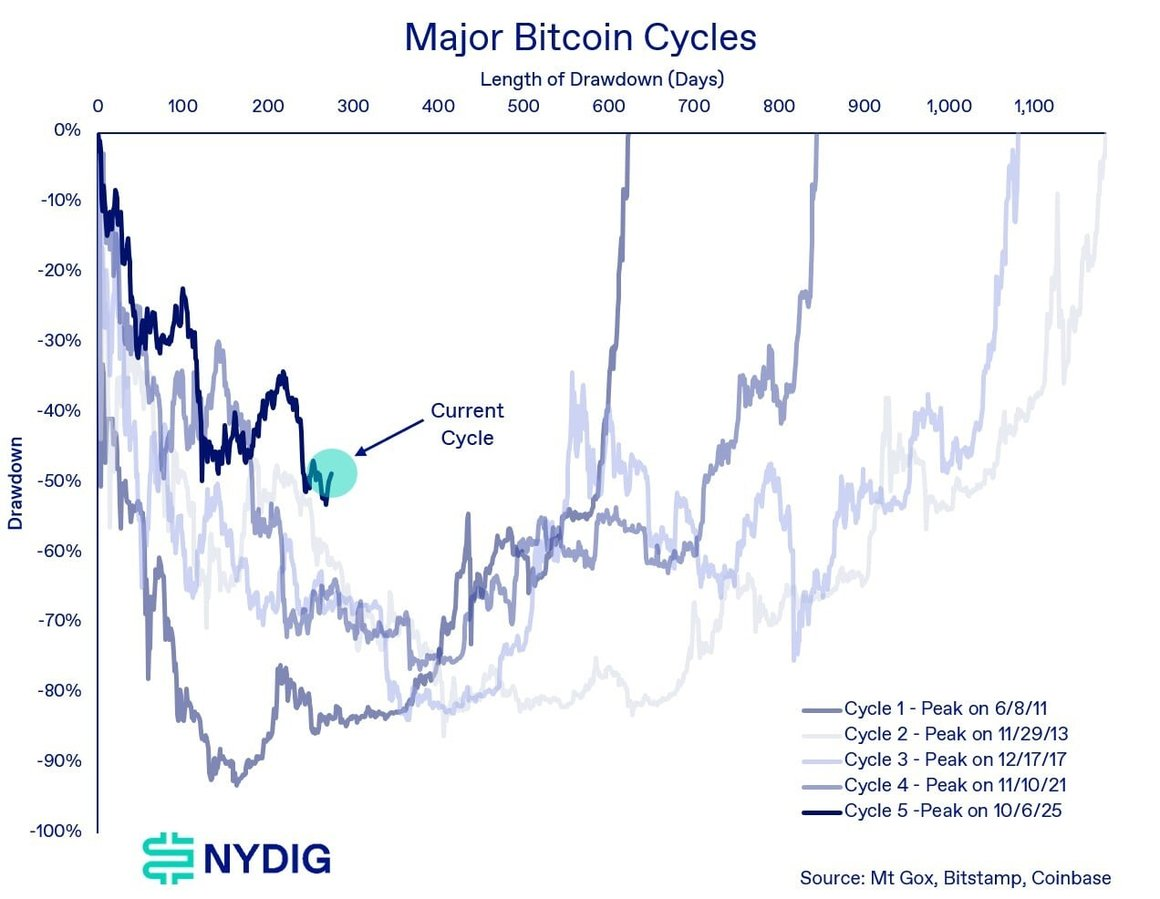
The current cycle, measured from the October 2025 all-time high of above $126,000, has now extended to 268 days. That puts it well within the duration range of prior cycles, but not yet at the point where prior cycles found their floors.
The $38,000 Scenario
If the pattern of progressively shallower cycle troughs holds, each cycle bottom being less severe than the last, a 70% drawdown from $126,000 would place the potential floor near $38,000 to $39,000. NYDIG’s timing analysis points toward early October as the window when that scenario would play out.
The firm is explicit that this is a scenario rather than a base-case forecast. But the fact that it is being modeled at all by institutional research reflects how seriously the cycle clock is now being taken.
What Made This Cycle Different So Far
The current drawdown has diverged from prior ones in one important respect. Bitcoin fell 13.4% in Q2 and 22.6% in Q1, while technology equities gained 43.5% and the Nasdaq 100 rose 27.7%. Rather than falling alongside risk assets as it did in 2022, Bitcoin underperformed in an environment where everything else rallied.
NYDIG attributes that divergence to two bitcoin-specific factors. Selling pressure tied to digital asset treasury companies, and tighter liquidity expectations following the hawkish policy shift under Fed Chair Kevin Warsh.
Bitcoin, the report concludes, behaved less like high-beta technology and more like a pressured hard asset.
What Would Prevent a $38,000 Low?
Three demand-driven catalysts could cut the cycle short before it reaches prior-cycle trough depths: a recovery in digital asset treasury company buying, a return of ETF inflows, and easier liquidity conditions.
US spot ETFs posted $4.9 billion in net outflows during Q2, with the three largest products, iShares, Grayscale, and Fidelity, accounting for nearly all of it.
The CLARITY Act represents the most significant potential catalyst on the regulatory side. With the Senate legislative window running only until August 7 before recess, the next three weeks carry outsized importance for whether a federal crypto market structure framework passes this year or gets pushed into a more difficult political environment.
The Counterargument
Bitcoin has now held above $58,000 for more than six months despite the Iran conflict, Strategy’s STRC difficulties, SpaceX IPO liquidity drain, and persistent inflation concerns. Every catalyst that historically would have produced a new cycle low has failed to do so.
That resilience is itself a data point that the cycle may be behaving differently because the holder base, with sovereign reserves, corporate treasuries, and ETF custodians, is structurally different from 2018 or 2022.
Whether $38,000 is the next stop or whether the floor is already behind us is the question the next three months will answer.
Related: Bitcoin Holder Losses Deepen as $65K Rejection Tests $68K Forecast
Disclaimer: The information presented in this article is for informational and educational purposes only. The article does not constitute financial advice or advice of any kind. Coin Edition is not responsible for any losses incurred as a result of the utilization of content, products, or services mentioned. Readers are advised to exercise caution before taking any action related to the company.