

- Block launches proof-of-reserves dashboard, letting users verify its Bitcoin holdings in real time.
- Firm reveals 28,355 BTC worth $2.2B, split between customer funds and corporate treasury.
- New Cash App, Square, and Bitkey features aim to drive everyday Bitcoin payments and use.
Block Inc., led by Jack Dorsey, has rolled out a new proof-of-reserves system, giving the public a clearer view into its Bitcoin holdings. At the same time, the firm is pushing deeper into everyday Bitcoin use.
The update, announced on April 27, combines transparency tools with new products across Cash App, Square, and its self-custody wallet Bitkey.
Block Opens Its Bitcoin Holdings for Public Verification
At the center of the announcement is a proof-of-reserves dashboard that allows users to independently verify Bitcoin balances held by Block.
The system uses blockchain-based cryptographic signatures, meaning users can confirm that the company controls specific Bitcoin wallets without exposing private keys. Verification happens directly in the browser, with no user data leaving the device.
Block said the dashboard separates funds into two categories: customer holdings and corporate treasury. Customer balances reflect Bitcoin stored on behalf of users across its platforms, while corporate holdings represent Bitcoin owned by the company itself.
In its first-quarter 2026 disclosure, Block reported holding 28,355 Bitcoin worth about $2.2 billion. This includes roughly $1.5 billion tied to Cash App users and around $689 million held in its corporate treasury. The company now ranks among the top 15 public firms holding Bitcoin globally.
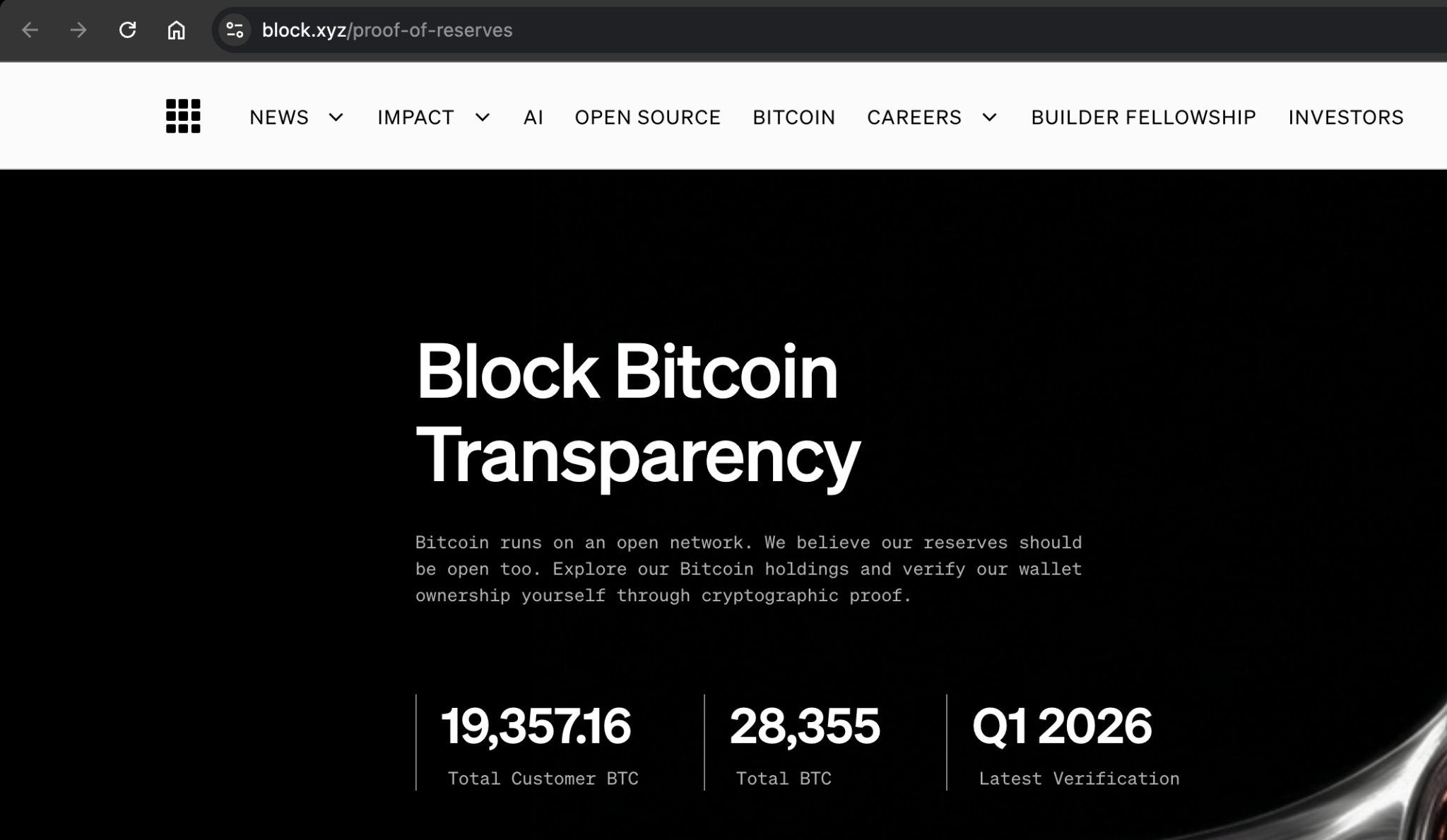
Source: Block
The move follows a wider industry shift toward transparency after the collapse of FTX in 2022, which pushed exchanges like Binance, Kraken, and OKX to adopt similar systems.
Proof-of-Reserves Still Has Limits
While proof-of-reserves improves visibility, Block made it clear that the system is only a snapshot in time.
It confirms asset ownership but does not show liabilities, loans, or internal financial obligations. In simple terms, a company can prove it holds Bitcoin, but that alone does not guarantee overall financial health.
For users, the tool offers more confidence that funds exist. But for investors, a complete picture still depends on audits, filings, and broader disclosures beyond blockchain data.
New Bitcoin Features Across Cash App and Square
Alongside transparency, Block introduced several features to make Bitcoin easier to use in daily life. On Cash App, eligible users can now automatically convert incoming payments into Bitcoin.
A new “Bitcoin Back” feature also offers up to 5% rewards in Bitcoin when spending at Square merchants, with limits applied.
Withdrawal limits have also been increased significantly, now set at $10,000 per day and $25,000 per week for eligible users.
For merchants, Square is preparing to demonstrate NFC tap-to-pay Bitcoin payments at Bitcoin Las Vegas 2026. The system allows customers to pay with a simple tap, similar to contactless cards, without QR codes.
The payments rely on the Lightning Network for near-instant settlement, while Square handles the technical complexity behind the scenes. Block says it will offer 0% processing fees for these payments through 2026.
Bitkey Wallet Pushes Self-Custody Simplicity
Block also introduced a new version of its Bitkey hardware wallet, featuring a secure touchscreen.
The device is built on a 2-of-3 multisignature setup and removes the need for traditional seed phrases, a common pain point for users. It also includes features like inheritance planning and privacy-focused controls.
The goal is to give users full control not just over their Bitcoin, but over the security system protecting it.
Building a Full Bitcoin Ecosystem
The latest updates show how Block is connecting different parts of its Bitcoin strategy into one system.
Cash App focuses on earning and storing Bitcoin; Square handles payments; Bitkey supports self-custody; and its mining initiative, Proto, focuses on infrastructure. Together, these pieces aim to make Bitcoin part of everyday financial activity.
Block’s approach highlights the ongoing trend in which companies are not just holding Bitcoin but building products around it.
With over 1.1 million Bitcoin now held collectively by public companies, corporate adoption continues to grow. Now, Block is positioning itself as one of the most active players trying to bring Bitcoin into daily life.
Related: Strategy Buys 3,273 BTC, Extends Massive Bitcoin Accumulation Streak
Disclaimer: The information presented in this article is for informational and educational purposes only. The article does not constitute financial advice or advice of any kind. Coin Edition is not responsible for any losses incurred as a result of the utilization of content, products, or services mentioned. Readers are advised to exercise caution before taking any action related to the company.