

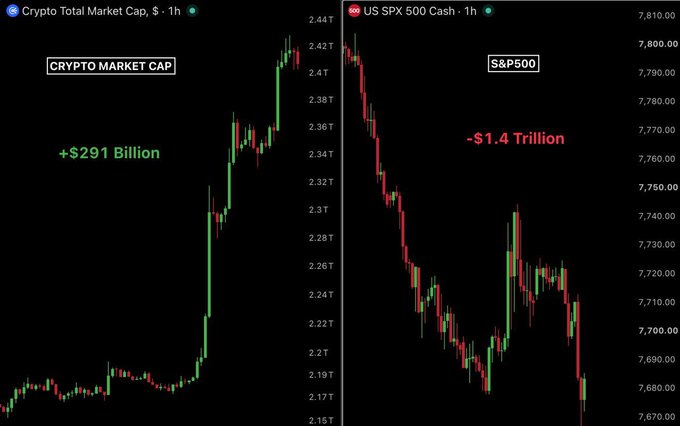
- An unusual decoupling saw the total crypto market cap rise 13% after adding $291B, as U.S. stocks lost $1.4T.
- The U.S. treasury buybacks, a weakening dollar, and short liquidations exceeding $2.7B boosted demand.
- This divergence shows crypto response to policy and liquidity tailwinds, as stocks face separate pressures.
The total cryptocurrency market capitalization surged approximately 13% this week, adding $291 billion, while U.S. stocks moved in the opposite direction, erasing $1.4 trillion as the S&P 500 fell 1.83%. The sharp divergence highlights a rare decoupling between the crypto market and U.S. stocks.
Crypto Market Adds $291B as Stocks Erase $1.4T
This week delivered one of the clearest divergences between crypto and traditional equities in recent memory. The total crypto market cap surged 13% after adding approximately $291 billion, while U.S. stocks moved in the opposite direction, erasing about $1.4 trillion in market value with the S&P 500 declining around 1.83%.
Source: X
As of 20 August 2026, the crypto market has surged back and is currently trading in the range of $2.45–2.55 trillion in total capitalization, after a robust multi-day uptrend. Bitcoin (BTC) surged above 71, 000 – 72,000, while Ethereum (ETH) led the charge with gains of 17–19%, trading above 2,270 – 2,300.
Major altcoins, such as XRP, Solana, and others, also rallied with double-digit gains, as the altcoin market capitalization returned to over $1 trillion levels. The trading volumes also increased substantially with the move.
Why Crypto Surged: Key Drivers Behind the Rally
Macro policy changes, institutional positioning and derivative market mechanics drove the divergence between the falling prices of equities and the rising prices of digital assets. Regulatory overhangs were alleviated by White House policy and regulatory optimism and institutional desks returned to spot markets with renewed confidence. Additionally, the bond yield drop and targeted US Treasury liquidity actions provided a favourable backdrop for digital risk assets.
Record short liquidations accelerated the upward move as prices broke key overhead resistance levels and over leveraged short positions were systematically wiped out. A record $2.7 billion was liquidated in perpetual futures markets in a 24 hour span as automated market makers were forced to purchase spot and futures assets to cover underwater positions. Spot Bitcoin ETFs and crypto-native corporate treasuries also posted significant net inflows.
Policy momentum and spot ETF inflows indicate real institutional accumulation, while the record $2.7 billion short squeeze confirms that a major engine of today’s surge of $291 billion was mechanical. Forced liquidations were behind the order book liquidity and added to the price appreciation above organic demand, raising the key question of whether the rally is driven by structural demand, or a liquidity move.
Related: Jane Street Lost $15B; Why Crypto Market Worry About Liquidity?
What’s Next for Crypto as Policy and Liquidity Tailwinds Diverge From Stocks?
The recent rally in the crypto market has put the industry on a key threshold, with policy and liquidity tailwinds diverging from traditional equity declines. Bitcoin has rebounded to $70,000 and is now trading above the 100 day and 200 day moving averages, but the $70,000 to $75,000 resistance area is crucial. The next test will be if spot market bids can absorb profit taking after the initial $2.7 billion short squeeze subsides.
Meanwhile, the relative strength of the crypto market will depend on macro deleveraging versus Treasury support. Wall Street grapples with megacap technology weakness and equity deleveraging, as well as higher long-term yields, while US Treasury buybacks offer liquidity support. Deeper equity liquidation or renewed yield pressure may cause institutional margin calls, though, and could test crypto’s decoupling.
Furthermore, regulatory milestones and structural flows will determine whether the rally becomes a sustained trend reversal. Sentiment has improved with White House support and movement under the Clarity Act, although there is still uncertainty. Inflows from continued spot Bitcoin ETF buying, corporate treasury buys, and robust open interest will be necessary to maintain the rally from the critical breakout levels.
Related: Bitcoin Price Prediction: Will BTC Hit $70K in July 2026?
Disclaimer: The information presented in this article is for informational and educational purposes only. The article does not constitute financial advice or advice of any kind. Coin Edition is not responsible for any losses incurred as a result of the utilization of content, products, or services mentioned. Readers are advised to exercise caution before taking any action related to the company.