

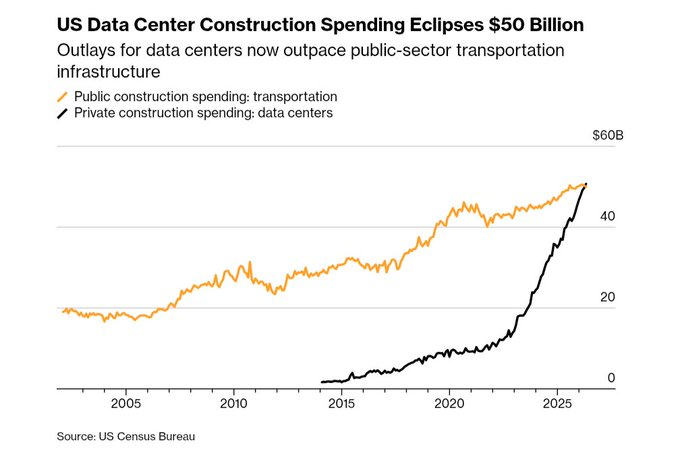
- US data centre construction hit $50.7B annualised in April 2026, topping record.
- Average US data centre build cost tripled to $475M from $177.9M in one year now.
- Electricity bills rose 40% since 2021 and up 267% near some US data centre hubs.
America is spending more money building data centres than it spends on airports, ports and mass transit systems combined, and the gap is widening fast.
U.S. data centre construction spending reached a $50.7 billion annualised rate in April 2026, overtaking the entire country’s investment in public transportation infrastructure. Data centres now account for 2.3% of all U.S. construction spending, up from a fraction of that figure just a few years ago.
The average facility now costs $475 million to build, nearly triple the $177.9 million average from a year ago, and construction costs per square foot have risen 45% in the same window.
Who Is Driving the Spending
The companies behind this construction boom are the same ones sitting at the top of the S&P 500 and inside most American retirement funds. Microsoft, Amazon, Meta and Google are collectively pouring hundreds of billions into data centre infrastructure to power their artificial intelligence ambitions, with each company racing to secure the computing capacity it believes it needs to remain competitive over the next decade.
Source: X
The scale of the buildout has been described by Bloomberg as increasingly central to the U.S. economy. It is also increasingly invisible to most Americans, who are more likely to notice its consequences than the facilities themselves.
The Consequences Landing in People’s Mailboxes
Average residential electricity prices in the United States have risen 40% since 2021. In areas located near large data centre clusters, some households have witnessed 267% rise, according to Bloomberg analysis. Utilities filed requests for more than $30 billion in rate increases last year alone, affecting approximately 81 million Americans.
Related: US Allows Anthropic’s Mythos AI Back Online as Trump Threatens 100% Tariffs
AI Is Also Reshaping How Institutional Investors Work
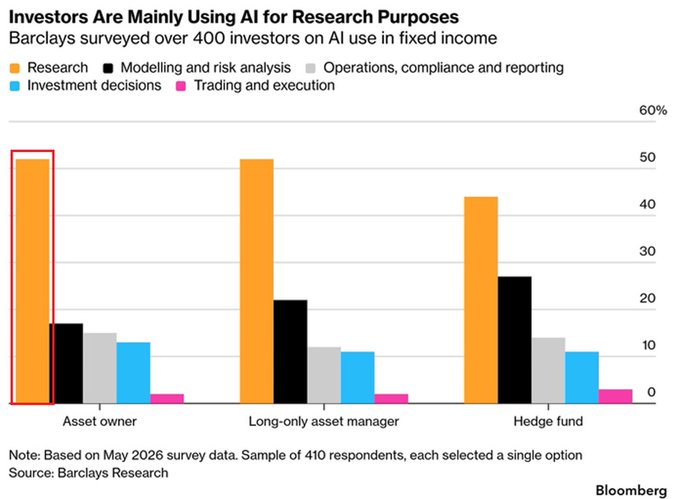
The demand driving this construction boom is not just coming from tech giants. According to a Barclays survey of 410 fixed-income investors, approximately 52% of institutional investors now primarily use AI for research.
Source: X
Hedge funds follow at around 44%, primarily using AI to process and analyse large volumes of market data. Around 27% of hedge funds use AI for modelling and risk analysis, compared with 22% of long-only managers and 17% of asset owners. Operations, compliance and reporting, and investment decisions each account for just 10% to 15% across these groups.
The numbers point to a structural shift in how capital markets operate, one that requires the physical infrastructure now being built at record pace.
The Infrastructure That Is Not Getting Built
While data centre investment surges, the public transportation infrastructure that Americans use every day is facing a projected $89.3 billion funding shortfall over the next decade. Roads, airports, transit systems and ports are competing for a much smaller pool of capital against an asset class backed by some of the most profitable companies in the world.
What It Means
Data centres do bring construction jobs, local tax revenue and new digital capacity. They are also the physical infrastructure that makes artificial intelligence possible at scale, which carries genuine economic value. But the concentration of investment in a single category of infrastructure, driven primarily by the needs of a handful of very large companies, is reshaping U.S. electricity grids, land use patterns and utility planning in ways that communities and regulators are only beginning to grapple with.
Related: AI Investment Boom Faces Mounting Cost Pressures as Chip Rally Raises Market Concerns
Disclaimer: The information presented in this article is for informational and educational purposes only. The article does not constitute financial advice or advice of any kind. Coin Edition is not responsible for any losses incurred as a result of the utilization of content, products, or services mentioned. Readers are advised to exercise caution before taking any action related to the company.