
- El Salvador claims daily Bitcoin purchases, but the IMF says its BTC reserves show no net accumulation.
- The IMF’s $1.4B loan allows voluntary public-sector Bitcoin holdings without setting a cap.
- The IMF’s next review may further examine differences between El Salvador’s BTC claims and data.
El Salvador says it continues buying Bitcoin (BTC) daily, raising its national Bitcoin reserve to 7,696 BTC worth approximately $460 million. However, the International Monetary Fund (IMF) says no net new government Bitcoin purchases have occurred since early 2025, citing the country’s $1.4 billion bailout terms that prohibit voluntary public-sector Bitcoin acquisitions.
El Salvador Claims Daily Bitcoin Purchases, But the IMF Disputes
President Nayib Bukele’s government has been pushing a narrative about buying one BTC a day to continue building its Strategic Bitcoin Reserve. As of June 28, 2026, official trackers show that El Salvador holds about 7,696 BTC, worth approximately $460M.
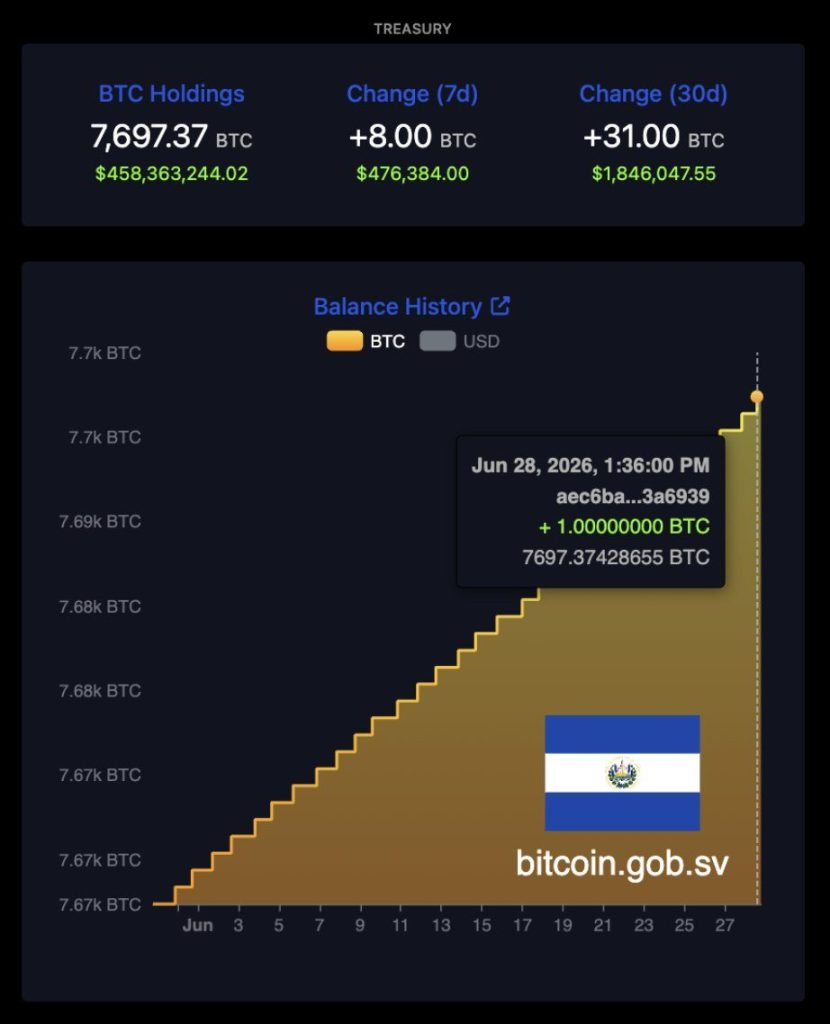
While this figure represents growth from around 5,968 BTC at the start of the IMF program in late 2024, the IMF maintains that there have been no net new market acquisitions. Instead, the increases mirror the consolidation of the country’s existing BTC across several government-controlled wallets, consisting of transfers from entities such as BANDESAL.
IMF Loan Imposes Strict Zero Ceiling on BTC Purchases
In February 2025, the IMF approved a $1.4 billion Extended Fund Facility (EFF) for El Salvador, which includes a continuous quantitative performance criterion that sets a hard limit on voluntary BTC purchases by the public sector. As per the agreement, the government and all public entities will not be allowed to buy new BTC during the program period.
The agreement also prohibits issuing or guaranteeing BTC-denominated or BTC-indexed public debt. These are conditions that must be fulfilled to maintain access to program financing, as they are binding conditions linked to IMF loan disbursements.
In addition to purchase restrictions, the EFF calls for increased transparency by demanding regular updates on the BTC wallet addresses and balances held by the public sector. It also mandates liquidating the Fidebitcoin trust, reducing public involvement in the Chivo wallet, and publishing audited financial statements for BTC-related entities.
What’s Next for El Salvador’s Bitcoin Strategy?
El Salvador’s BTC strategy now operates at the intersection of domestic political priorities and IMF obligations. Ahead of the next EFF review, it must show compliance with the zero-ceiling rule on public Bitcoin purchases despite Bukele’s pro-Bitcoin stance. Any breach could delay disbursements or trigger corrective measures under the program, increasing scrutiny, going forward.
Politically, the “Bitcoin nation” brand continues to be a potent asset for Bukele, sustaining global attention and domestic backing. However, sustained economic stability could require deeper integration of BTC into tourism, remittances, or technology sectors.
Therefore, without new purchases, future growth will depend on price appreciation, internal optimization, and potential non-market acquisitions. In the longer run, the country could explore private-sector partnerships, tokenized instruments under IMF restrictions, and gradual diversification to balance risk.
Related: El Salvador: $1.4B IMF Deal on Paper, 6,154 BTC In Reserve
Disclaimer: The information presented in this article is for informational and educational purposes only. The article does not constitute financial advice or advice of any kind. Coin Edition is not responsible for any losses incurred as a result of the utilization of content, products, or services mentioned. Readers are advised to exercise caution before taking any action related to the company.