

- Ethereum trades below major EMAs, with $2,140–$2,280 forming strong resistance barrier.
- Derivatives elevated, open interest stable, traders cautious near key support.
- Long-term outlook remains bullish as institutions maintain $4K and $40K targets.
Ethereum extended its decline this week after losing the critical $2,000 support level, while bearish technical signals continued building across the market. The second-largest cryptocurrency traded near $1,984 during Thursday’s session.
Consequently, traders faced rising uncertainty as weak momentum and heavy resistance limited recovery attempts. At the same time, derivatives activity remained elevated, showing that investors still maintained strong exposure despite growing downside risks. However, long-term institutional forecasts continued supporting Ethereum’s broader outlook, even as short-term sentiment weakened.
Ethereum Faces Strong Resistance Pressure
Ethereum now trades below its 20-day, 50-day, 100-day, and 200-day exponential moving averages. Besides, the EMA cluster between $2,140 and $2,280 continues acting as a major resistance barrier. Sellers regained control after Ethereum failed to sustain rebounds above the $2,100 region earlier this month.
Technical indicators also reflected growing bearish momentum. The Directional Movement Index showed the negative directional line moving sharply above the positive line. Additionally, the Average Directional Index strengthened, signaling increasing trend pressure on the downside.
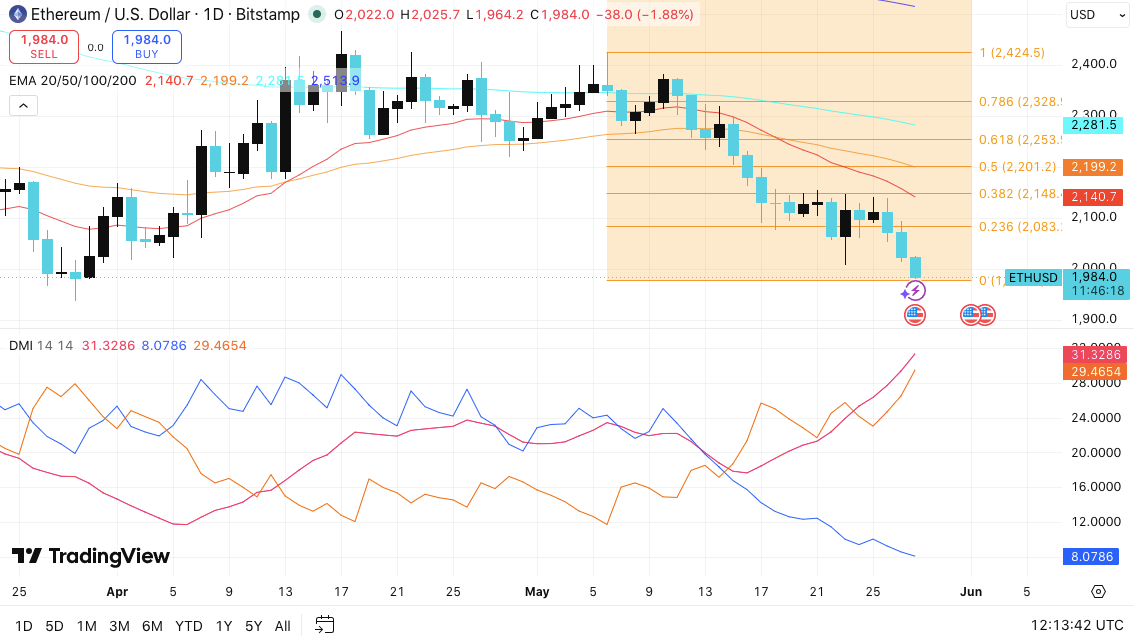
Several Fibonacci retracement levels now serve as key resistance points for traders. The 0.236 retracement level sits near $2,083, while stronger resistance remains around $2,148 and $2,201. Moreover, Ethereum faces additional barriers near $2,253 and $2,328 if buyers attempt another recovery rally.
On the downside, immediate support sits between $1,970 and $1,950. If bearish momentum intensifies, Ethereum could test the psychological $1,900 level. Consequently, further selling pressure may expose the market to a deeper decline toward $1,800.
Derivatives Activity Remains Elevated
Ethereum’s derivatives market continued showing strong participation despite recent volatility. Open interest expanded aggressively during Ethereum’s rally toward the $4,000 to $4,800 range last year. Significantly, leveraged positioning accelerated between June and September, pushing open interest above $60 billion.
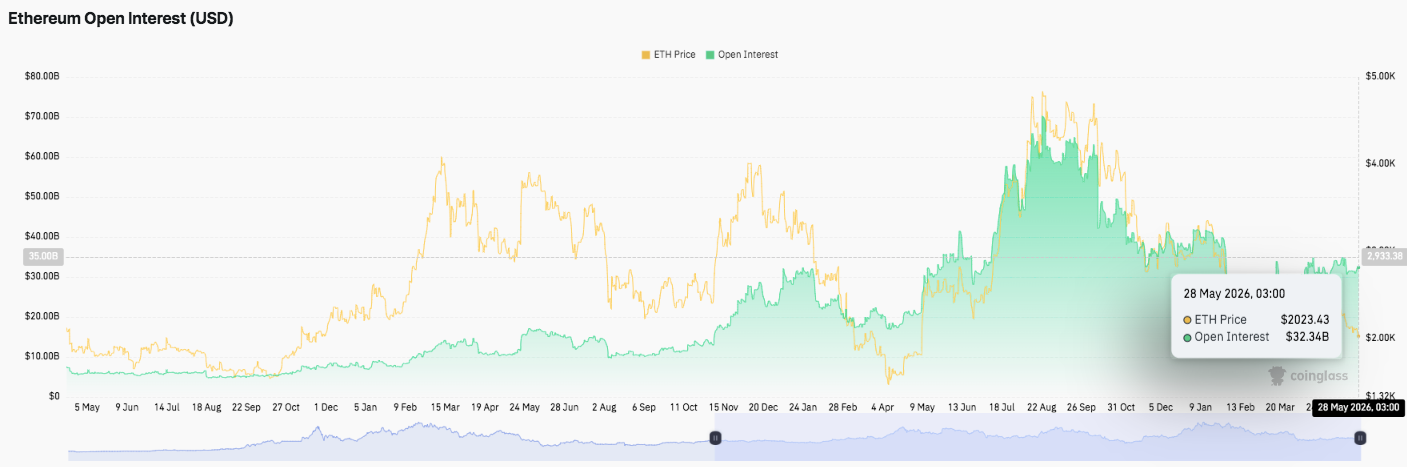
However, traders reduced exposure after the market peak triggered broad price corrections. Open interest later declined sharply before stabilizing between $32 billion and $35 billion. Current positioning suggests traders remain cautious while waiting for stronger directional confirmation.
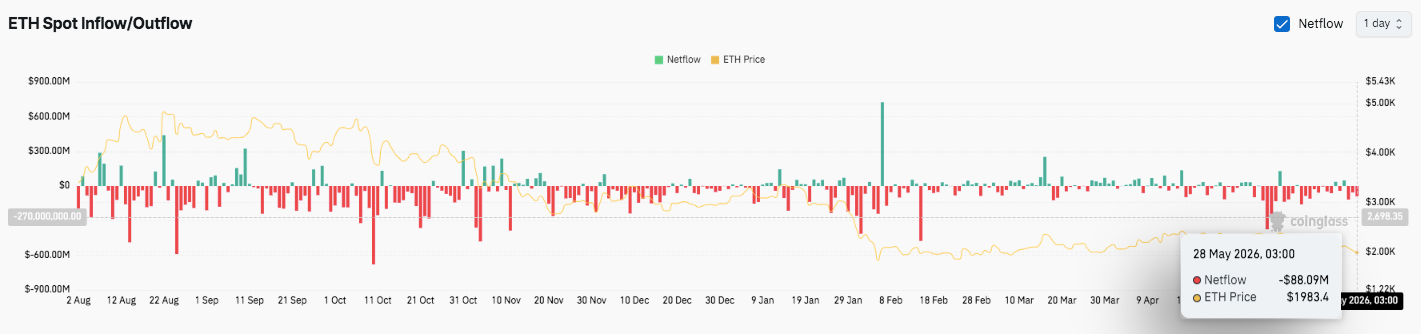
Meanwhile, exchange flow data showed continued outflows dominating the broader trend since late August. Large withdrawal spikes appeared throughout September, October, and February. Besides, several outflow surges exceeded $500 million, signaling ongoing accumulation behavior among investors.
Although periodic inflows appeared during November, January, and March, they failed reversing the larger exchange-flow structure. Recently, flows remained relatively balanced but slightly negative as investors continued moving Ethereum away from exchanges.
Standard Chartered Maintains Bullish Long-Term Outlook
Despite Ethereum’s current weakness, Standard Chartered maintained its aggressive long-term forecast for the asset. The bank reaffirmed its $4,000 Ethereum target for 2026 and a $40,000 projection for 2030.
Related: Vitalik Buterin Says DeepSeek v4 Supports Local AI Setup on Ethereum
Geoff Kendrick, the bank’s head of digital assets research, compared Ethereum’s current market structure to Amazon during the early 2000s technology crash. He argued Ethereum’s internal ecosystem metrics continued improving despite the token’s declining price.
Additionally, network activity and total value locked remained near record highs when measured in Ethereum terms. Kendrick suggested the disconnect between price performance and network growth could eventually narrow as market sentiment improves.
Technical Outlook for Ethereum (ETH)
Ethereum remains in a clearly defined bearish structure heading into the current market phase, with price action trading below the major EMA cluster and struggling to reclaim lost support levels. The breakdown below the $2,000 psychological zone has reinforced seller dominance, while the market now consolidates near the $1,950–$2,000 region.
Upside levels: Immediate recovery hurdles are seen at $2,083, $2,148, and $2,201. A stronger rebound above these zones could extend gains toward $2,253 and $2,328, where Fibonacci resistance aligns with prior rejection points. Beyond this range, the EMA resistance cluster between $2,140 and $2,280 remains the key barrier that bulls must reclaim to shift momentum.
Related: Ethereum Falls Below $2,000 as Retail Rushes to Buy the Dip
Downside levels: Immediate support sits at $1,970–$1,950, followed by a deeper liquidity zone near $1,900. If selling pressure accelerates, Ethereum risks extending losses toward $1,800, where historical demand may re-emerge.
Resistance ceiling: The $2,140–$2,280 EMA cluster acts as the main structural ceiling for any medium-term bullish recovery. Until Ethereum reclaims this zone, rallies are likely to face strong rejection pressure.
The technical structure suggests Ethereum is in a compression phase following a breakdown from its prior consolidation range. This setup often leads to volatility expansion once either support or resistance decisively breaks.
Will Ethereum Rebound?
Ethereum’s near-term direction depends on whether buyers can defend the $1,950–$1,900 support band long enough to rebuild momentum. If inflows strengthen and ETH reclaims $2,083, a recovery toward $2,200+ becomes possible. However, failure to hold current support risks accelerating downside continuation.
For now, Ethereum remains in a pivotal zone where both breakdown continuation and relief rally scenarios remain active. Volume confirmation and EMA recovery will decide the next major move.
Disclaimer: The information presented in this article is for informational and educational purposes only. The article does not constitute financial advice or advice of any kind. Coin Edition is not responsible for any losses incurred as a result of the utilization of content, products, or services mentioned. Readers are advised to exercise caution before taking any action related to the company.