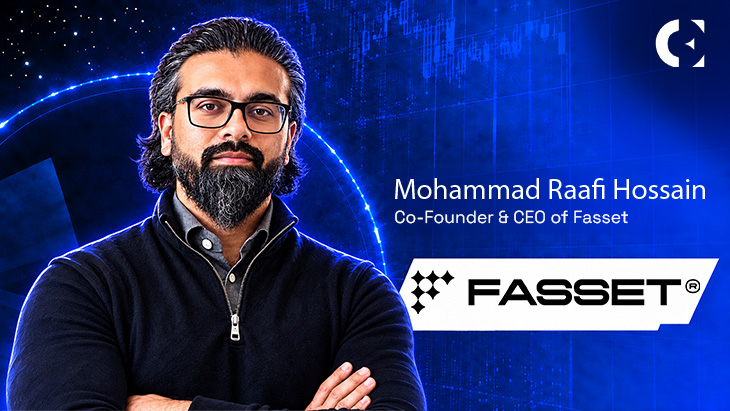

Crypto’s narrative is shifting from price speculation to real-world utility, with stablecoins emerging as a key bridge between traditional finance and digital assets. In regions where access, speed, and cost matter most, this transition is already underway.
In an interview with CoinEdition, Mohammad Raafi Hossain, Co-Founder and CEO of Fasset, explains how stablecoins are redefining cross-border payments, why infrastructure, not demand, is the real bottleneck, and what it will take for tokenized assets to move into the mainstream.
1. We’ve spent years talking about crypto as something people buy and trade. But stablecoins are starting to look much more like a way to actually move money. Do you think that’s where the biggest change is happening now?
Yes, absolutely. For a decade, the story was about what you could legitimately hold and whether it would go up. The real shift is that value has started to move the way information already does. Legacy rails move messages between banks, and stablecoins move the value itself in near-real time.
The clearest evidence is who’s using it and for what. We’re now processing over US$40 billion in annualized volume, and the bulk of that is traders, importers, exporters, and businesses and families moving money across borders. That number far surpasses the categorization of “early adoption.” When commodity traders are settling in stablecoins because it’s faster and cheaper than the banking system, the “buy and trade” framing is already behind us.
What makes it durable is that trust attaches to the institution, not the token. People are trusting a licensed entity with audited reserves and a regulator behind it, not a code. That’s the difference, and it’s healthy that the conversation has shifted from value speculation to financial utility.
2. If you look at something as simple as sending money from one country to another, the traditional system can still be frustratingly slow and expensive. What are you seeing on the ground that makes you think stablecoins can genuinely fix that?
Take the most ordinary case: someone earning in one currency who needs to hold value in another and send it home. Today, that process requires three intermediaries and the better part of a week, with fees stacked at every stage. On Own Network, it’s done via one app, and it settles in minutes.
The reason the old system is slow boils down to structure. The exclusion moved up a layer. It used to be “there’s no bank branch near me.” Now it’s “my bank has no correspondent relationship with yours.” Cross-border is the piece regulators still haven’t fully addressed anywhere, which is exactly why it’s stayed broken for so long.
Stablecoins are the fix, as that last mile is now tangible, not theoretical. Through our partnership with SBI Remit, we reach roughly 200 countries and let people turn digital assets into cash at hundreds of thousands of locations. Digital-native isn’t the whole market yet, so cash-out has to work. That’s the part that turns a clever rail into something a person in a frontier market can actually use.
3. Fasset is operating across some very different markets in Asia. You can’t really take the same financial product and approach to every country. What has surprised you most about building the business across the region?
What surprised me most is that the biggest challenge wasn’t demand, but infrastructure. We went in expecting to have to convince people; instead, we found that in most markets we serve, the question was whether people trust the dollar more than their own currency, and that answer has been yes for a long time. The appetite was already there.
You can see it in the adoption data: Chainalysis’s 2025 Global Adoption Index has high-growth markets, including India, Pakistan, and Vietnam, leading global crypto adoption, driven by remittances, savings, and inflation hedging rather than speculation.
Bangladesh is a good example. It has one of the world’s largest freelancer communities, and for them, the real friction is getting paid, as income earned abroad arrives through a chain of intermediaries, each taking a cut. A Fasset account collapses that chain: with its own IBAN, a card, and an investment platform in one place, a freelancer can receive earnings directly, spend them, and put them to work without middlemen.
The real work is that every market has its own rulebook, and there are no shortcuts. Simply put, you can’t copy-paste a product from the UAE into Indonesia or Pakistan. We built compliance-first and licensed market by market because that’s the only foundation that holds. The lesson I’d pass on is that readiness is built through action, not by waiting for perfect conditions.
4. You’re bringing payments, stablecoins, investing, and things like tokenized gold into the same financial experience. At what point does a user stop thinking about these as “crypto products” and just start seeing them as normal ways to manage their money?
For most of our users, that point has already passed, because they never really thought of it as crypto in the first place. They think in terms of what they’re trying to do: keep their savings in something stable, earn on it, send money home. The technology underneath is our problem to solve, not theirs.
The threshold matters more than the label. When you can hold tokenized gold or a stablecoin and spend it directly through partner networks, it starts to feel like a savings account, not a barter trade. That’s the moment the “crypto” framing falls away.
The broader shift we’re seeing is away from speculative use cases toward outcome-driven ones, including yield, stability, and access. People want the things a bank was supposed to give them and often didn’t, and once the product delivers that reliably, nobody’s thinking about the rails.
5. There’s a lot of excitement around tokenized real-world assets, but most people probably don’t care whether something is on a blockchain. They care about whether it’s safe, useful, and easy to understand. What needs to happen before tokenized assets really become mainstream?
This is the crux of the dilemma: the blockchain is irrelevant to the person using it, and it should be. Nobody asks which database their bank runs. Three things have to be true before tokenized assets go mainstream, and none of them are about technology.
First, real backing and real ownership. Every asset has to be backed by something tangible, with audited reserves and clear, enforceable ownership rights. Our gold-backed products, for instance, are redeemable for physical gold. Second, liquidity. An asset you can’t easily turn back into money in your own market isn’t useful, however elegant the token, and that’s why the distribution and remittance side matters as much as the tokenization itself. Third, it has to sit inside a regulated perimeter, because that’s what lets people trust it without understanding it.
The technology has been ready for some time, but the gap is building the corridors and getting the regulatory frameworks aligned market by market. That’s unglamorous work, but it’s non-negotiable to bring tokenized assets to the mainstream, and the demand is already outpacing the plumbing. The value of tokenized real-world assets held on-chain grew around 380% in three years to roughly US$24 billion by mid-2025, with forecasts from BCG and Standard Chartered putting the market in the tens of trillions by the early 2030s.
6. Looking a few years ahead, if stablecoins and digital assets become a normal part of everyday banking, what do you think will actually feel different for someone managing their money in Southeast Asia?
For an individual in Southeast Asia, the changes to day-to-day money movement will feel quieter than that. Your savings can sit in something stable instead of watching inflation eat them; idle money earns yield instead of nothing; sending money to family in another country costs cents and clears in minutes, not days; you can own a fraction of gold or a tokenized bond from your phone. None of it feels like “digital assets” per se; it just feels like your money is finally working the way it does for people in wealthier markets.
That’s the version of the future worth building toward: not a new financial system layered on top of the old one, but the same access everyone else already takes for granted, extended to the two billion people who’ve been left out of it.
Disclaimer: The information presented in this article is for informational and educational purposes only. The article does not constitute financial advice or advice of any kind. Coin Edition is not responsible for any losses incurred as a result of the utilization of content, products, or services mentioned. Readers are advised to exercise caution before taking any action related to the company.