

- Quantum computing stocks fell alongside Bitcoin since October, proving no divergence in prices.
- Grayscale says macro de-risking and AI disruption fears drove both assets lower together.
- Grayscale backs quantum readiness but says Bitcoin exposure needn’t wait for post-quantum upgrades.
A theory has been circulating in crypto circles that growing fears about quantum computing’s threat to blockchain cryptography are partly responsible for Bitcoin’s price decline since late 2025. Grayscale’s head of research, Zach Pandl, disagrees, saying that quantum computing stocks have fallen alongside Bitcoin rather than risen against it.
If quantum breakthroughs were genuinely threatening Bitcoin’s security model, the companies building those breakthroughs would be seeing their valuations climb as Bitcoin fell. That is not what the data shows.
Shares of public quantum computing companies, including IonQ, QBTS, RGTI, and QUBT, have tracked Bitcoin’s drawdown almost in lockstep since October 2025, moving down together rather than diverging in opposite directions.
What Is Actually Driving the Selloff
Grayscale’s read is that both Bitcoin and quantum computing stocks are victims of the same macro force: a broad de-risking of growth-oriented portfolios that began accelerating with concerns about AI disruption across the technology sector.
Bitcoin has been trading with increasingly tight correlation to frontier technology assets in recent months, a dynamic Grayscale expects to continue when prices recover.
That correlation reflects how institutional investors are currently categorizing Bitcoin as a growth and technology-adjacent asset, rather than representing any fundamental change in Bitcoin’s role as a store of value in a diversified portfolio.
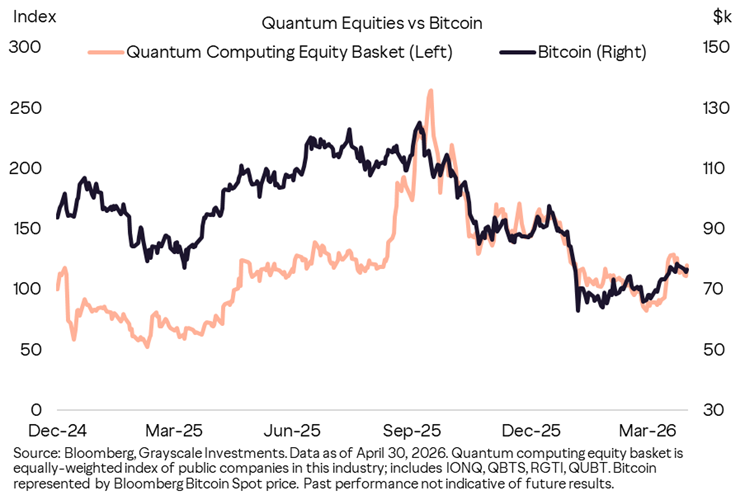
Bitcoin peaked near $126,000 in late 2025 alongside quantum computing equities, and both have since pulled back to current levels.
The Quantum Risk Is Real but Not Urgent
Grayscale is not dismissing quantum computing as a long-term concern for blockchain security. The firm has previously called for accelerated quantum readiness efforts across major blockchains and supports the broader industry push toward post-quantum cryptographic standards.
The threat from quantum computers to existing cryptographic systems remains years away from being practical, and Pandl’s central point is that investors do not need to wait for a complete post-quantum upgrade to the Bitcoin network before considering exposure.
Related: Paradigm Unveils Quantum Shield Plan for Bitcoin Wallets
Disclaimer: The information presented in this article is for informational and educational purposes only. The article does not constitute financial advice or advice of any kind. Coin Edition is not responsible for any losses incurred as a result of the utilization of content, products, or services mentioned. Readers are advised to exercise caution before taking any action related to the company.