

- India’s DEA will appear before Parliament’s Finance Committee to discuss VDAs and crypto regulation.
- The committee is working on a report called “A Study on Virtual Digital Assets (VDAs) and Way Forward.”
- The September 16 meeting could give a major signal about where India’s crypto policy is heading next.
India’s Parliamentary Standing Committee on Finance has scheduled a critical hearing for September 16, 2026, where it will question the Department of Economic Affairs (DEA) on the future regulatory roadmap for Virtual Digital Assets (VDAs).
This hearing follows a series of consultations, including testimonies from the Reserve Bank of India (RBI) and the Institute of Chartered Accountants of India (ICAI), adding to Parliament’s ongoing VDA study.
Parliament’s Finance Committee Reviews India’s Crypto Framework Again
The Standing Committee on Finance in India is revisiting the policy of the country towards VDAs. The Ministry of Finance Department of Economic Affairs representatives are set to give oral evidence before the committee on September 16, as part of its continuing study titled “A Study on Virtual Digital Assets (VDAs) and Way Forward.”
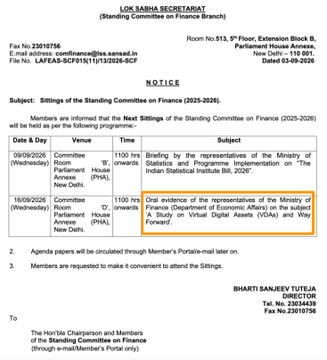
Meanwhile, the hearing revives a session that had earlier been listed and then cancelled in late August. The sitting is fixed for 1100 hours in Committee Room D of the Parliament House Annexe in New Delhi, with Bhartruhari Mahtab chairing the committee.
Why Is Parliament Reviewing Crypto Tax, 1% TDS and VDA Regulation?
The committee is examining India’s broader VDA framework, which currently combines taxation and AML obligations with a less comprehensive market-structure regime for areas such as exchange oversight, custody and investor redress. Crypto is neither banned nor recognised as legal tender. Under Section 115BBH, gains on the transfer of VDAs are subject to a flat 30% tax, whereas under Section 194S, there is a Tax Deducted at Source of 1% on specified transfers.
These provisions, introduced in 2022, were retained unchanged in the Union Budget 2026. The Prevention of Money Laundering Act also requires service providers to be registered with the Financial Intelligence Unit India.
However, other than taxation and anti money laundering (AML) reporting, no specific legislative framework regulating trading platforms, asset classification, custody standards, protection of investors or redressal of grievances exists.
In its report on the Securities Markets Code, 2025, the committee noted that many VDAs fall outside the technology neutral definition of securities and derivatives, leaving them in a regulatory grey area. It cautioned that such uncertainty subjects investors to additional risks of fraud, manipulation of markets and poor remedies.
Moreover, the amount of offshore activity has also turned into a second pressure point. According to industry data and submissions, there exists a vast majority of Indian crypto trading volumes occurring on offshore platforms, with estimates of between 73% in FY25 to approximately 90% -91.5% in more recent evaluations.
Related: RBI Rejects Crypto Legal Status at India’s 7th Parliamentary Meeting
Industry groups have argued that offshore migration can reduce the domestic trading activity captured by India’s TDS framework. The institutional opinions are also divided with the RBI against legalisation and the ICAI contending that a clear legal and account systems should be in place.
What This Means for Indian Crypto Traders and Users
The September 16 hearing does not change India’s existing crypto rules. The 30% tax on gains from VDA transfers and 1% TDS on specified crypto transactions remain in force.
However, it may reveal whether taxation, TDS, exchange oversight, P2P risks and investor protection are becoming priorities in Parliament’s policy recommendations. Those recommendations could later influence government or regulatory action.
Related: India Panel Proposes SRO-Led Crypto Watchdog Weeks After RBI Warning
Disclaimer: The information presented in this article is for informational and educational purposes only. The article does not constitute financial advice or advice of any kind. Coin Edition is not responsible for any losses incurred as a result of the utilization of content, products, or services mentioned. Readers are advised to exercise caution before taking any action related to the company.