

- Ireland has published the 2026 National Risk Assessment report of ML, TF, and PF risks.
- It classifies crypto assets as very significant threats that criminals exploit for illicit activities.
- The government introduced a 30-point action plan to strengthen crypto oversight and transparency.
The Irish Government has released the 2026 National Risk Assessment (NRA), alongside an action plan to strengthen responses to Money Laundering (ML), Terrorist Financing (TF), and Proliferation Financing (PF). The assessment classifies crypto assets as a very significant ML and TF risk and introduces a 30-point action plan to enhance regulatory and enforcement responses.
Ireland Publishes 2026 National Risk Assessment on Financial Crime
On 18 June 2026, Ireland’s Department of Finance published the National Risk Assessment Ireland 2026 – Money Laundering, Terrorist Financing, and Proliferation Financing. This comprehensive update is prepared with input from the Anti-Money Laundering Steering Committee, law enforcement, regulators, and private sector stakeholders, replacing previous assessments, including the 2019 edition.
The document provides a detailed, evidence-based evaluation of threats, vulnerabilities, and consequences across Ireland’s financial and non-financial sectors. It incorporates Ireland’s first dedicated assessment of PF risks and highlights evolving challenges from digital technologies, including crypto-assets, AI, and sophisticated layering techniques used by criminals.
Crypto Assets Classified as Very Significant Threats in Ireland
Ireland’s 2026 NRA has classified crypto-assets as presenting very significant risks for both ML and TF. This is the highest rating in the four-tier scale (Low, Moderate, Significant, Very Significant) and marks an increase since the previous 2019 assessment.
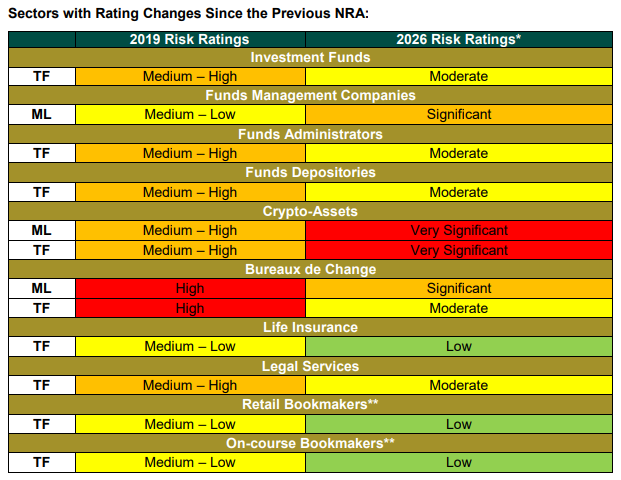
The assessment highlights crypto-asset service providers (CASPs or VASPs) as particularly exposed due to the speed, cross-border nature, pseudonymity, and global reach of digital asset transactions. These features enable criminals to layer and integrate illicit funds rapidly, often combining them with traditional methods such as money mules or complex corporate structures.
Additionally, the NRA notes that crypto is increasingly attractive for laundering proceeds from drug offenses, fraud, and other predicate crimes, as well as for small-scale TF activities, including self-funding and online radicalization support.
What’s Next for Ireland’s Crypto AML Framework?
In response, the government released an accompanying 30-point Action Plan that includes strengthened oversight of crypto-assets, enhanced intelligence sharing, and measures to improve beneficial ownership transparency. It also commits to implementing industry standards on accepting crypto-related activities as a source of funds by the second half of 2027.
Ireland’s next steps strengthen MiCAR-based supervision of crypto-asset service providers through the Central Bank using risk-based enforcement and tighter authorization controls. Regulated entities in the crypto sector are expected to apply heightened due diligence, robust transaction monitoring, and risk-based controls. The full NRA provides detailed sectoral analysis to guide compliance and supervision efforts ahead of Ireland’s 2028 FATF Mutual Evaluation.
Furthermore, intelligence sharing between An Garda Síochána, Revenue, and regulators will improve detection of crypto-related threats, typologies, and sanctions evasion. The plan also introduces industry standards for verifying crypto as a legitimate source of funds, led by the Gambling Regulatory Authority, by 2027, with strict due diligence requirements.
Related: Virtu Financial Ireland Gets MiCA Approval and CASP License for EU Crypto Services
Disclaimer: The information presented in this article is for informational and educational purposes only. The article does not constitute financial advice or advice of any kind. Coin Edition is not responsible for any losses incurred as a result of the utilization of content, products, or services mentioned. Readers are advised to exercise caution before taking any action related to the company.