

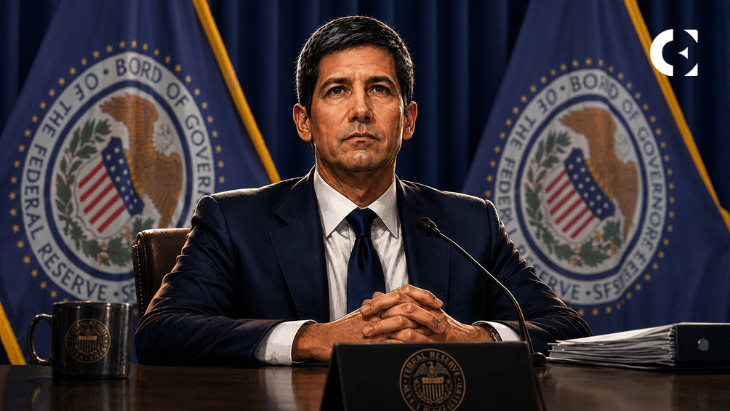

- Kevin Warsh outlines three possible economic outcomes of the AI boom.
- Rising interest rates could increase AI companies’ debt refinancing costs.
- The Fed is studying AI’s impact on economic growth, jobs, and monetary policy.
Federal Reserve Chair Kevin Warsh’s latest remarks have sparked discussions about the future of artificial intelligence and its impact on the US economy. While the AI boom could bring economic growth and boost productivity, it could also result in financial risks if companies fail to generate expected returns. Rising interest rates and growing debt among AI companies have also added to these concerns.
Kevin Warsh Highlights Potential Risks of AI Boom
During the Productivity and Jobs Task Force Conference on November 16, 2026, Federal Reserve Chair Kevin Warsh discussed the growing use of AI and how it could shape the US economy in the coming years. According to him, there are three possible outcomes, including a strong productivity boom, economic growth with job losses, and a slowdown if AI investments fail to provide expected results.
The first result is the possible improvement in productivity. Warsh stated that AI bool could reduce costs and increase economic output. This could support stronger growth in the US economy without significantly increasing inflation.
But this could result in another major concern, added the Fed chair. If companies increasingly adopt AI tools to automate tasks, many industries could potentially see massive job losses. In addition, businesses could also struggle to recover their heavy AI investments, leading to falling company valuations, lower spending, and rising unemployment.
Why the Fed Chair is Concerned About AI Companies’ Growing Debt
Companies are largely investing in AI-related infrastructure, resulting in growing debt. They are investing heavily in data centers, chips, and computing infrastructure to facilitate their AI activities.
Though such investments are costly, some businesses might not be able to earn enough money to recoup their investment. High-interest rates can make the problem more severe since higher interest rates will increase the cost of borrowing. More stringent lending conditions on the part of financiers can further aggravate the problem.
This could create additional pressure on the broader financial market. If AI companies are not repaying their debt, the impact could affect lenders, investors, and infrastructure developers. Thus, the Federal Reserve is concerned, as AI-related borrowing is an important financial risk.
Why Interest Rates Matter
Amid this backdrop, the Federal Reserve’s interest rate decision is something important to watch. With higher interest rates, AI companies face additional challenges. If interest rates are higher, these businesses may have to pay more to refinance existing loans or secure new funding.
This is more concerning for companies with large debt obligations and long-term infrastructure commitments. If they cannot generate enough revenue from their AI investments, higher financing costs could put further pressure on their finances. Also, borrowing could become more expensive if these companies do not secure enough returns.
Social sentiment turns cautious
Interestingly, Kevin Warsh’s comments on the AI boom come at a time when investors remained cautious. In recent times, investors have started questioning the sustainability of the AI boom. Although many remained optimistic, others were concerned about high valuations, growing debt, and uncertain returns.
One of the main focuses was potential revenue generation. Investors have been questioning whether tech companies could generate enough revenue to justify their heavy spending on AI infrastructure. Some investors are also worried that higher interest rates could put additional pressure on these companies.
(adsbygoogle = window.adsbygoogle || []).push({});Fed Is Preparing for AI Boom’s Economic Impact
Further, the Fed chair stated that the central bank is preparing for different outcomes of the AI boom. As noted by Warsh, the bank has brought together AI experts to understand how the technology could impact the economy and future monetary policy. He added,
“Our role in all this is neither advocacy nor opposition. Our responsibility is to recognize that the widespread adoption of this technology will have significant impact on the economy, with important implications for monetary policy down the road. The big questions are about magnitude, scope, and timing.”
According to him, AI is a major shift, and it could have a notable impact on the economy. However, policymakers need to understand how quickly it will spread and how widely businesses will adopt it.
Related: India Signs San Francisco Declaration With US and 8 Nations to Protect AI Technology
Disclaimer: The information presented in this article is for informational and educational purposes only. The article does not constitute financial advice or advice of any kind. Coin Edition is not responsible for any losses incurred as a result of the utilization of content, products, or services mentioned. Readers are advised to exercise caution before taking any action related to the company.