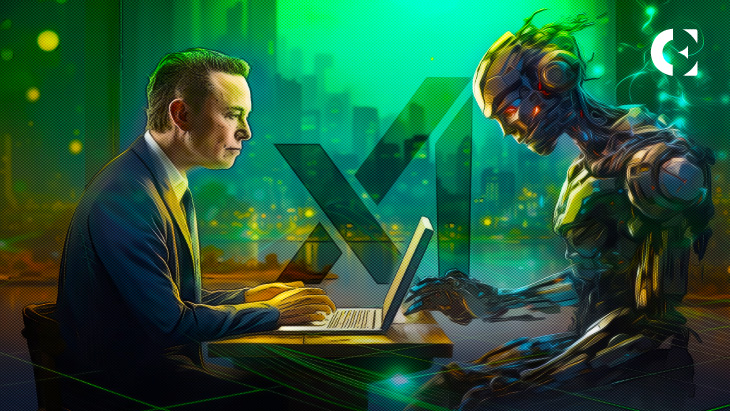

- Elon Musk proposes Universal High Income to address AI-driven unemployment.
- He says AI-led production growth could prevent inflation despite cash payouts.
- Tech leaders differ on how AI will reshape work, income, and economic systems.
Elon Musk said government-issued payments could address job losses from AI. He shared the view in a recent post on X, arguing that rising AI output would prevent inflation despite a higher money supply.
Musk Proposes Universal High Income
Musk said “universal high income,” or UHI, could serve as a response to unemployment caused by artificial intelligence and robotics. He suggested that regular payments from the federal government could help maintain living standards if machines replace large parts of the workforce.
The idea builds on universal basic income (UBI), which focuses on providing a minimum level of financial support. UHI goes further by assuming people would receive enough income to cover not only basic needs, such as food and housing, but also broader expenses.
Musk has also indicated that, in such a system, money may become less central to daily life as access to goods and services improves.
AI Productivity and Inflation Debate
Musk, who has been vocal about UHI for years, linked it to rapid gains in AI-driven productivity. He said AI and robotics will produce goods and services at a rate that exceeds growth in the money supply.
In theory, this would mean supply keeps up with or surpasses demand. That balance could help stabilize prices, even if governments increase spending through direct payments.
However, economists continue to debate this claim. Traditional models suggest that increasing the money supply can drive inflation. Whether productivity gains alone can offset this effect remains uncertain.
Shift Toward a Post-Work Economy
In late 2025, Musk opined that work will be optional. He said AI could make human labor optional within the next two decades. In that scenario, work may shift from necessity to choice.
People could spend more time on creative, educational, or recreational activities, rather than working for income. Musk has described a future where access to essential goods and services becomes widespread due to automation.
This vision reflects a broader idea of a “post-work” economy, where technological systems handle most production tasks.
Other Tech Leaders Weighed In
In a previous discussion, Bill Gates said AI could reduce the need for human labor and shorten the workweek. He noted that industries such as manufacturing, agriculture, and logistics may become highly automated over time.
NVIDIA CEO Jensen Huang offered a more cautious outlook. He said predicting long-term outcomes remains difficult due to the number of variables involved.
Huang added that abundance may not be limited to financial wealth, pointing to access to information as an example of how technology has already expanded resources.
Policy and Implementation Questions
Musk did not provide details on how UHI would be funded or implemented. Questions remain about taxation, government spending, and the structure of payment systems.
There are also concerns about how such a system would be introduced during a transition period, especially if job displacement outpaces the adoption of new economic models.
Related: X Executive Hints at Crypto Launch as Elon Musk’s X Money Prepares for April Debut
Disclaimer: The information presented in this article is for informational and educational purposes only. The article does not constitute financial advice or advice of any kind. Coin Edition is not responsible for any losses incurred as a result of the utilization of content, products, or services mentioned. Readers are advised to exercise caution before taking any action related to the company.