

- Nifty has recorded its longest-ever streak without surpassing the previous day’s high for 12 sessions.
- CAS timing since SEBI’s rollout is striking, but it does not prove causation as macro factors also weigh.
- Traders should watch if Nifty’s weakness spreads to crypto or spot returns remain different from equities.
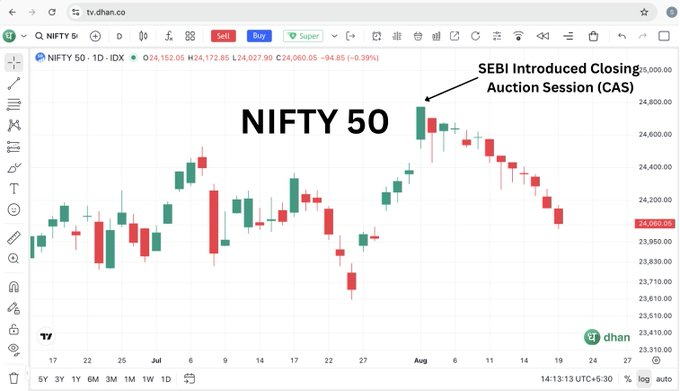
The Nifty 50 has set a historic record by failing to surpass its previous day’s high for 12 consecutive trading sessions from August 4 to August 19, 2026. This is the longest streak of its kind in Nifty’s history, breaking the previous record of 9 consecutive sessions, most recently recorded in December 2014.
Nifty’s Record 12-Session Failure to Break the Previous High
The NSE Nifty 50 failed to surpass the previous day’s high for 12 consecutive trading sessions, from August 4 to August 19, 2026. The streak is the longest of its kind in the index’s history, surpassing the previous record of 9 sessions.
The previous 9-session record occurred nine times in Nifty’s history, most recently from December 5 to December 17, 2014, with earlier instances recorded in 2012, 2011, 2001, 2000 and 1995. The new record is thus an unusual period of continued weakness in the benchmark’s daily trading range.
Source: X
On the 12th session, Nifty fell 0.32% to close at 24,078.30, extending its losing streak to seven sessions. Indian equities were under pressure with rising crude oil prices and higher global bond yields offering a broader market backdrop for the index’s continued inability to form a higher daily high.
CAS Timing Stands Out, But It Does Not Prove Causation
The timing is hard to ignore because SEBI’s Closing Auction Session (CAS) went live on August 3, 2026. From the very next trading day, August 4, the Nifty began its record 12 session streak of failing to surpass the previous day’s high. However, a remarkable coincidence does not imply causation. It does not automatically account for 12 straight sessions of lower or flat highs, or the approximately 2.2% drop from the 4 August close. True causation needs to be supported by an evaluation that goes beyond the sequence of events and meets strict operating conditions.
Bitcoin vs Nifty: Which Market Delivered Better Spot Returns?
From August 4 to August 19, 2026, Nifty 50 fell from 24,614.90 to 24,078.30, losing 536.60 points or 2.18%. Bitcoin (BTC) was more stable, with the spot price rising from around $64,050 to $64,220, then continuing to approximately $64,300 to $65,000, representing an estimated 0.5% to 1.5% increase in the spot price.
The divergence is significant for Indian spot traders as Nifty looked significantly weaker while BTC was broadly flat to slightly positive. Bitcoin thus outperformed Nifty in terms of spot returns during this particular period, but the margin was small. The comparison does not show that crypto is safer but Bitcoin failed to follow the short term risk off signal of Nifty.
Ethereum and Altcoins Show a Different Risk Picture
On the contrary, Ethereum and other large-cap altcoins painted a milder picture than Nifty within the same timeframe from August 4 to August 19. Ethereum rose from around $1,860 to $1,870 to $1,910 to $1,936, delivering roughly +2.5% to +4%, while Solana gained about 4% to 5% from approximately $73.50 to $77. Meanwhile, XRP was weaker, dropping about 6% to 7% from nearly $1.07 to $0.99 to $1.00, indicating that crypto did not exhibit a uniform risk profile.
What the Nifty-Crypto Divergence Means for Indian Spot Traders
The main lesson to be learned here is not that crypto is safer or destined to outperform, but the daily price behaviour of Nifty was unprecedented and not seen across the major crypto spot markets. Hence, Indian spot traders should watch both markets separately and not expect that equity weakness will mean crypto weakness as well, and the next signal will be whether this divergence holds or not.
The Next Signal: Will Nifty Weakness Spread to Crypto?
Nifty’s weakness is unlikely to directly hurt Bitcoin or major cryptocurrencies as crypto prices are driven more by the liquidity conditions in the world and U.S. monetary policy, institutional flows and overall risk appetite. But the same external factors, such as high global bond yields, can affect both markets. Thus, Indian spot traders should keep an eye on whether these common pressures can also bring crypto down or if Nifty’s decline is a direct signal for crypto.
Related: Why Bitcoin Didn’t Correlate With the Rally in the S&P 500 and Nasdaq
Related: Dow Jones, Sensex and Nasdaq Fall: What It Means for Crypto Investors
Disclaimer: The information presented in this article is for informational and educational purposes only. The article does not constitute financial advice or advice of any kind. Coin Edition is not responsible for any losses incurred as a result of the utilization of content, products, or services mentioned. Readers are advised to exercise caution before taking any action related to the company.